The story of the film
Prague, Rome, then London, Chicago and Yale · c. 1404–2024
In a library at Yale University, behind walls of thin marble that glow when the sun shines through them, there is a small book that no one can read. Its pages of calfskin are crowded with paintings of strange plants, wheels of stars, and line after line of a flowing, unknown script.
Alchemists, Jesuits, professors and great codebreakers have tried. None has ever proved that they could read a single sentence.
Chapter Iwatch from 0:39
A Book from the Jesuits' Chests
In 1912 a London bookseller named Wilfrid Voynich bought a group of old manuscripts from the Jesuits, near Rome. He had lived a hard life. As a young Polish revolutionary he had been arrested by the Russian police and sent to Siberia. He escaped, and reached London with almost nothing.
Voynich promised to keep the sellers secret. In public he said only that he had found the books in chests, in an ancient castle in southern Europe. Later accounts placed the sale at the Villa Mondragone, a grand Jesuit house near Frascati. Some researchers think the books were kept elsewhere.
Among them was a small volume in a plain, soft cover of vellum, about the size of a modern hardback, with some 240 pages. Voynich opened it, and could not read a word.
Voynich opened it, and could not read a word.
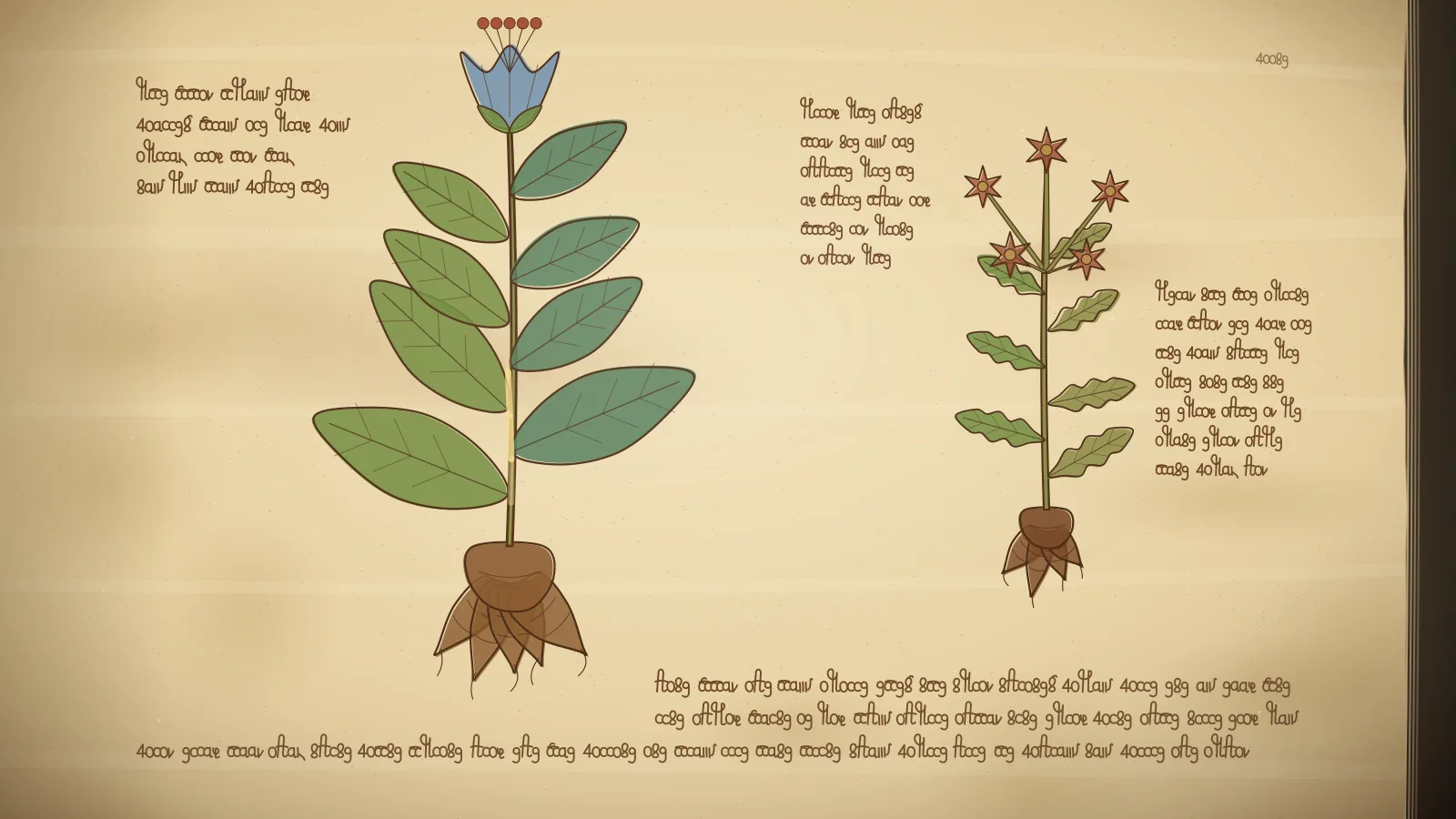
Most of its pages showed plants, painted in green, brown and blue, the blue made from the mineral azurite, the text in brownish iron-gall ink. Botanists have argued over them ever since, and most have never been identified with any certainty. Other pages held circles of stars, suns and moons and the signs of the zodiac, with the names of months in ordinary Latin letters. Then came stranger pages: small figures bathing in green pools, joined by pipes and tubes, like some lost system of plumbing. Then rows of jars, like those in an apothecary’s shop. At the end came page after page of dense text, each paragraph marked with a small star.
And with the book was a letter, in Latin, dated 19 August 1665.
Chapter IIwatch from 2:27
The Emperor's Ducats
The letter came from Prague, from an old physician named Johannes Marcus Marci. His eyesight was failing. A scribe wrote it out, and Marci signed it. He was sending the book to Rome, to one of the most famous scholars of his age: the Jesuit Athanasius Kircher.
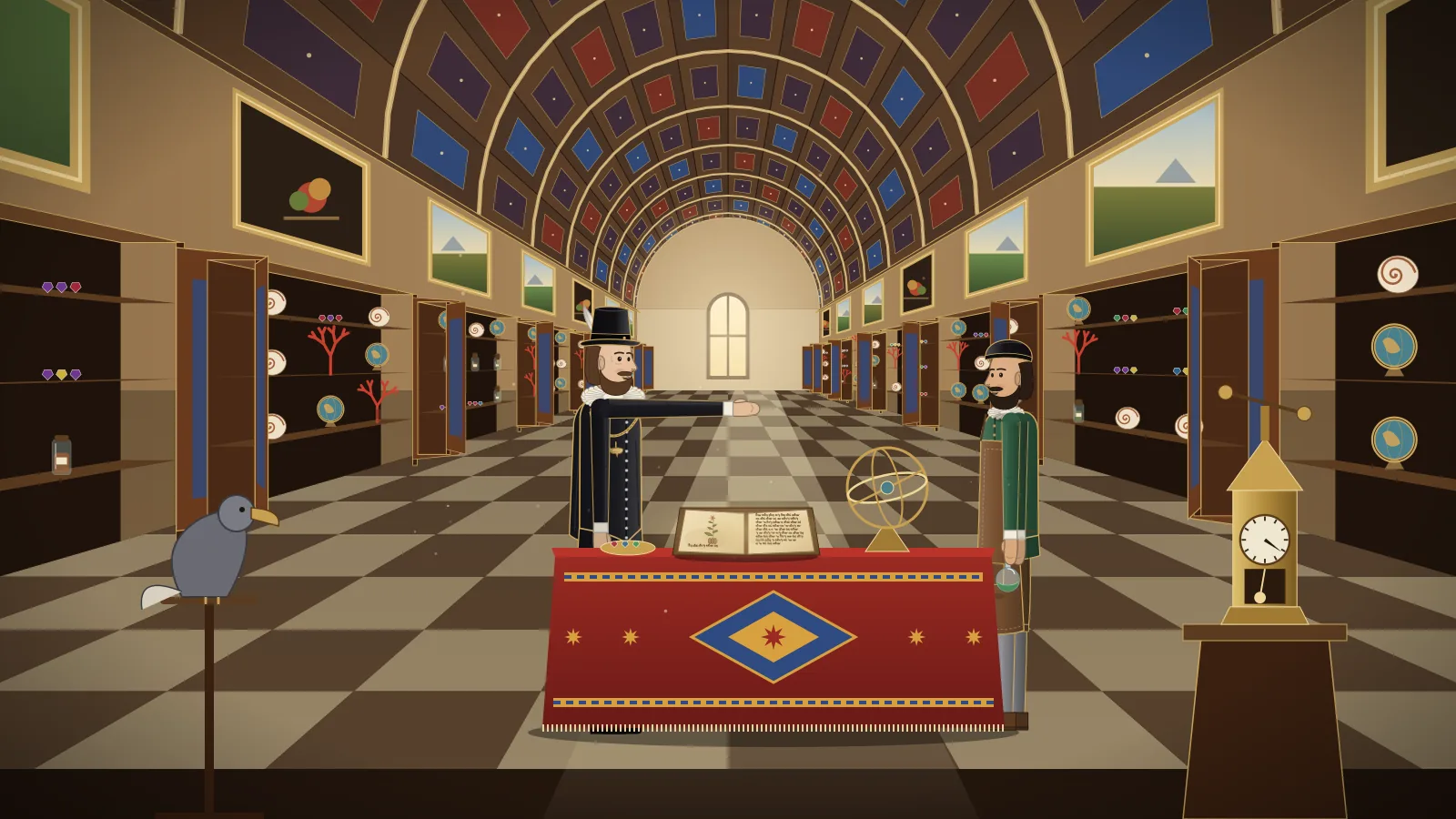
The letter passed on a story, heard from a learned man, Doctor Raphael, who had once taught the young king Ferdinand III. The book, Raphael said, had belonged to the Emperor Rudolf II, who had paid 600 ducats for it. Rudolf, who reigned from 1576 until his death in 1612, ruled his empire from Prague Castle and filled it with wonders: clocks, gems, paintings, and alchemists.
But this was hearsay, recorded decades after Rudolf’s death.
But this was hearsay, recorded decades after Rudolf’s death. Raphael also thought the author was the English friar Roger Bacon. On that, Marci wrote, he suspended judgement.
There is one firmer clue. On the first page, under ultraviolet light, a faint name appears: Jacobus Horcicky de Tepenec. Horcicky made medicines for Rudolf, and was given the noble title “of Tepenec” in the early 1600s. If the name is his, the book passed through his hands.
Chapter IIIwatch from 3:54
The Sphinx and Its Master
The next owner we know of was a Prague alchemist, Georg Baresch. He believed the book was about medicine, and he spent years trying to read it. In 1637 he had part of it carefully copied, and the copy was sent to Kircher in Rome. The book itself stayed in Prague.
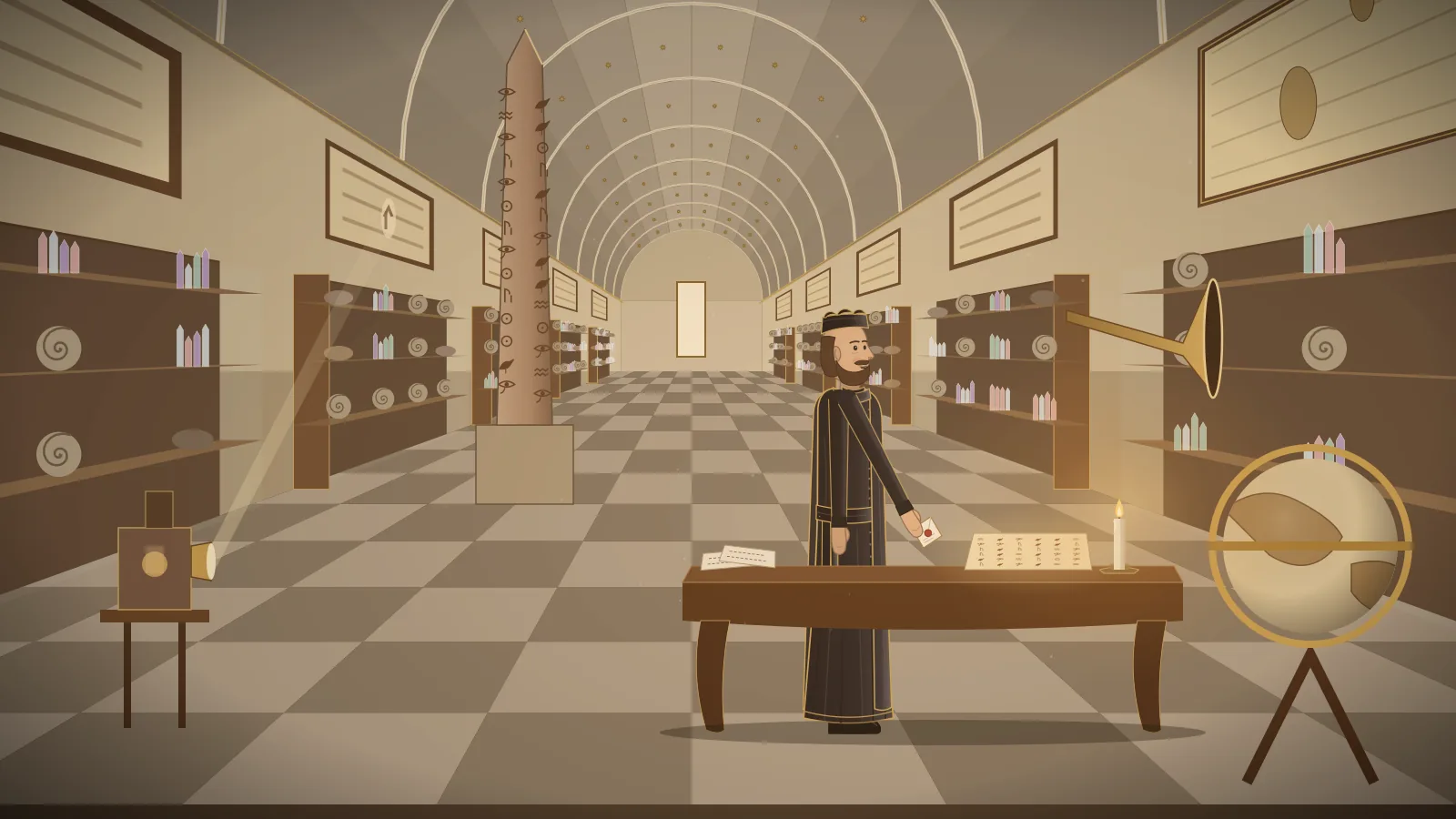
Kircher was famous for claiming that he could read Egyptian hieroglyphs. We now know that he could not, but in his own time many believed him. Baresch wrote again in 1639, pleading for help. Kircher’s only known comment was that the puzzle needed hard work more than insight.
When Baresch died, his books passed to his friend Marci. Baresch, the letter said, had given up hope only with his life. Now Marci sent the book itself. Such sphinxes as this, he told Kircher, obey no one but their master.
Such sphinxes as this, he told Kircher, obey no one but their master.
If Kircher ever answered, no reply has been found. The book stayed in the Jesuits’ library in Rome, quiet for 2 centuries. In 1873 the new Italian state took over the religious libraries of Rome. Some Jesuit books escaped, labelled as the private property of the order’s leader. This one carried that label.
Chapter IVwatch from 5:17
Bacon and the Cracks in the Ink
In 1915 Voynich showed the book at the Art Institute of Chicago, and sent photographs to scholars, hoping that someone would read it. Like Doctor Raphael long before him, he believed it was the work of Roger Bacon. He valued it at 100,000 dollars.
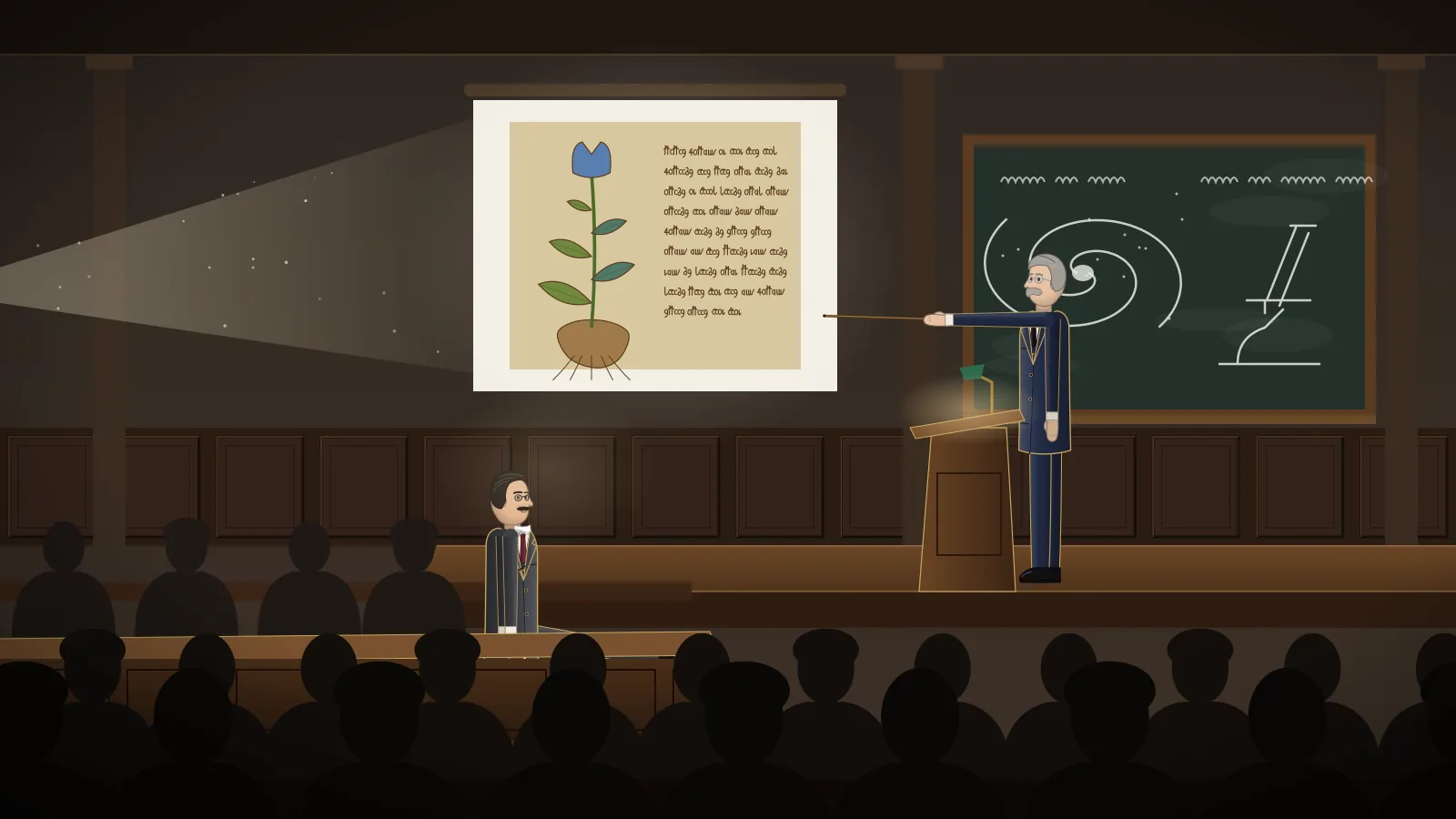
In 1921 a philosophy professor in Philadelphia, William Newbold, announced that he had broken the code. Bacon, he claimed, had built a microscope and a telescope centuries before anyone else, and had seen living cells, and spiral clouds among the stars.
Newbold read his message in tiny strokes inside the letters. In 1931 the scholar John Manly showed that those strokes were only cracks in the ink.
Those strokes were only cracks in the ink.
Voynich died in 1930, without an answer. His widow, the novelist Ethel Voynich, kept the book locked in a bank vault. After her death in 1960, it was sold on.
Chapter Vwatch from 6:15
The Codebreakers
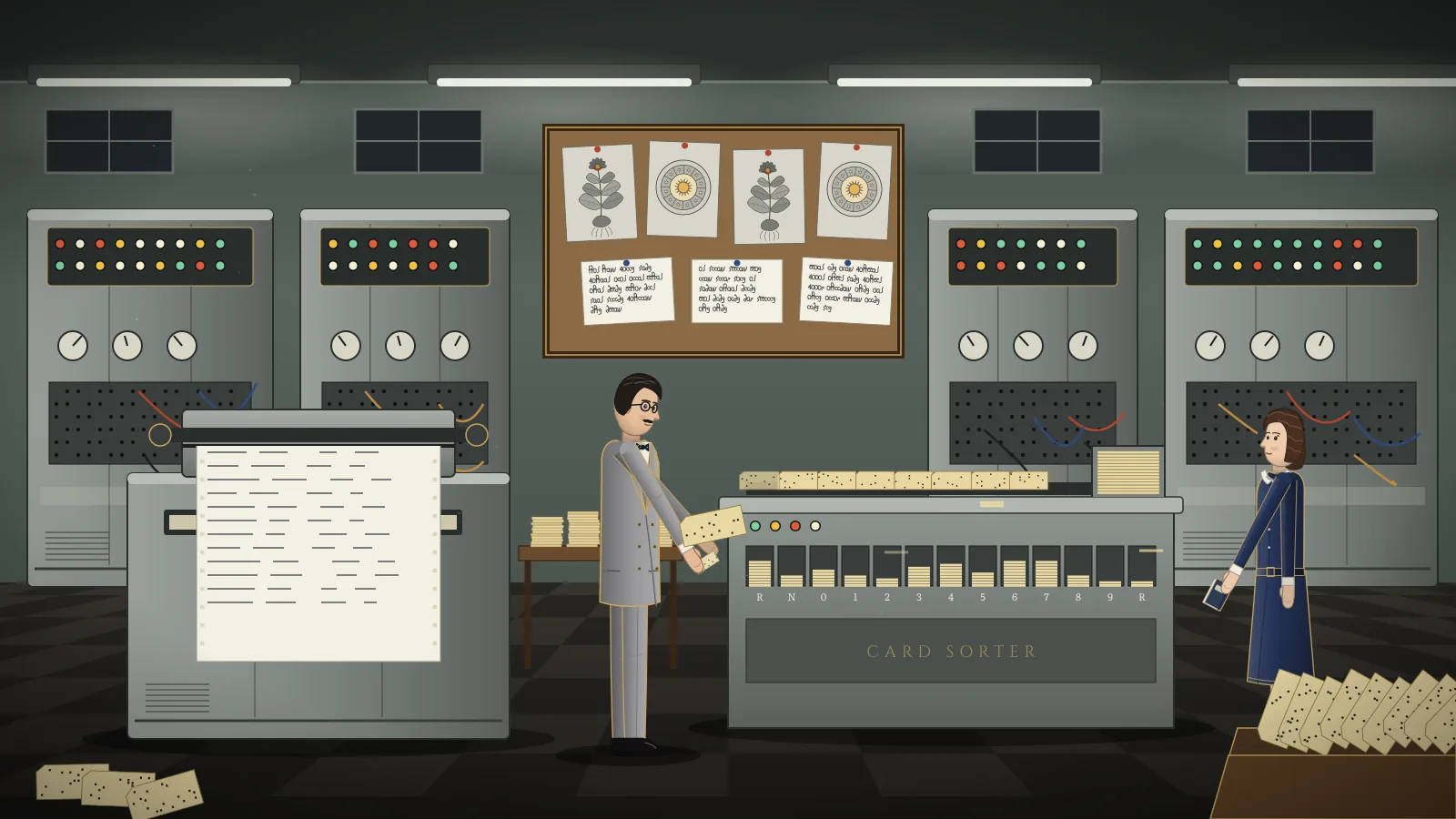
In 1944 the American codebreaker William Friedman, whose team had broken a top Japanese cipher in 1940, gathered colleagues to work on the book after hours. They copied every line onto punch cards for early computing machines, then counted, sorted and compared. Nothing gave way.
Friedman tried again in the 1960s. His wife Elizebeth, a brilliant codebreaker herself, warned that counting alone would end in frustration. Friedman hid his own best guess in a footnote to a paper about Chaucer, as a scrambled sentence. Its solution was released only after his death. Unscrambled, it said that the book was probably an early attempt at an artificial language.
Friedman hid his own best guess in a footnote, as a scrambled sentence.
Friedman died in 1969. That same year, the book found its final home. A New York dealer, Hans Kraus, had bought it in 1961 for 24,500 dollars. He asked 160,000 dollars, and no one would pay. So he gave it to Yale University, where it became manuscript 408 of the Beinecke Library.
In 1978 the National Security Agency published a long study of the book by Mary D’Imperio. She called it an elegant enigma.
Chapter VIwatch from 7:38
The Date in the Vellum
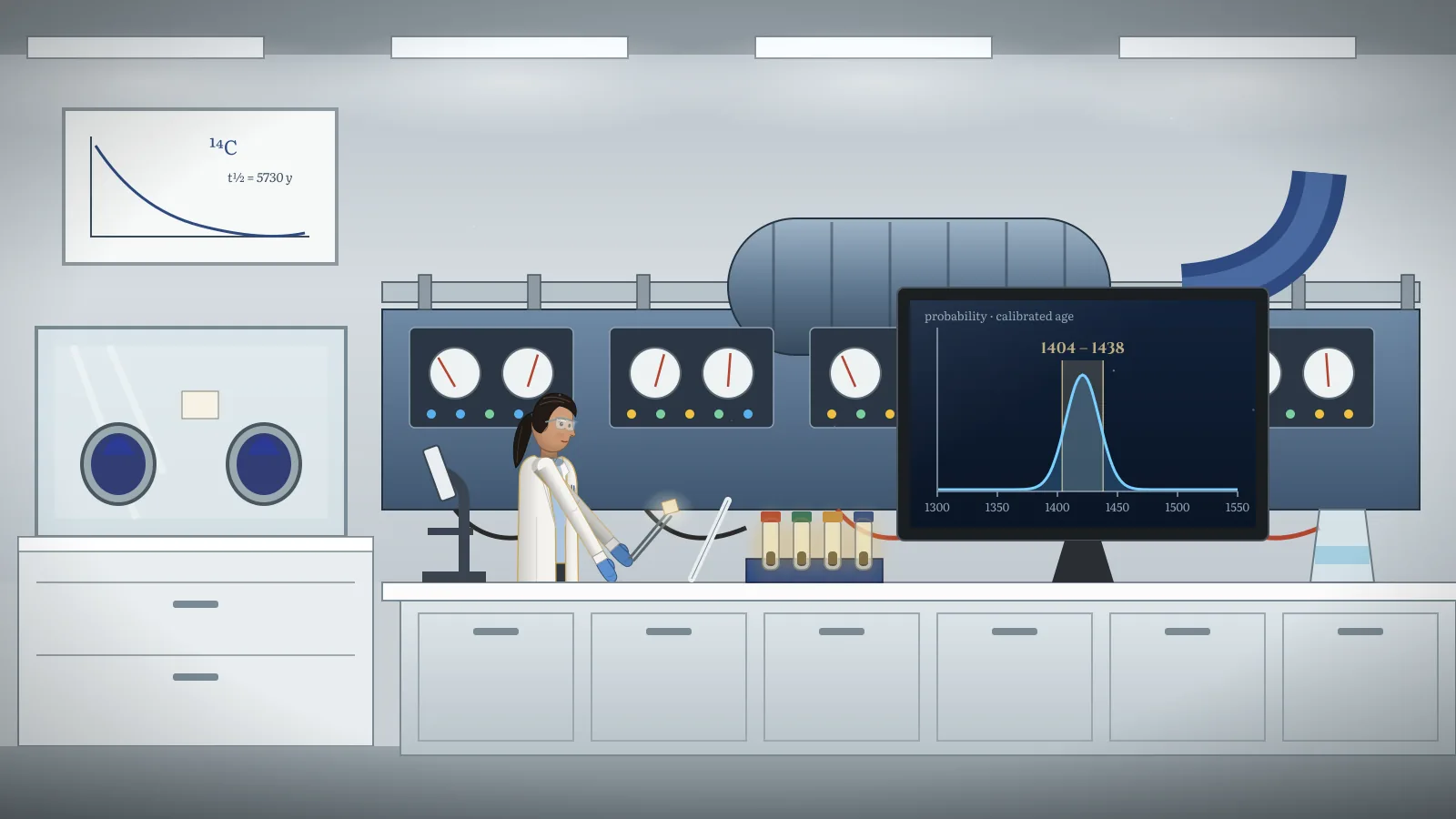
Then, in 2009, scientists at the University of Arizona dated tiny samples of the vellum by radiocarbon. The skins had been prepared between 1404 and 1438, and the ink and paint were consistent with that time.
It was a turning point. Roger Bacon had died more than a century earlier. And a modern forgery by Voynich himself, as some had whispered, now looked very unlikely.
So what is it? A cipher hiding a known language. A real language in a script of its own. An invented language. Or a clever hoax, made to impress a rich collector. In 2004 a British researcher, Gordon Rugg, showed in the journal Cryptologia that a card with holes cut in it, laid over a table of word parts, could produce word-like gibberish. Some suspect Edward Kelley, an English alchemist who lived in Rudolf’s Prague.
Others counted the words, among them a statistical study published in 2013. Common words, they found, appear about as often as they do in real languages. But the same word often repeats 2 or 3 times in a row. In 2020 Lisa Fagin Davis, an expert in medieval handwriting, argued that 5 different scribes wrote the book. Every few years, headlines announce that the code is cracked: it is Latin shorthand, early Turkish, Hebrew, a guide to women’s health. None has produced a consistent reading of the whole book.
None has produced a consistent reading of the whole book.
In 2024, scans of the first page, made 10 years earlier with light of many different wavelengths, revealed faded columns of letters in the margin: the Latin alphabet, beside the book’s own strange characters. Fagin Davis suggested that the hand may be Marci’s. If so, the old physician had quietly tried to break the code himself, before sending the sphinx to Rome.
Today every page can be seen online, free, by anyone, and thousands of people, from students to professors, are still trying. And in the library of glowing marble, the little book still waits, as it has for nearly 600 years, for its master.