The story of the film
Zurich, the Emmental and Alsace, then Pennsylvania, Ohio, Indiana and much of North America · 1525–today
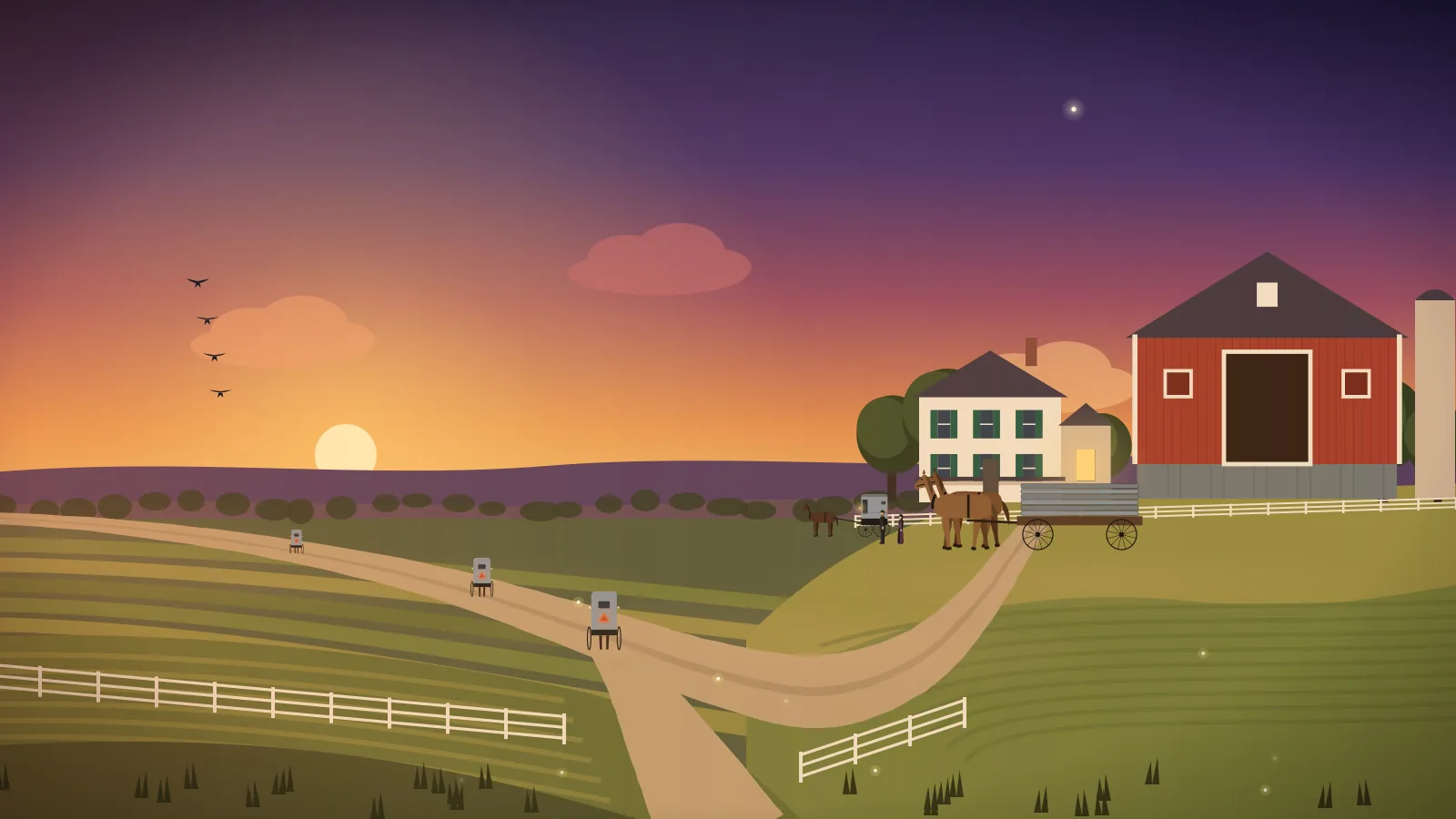
Early on a Sunday morning in Lancaster County, Pennsylvania, lamps glow on grey buggies, and hooves ring on the road. Whole families are on their way to church. But there is no church building. Every other Sunday the members of a district gather in a home or a barn, and this Sunday the service is held in a neighbour’s barn, on plain wooden benches brought by wagon. Men sit on one side, women on the other, for a service of about three hours. They sing slowly, without instruments, from a hymnbook called the Ausbund. Many of its hymns were written almost five hundred years ago, by Anabaptist prisoners in a castle dungeon at Passau. To understand why those hymns are still sung, we have to go back to the beginning.
Chapter Iwatch from 0:47
Baptised as Adults
The story begins in Zurich, in January 1525. The Reformation was dividing the Church, and a small circle of young believers wanted to go further than their teacher, the reformer Zwingli. They held that baptism belonged not to infants, but to those old enough to confess their own faith.
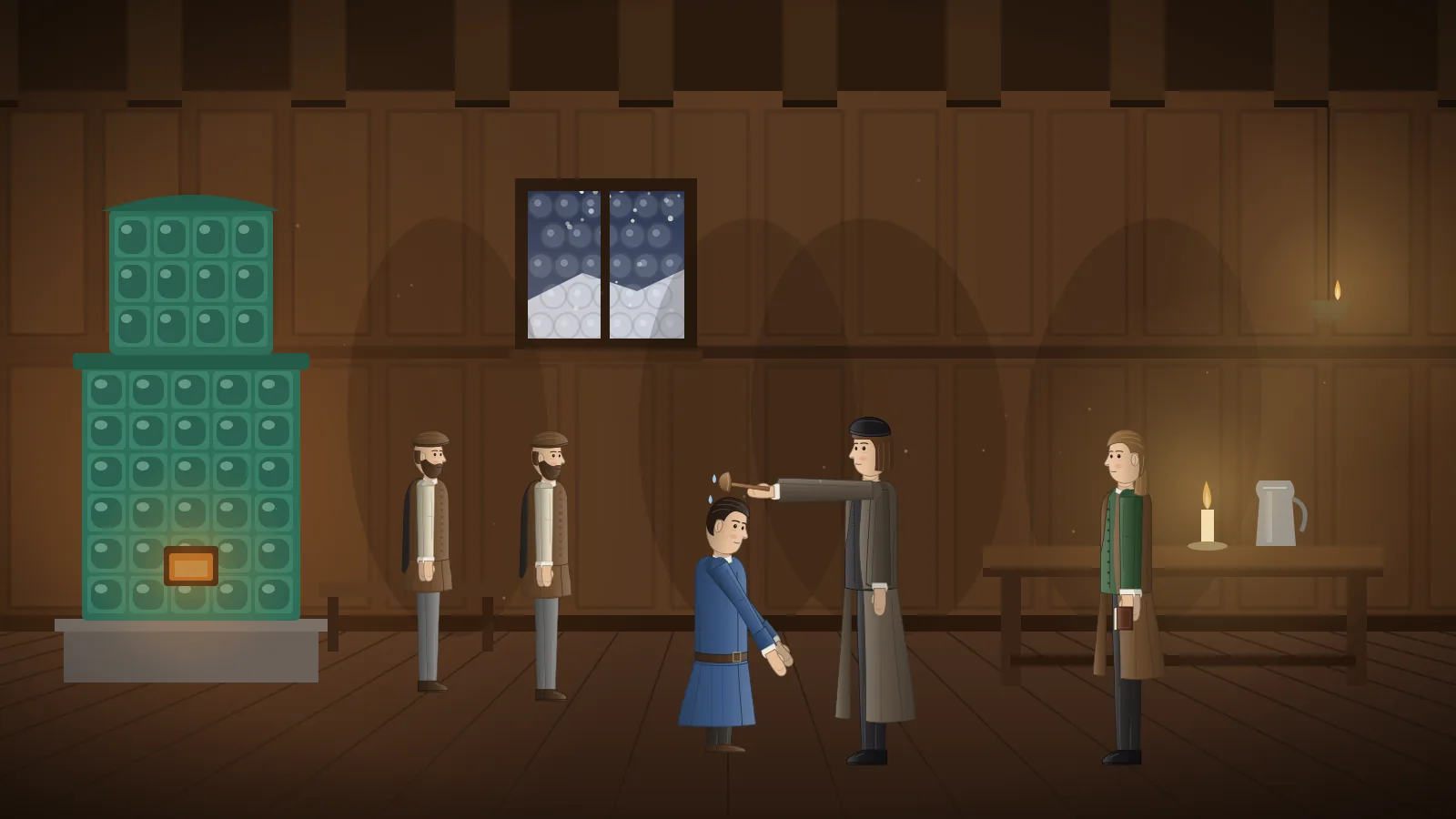
On the evening of 21 January, at the house of Felix Manz, a former priest named George Blaurock asked Conrad Grebel to baptise him, as an adult, on his own confession of faith. Then Blaurock baptised the others.
Their opponents called them Anabaptists, re-baptisers. They wanted a church of committed adults, free from the state, that would follow the teachings of Jesus literally. They would not swear oaths, and they would not take up the sword.
In 1527 Swiss Anabaptists met in the village of Schleitheim, in the hills of northern Switzerland, and agreed on seven articles of faith, among them separation from the world, and no use of the sword.
Catholic and Protestant rulers alike saw them as a threat. That same year, Felix Manz was drowned in Zurich’s river, the Limmat. Thousands more were imprisoned, exiled or put to death. A hymn by Manz himself is among those in the Ausbund.
Their stories were gathered in a great book, the Martyrs Mirror, first published in 1660. After the Bible, it has long been the most treasured book in Amish homes.
After the Bible, it has long been the most treasured book in Amish homes.
Chapter IIwatch from 2:14
Jakob Ammann’s Call
Over the next century and a half, many Swiss Anabaptists kept their faith quietly on hill farms, in valleys like the Emmental, near Bern. Many others left, for Alsace and the Palatinate.
Among them was Jakob Ammann, a tailor, born in 1644 at Erlenbach, in the Simmental. No portrait of him survives. By 1693 he was an elder among the Anabaptists of Alsace.
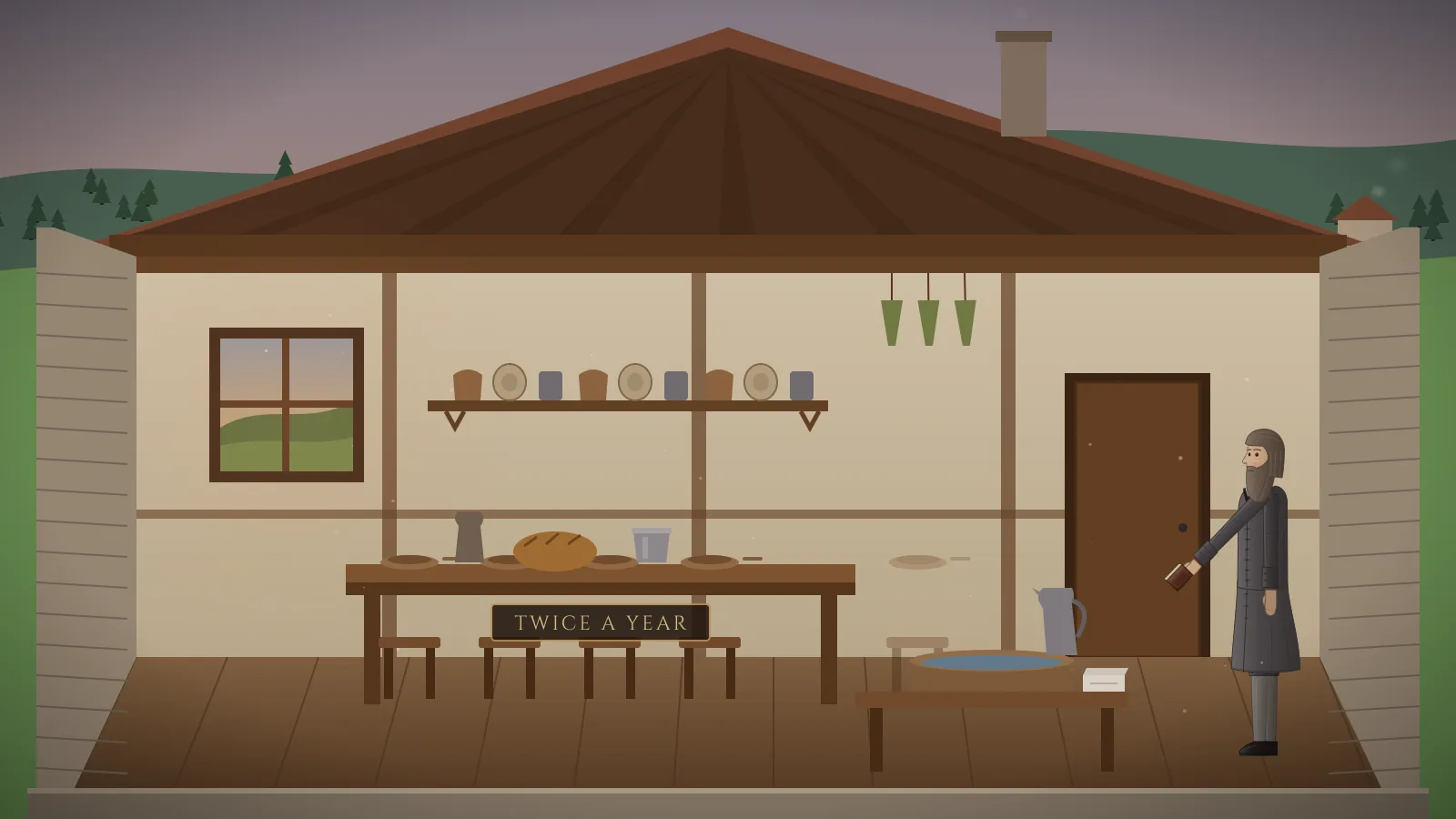
Ammann believed the church had grown lax. He called for communion twice a year instead of once, and for the washing of one another’s feet, as Jesus had washed his disciples’ feet. Above all, he insisted on shunning: a member put out of the church for sin should be avoided, even at the family table, until he repented.
In 1693 Ammann travelled among the Swiss congregations. The elders gathered at the house of Niklaus Moser, at Friedersmatt, to settle the question. Hans Reist, a respected minister in the Emmental, held to a milder practice, and would not come. Ammann declared Reist and other ministers excommunicated.
The Swiss Brethren divided. Seven years later, in February 1700, Ammann and his fellow ministers admitted that they had acted too hastily, and asked forgiveness. But the break was never healed.
Ammann’s followers came to be called Amish. He himself disappears from the records after 1712, when King Louis XIV expelled the Anabaptists from Alsace.
Chapter IIIwatch from 3:59
Across the Ocean
Far across the ocean, William Penn’s colony of Pennsylvania promised freedom of religion. From the 1730s, Amish families travelled down the Rhine to Rotterdam, and on to America.
In 1737 the ship Charming Nancy carried one of the first sizeable groups. It left Rotterdam at the end of June, and the crossing took nearly three months. A passenger’s diary records the children buried at sea.
The newcomers cleared farms along Northkill Creek, in Berks County. Later families moved south to Lancaster County, with its deep, rich limestone soil.
The martyrs’ book came with them in spirit. By 1749, at the Ephrata Cloister in Pennsylvania, the Martyrs Mirror had been printed in German, by the brothers of the Cloister, a celibate community that was not Amish. With over fifteen hundred pages, it is thought to be the largest book printed in colonial America.
Generation after generation, families moved west in search of land: to Holmes County, Ohio, from 1809, and to northern Indiana, from 1841. In Europe, meanwhile, the last Amish congregations slowly merged with the Mennonites, until by the mid-twentieth century none were left.

Chapter IVwatch from 5:16
The Old Order
By the 1860s America was changing fast, and so were many Amish congregations. In June 1862 Amish ministers met in Wayne County, Ohio, for the first of a series of conferences.
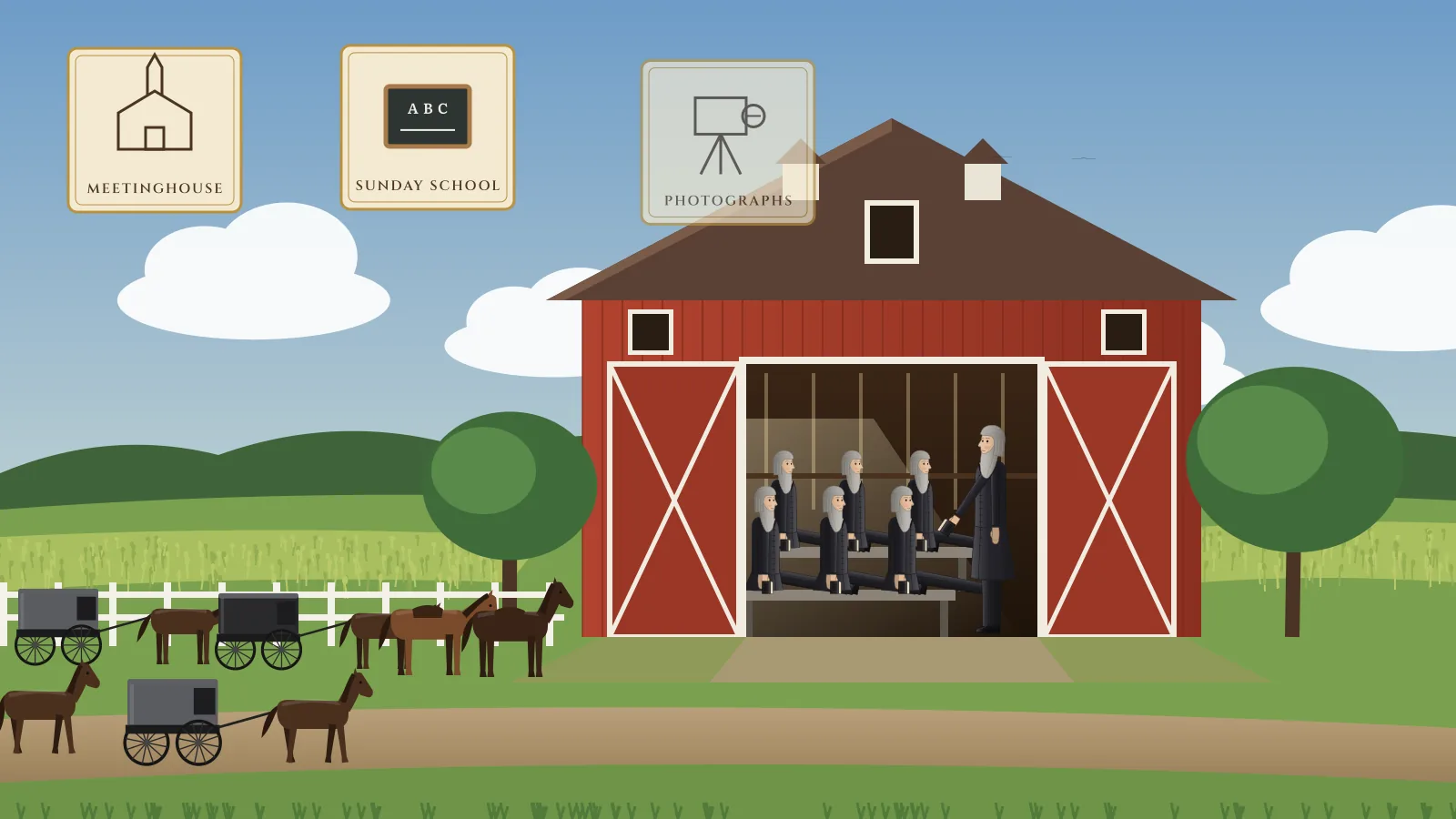
They debated meetinghouses, Sunday schools, photographs, dress, and new ways of farming. Most congregations chose change, and in time joined Mennonite bodies.
A minority, about a third, kept to the old ways. By the last conference, in 1878, they had gone their own way, and came to be known as the Old Order Amish. When people speak of the Amish today, they usually mean them.
Chapter Vwatch from 6:07
A Life of Yieldedness
At the heart of their life is a German word, Gelassenheit: yieldedness. It means giving up self-will, to God, to the church, and to the family.
Each church district, some twenty to forty households, keeps its own Ordnung, an order of life passed on mostly by word of mouth, and affirmed by its members before communion, twice a year. It can set the width of a hat brim, or the colour of a buggy.
The Amish do not reject technology as such. They ask whether a tool will draw people apart, or keep them together.
They ask whether a tool will draw people apart, or keep them together.
Most will not connect to the public power grid, which would bring television and dependence on the outside world, nor own cars, which would scatter the community. But a family may share a telephone in a small shed by the road, hire a driver for a long journey, run a workshop with a diesel engine, or charge batteries with solar panels. Communities that look alike from outside may make quite different choices.
Ministers are chosen by lot from among the men of the district, and serve for life, without pay. At home, families speak Pennsylvania German, or Deitsch. They read the Bible and sing in High German, and children learn English at school.
Most children walk to one-room Amish schools, taught by young Amish women, until the eighth grade. After that, they learn farming, carpentry and other trades at home.
That right was hard won. In Wisconsin, three fathers from an Amish community were convicted and fined five dollars each for keeping their children out of high school. In 1972, in Wisconsin v. Yoder, the Supreme Court ruled in their favour.
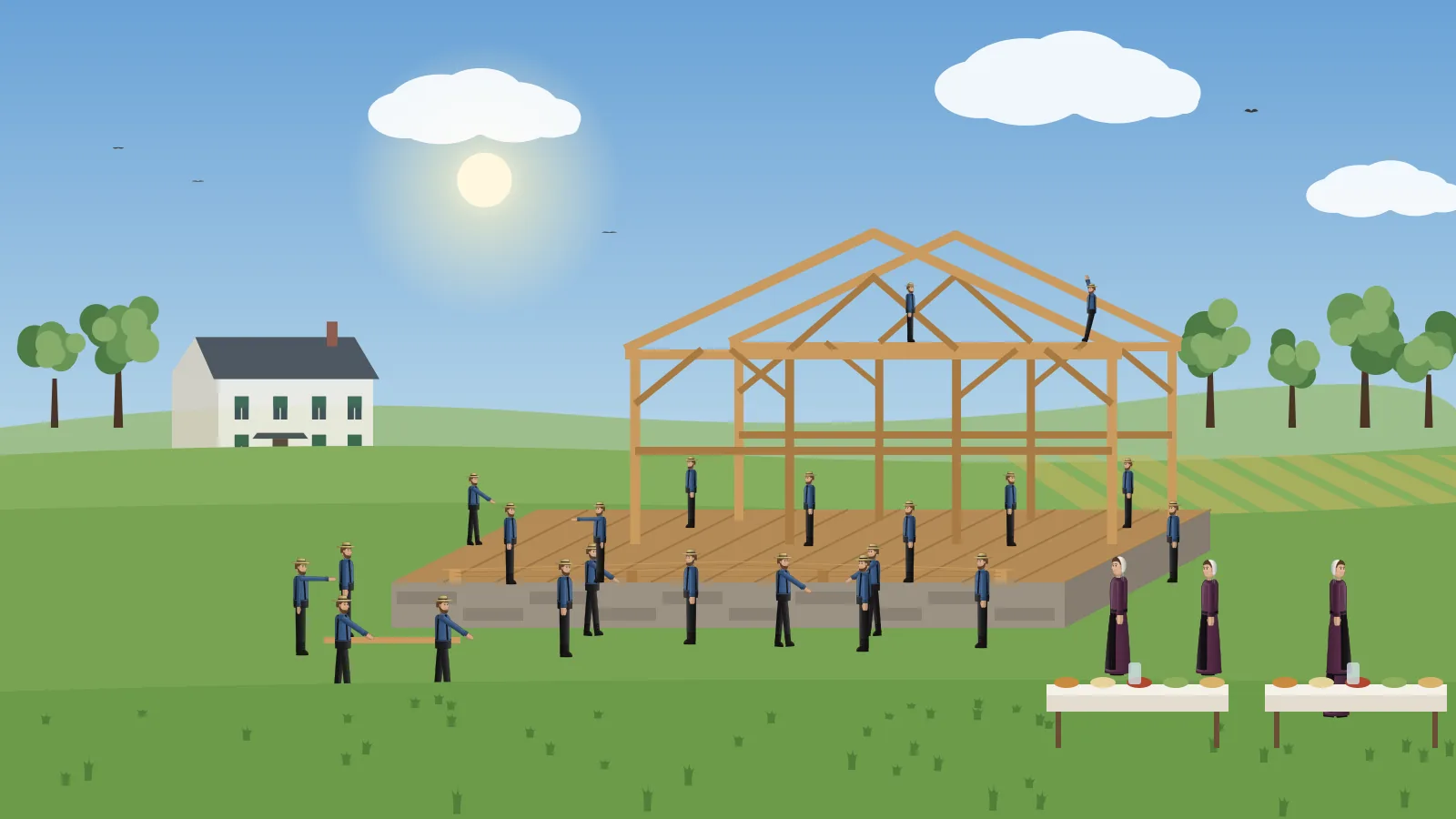
The Amish care for their own. In 1965 Congress allowed self-employed Amish to be exempted from Social Security, since the community looks after its own elderly and does not accept its benefits. They still pay income, property and sales taxes. When a family faces large hospital bills, the church districts collect money. And when a barn burns, neighbours gather to rebuild it, sometimes in a single day.
Chapter VIwatch from 8:01
Rumspringa and Baptism
At about sixteen, young people enter Rumspringa, “running around”, a time of greater freedom. Television often shows it as wild partying. Researchers find that for most, it means youth groups, Sunday evening singings, and some freedom to look around, and that its form varies greatly from one community to another.
Then each one chooses. In most settlements, well over eight in ten ask to be baptised, kneeling before the church to make their vows.
A baptised member who breaks those vows and will not repent may be excommunicated and shunned. The Amish see it as an act of love, meant to bring the person back. Former members have written of how painful it can be. The practice varies, stricter in some communities and milder in others. And those who leave before baptism are not shunned.
Chapter VIIwatch from 8:56
Nickel Mines
On 2 October 2006, a gunman entered the one-room school at Nickel Mines, Pennsylvania. Five girls lost their lives, and five more were badly wounded.
That same day, an Amish neighbour went to comfort the gunman’s family. Amish mourners came to his funeral, and some of the money given for the victims was passed on to his widow and children.
People around the world were moved. For the Amish, it was simply their faith, the faith they try to live every day. Ten days later the old school was taken down, and a new one, called New Hope, was built nearby. It opened the following spring.
Chapter VIIIwatch from 9:40
A Growing People
Today there are about 421,000 Amish in North America, children included, in some 3,285 church districts across thirty-three states and three Canadian provinces. Ohio, Pennsylvania and Indiana together hold almost six in ten of them. Families are large, and their numbers double about every twenty years.
With farmland scarce and costly, many now work as carpenters, builders and furniture makers, and new settlements are founded every year, in states such as New York, Kentucky and Missouri.
Legend says the Amish reject everything modern, pay no taxes, and are a fading remnant of the past. The records show a people who weigh each tool with care, pay income, property and sales taxes, and are one of the fastest-growing faiths in North America.
Back in Lancaster County, the service is over. After the shared meal, the benches go back onto the wagon, and the buggies turn for home. More than three centuries after a division among Swiss elders, the same slow hymns are still sung. Not as a museum of the past, but as a way of living, together.