The story of the film
Florence, Ferrara and Milan, then Paris and London · 1440–today
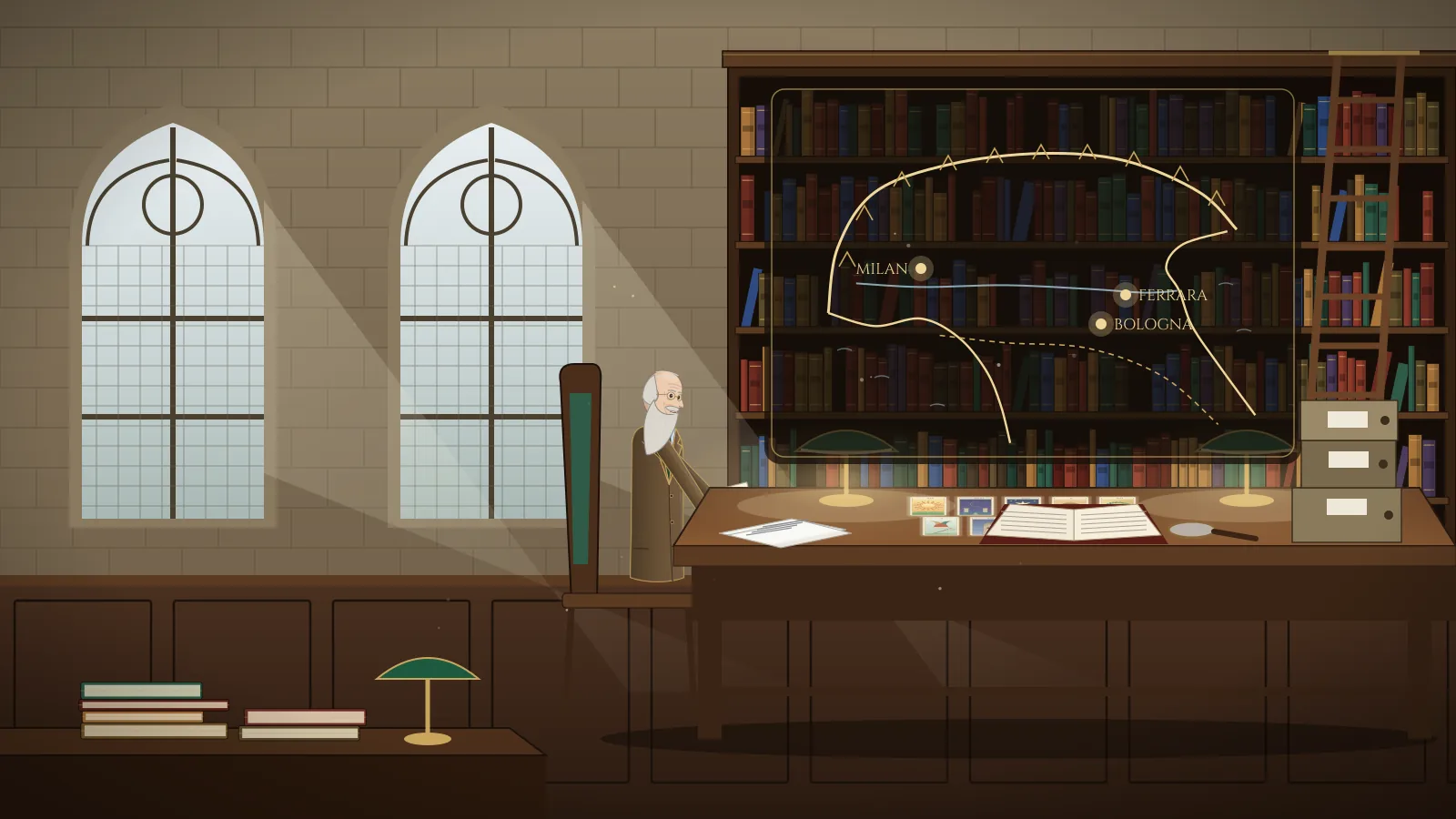
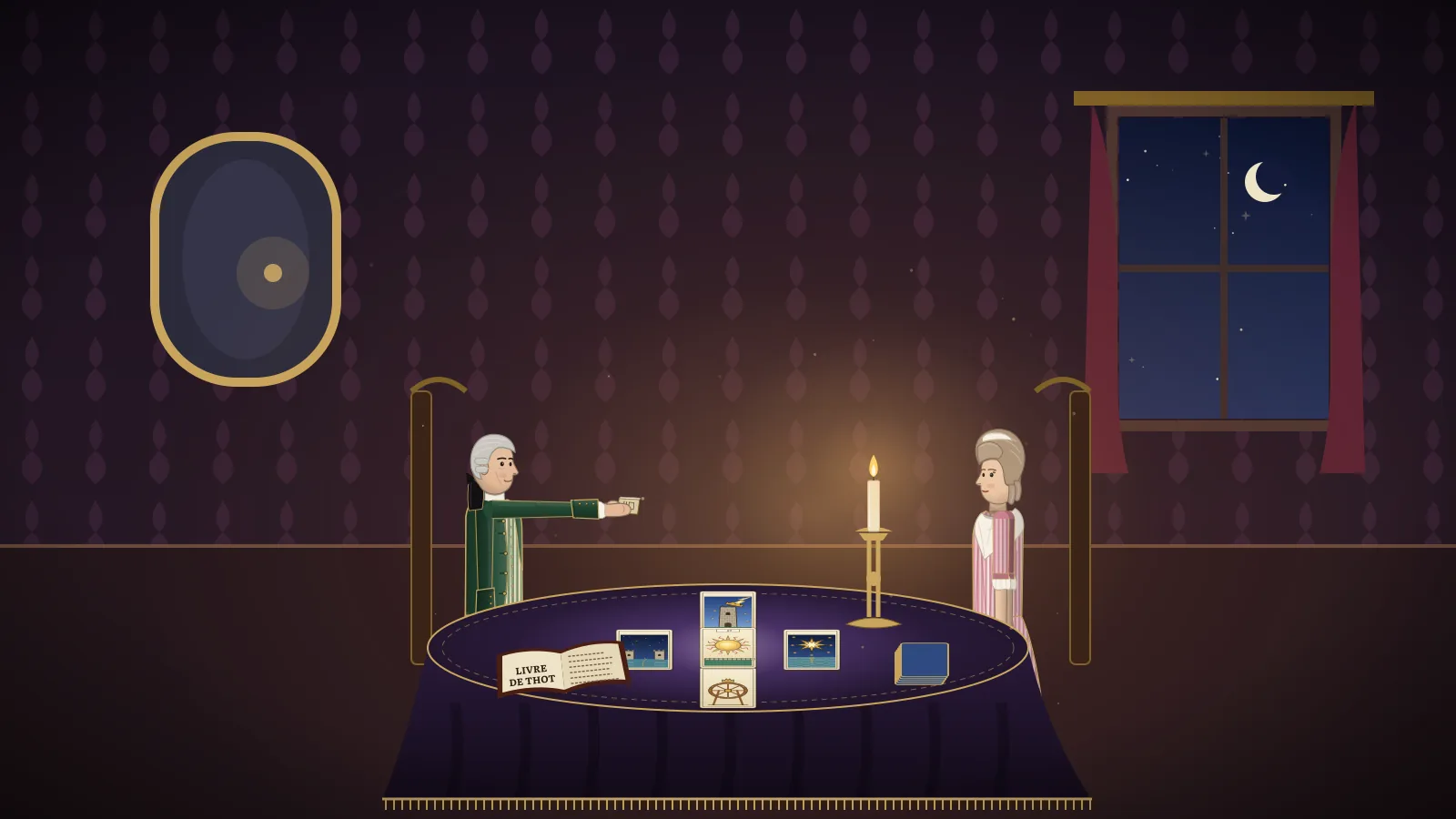
In Paris, a few years before 1781, a scholar went to call on a lady he knew. He found her at a table with friends, playing cards. The cards were strange. Besides the usual kings and queens, there were pictures: a fool, a tower, a wheel, the sun and the moon.
One of them was called the World. He looked at it and, by his own account, recognised its hidden meaning at once. Within a quarter of an hour, he later wrote, the game had been played, explained, and declared Egyptian.
Chapter Iwatch from 0:45
The Egyptian Book
The scholar was Antoine Court de Gébelin, a Protestant pastor and man of letters. In his study, among stacks of paper and old books, he was at work on an enormous project called The Primitive World, a many-volume search for the lost wisdom of the earliest peoples. He believed that behind every language and every myth lay traces of one ancient, forgotten knowledge.
In 1781, in the eighth volume, he announced his discovery to the world. The tarot, he wrote, was an ancient Egyptian book, hidden inside a game so that it would survive.
The tarot, he wrote, was an ancient Egyptian book, hidden inside a game so that it would survive.
Even the name, he claimed, was Egyptian: “tar”, meaning a road, and “ro”, meaning royal. Put together, the tarot was the royal road of life. Later scholars would find no basis for this etymology at all.
There was one problem. No one in Europe could yet read Egyptian hieroglyphs, so nobody could check what the old Egyptians had really written. And the cards themselves had a very different story to tell.
Chapter IIwatch from 1:33
Cards of Triumphs
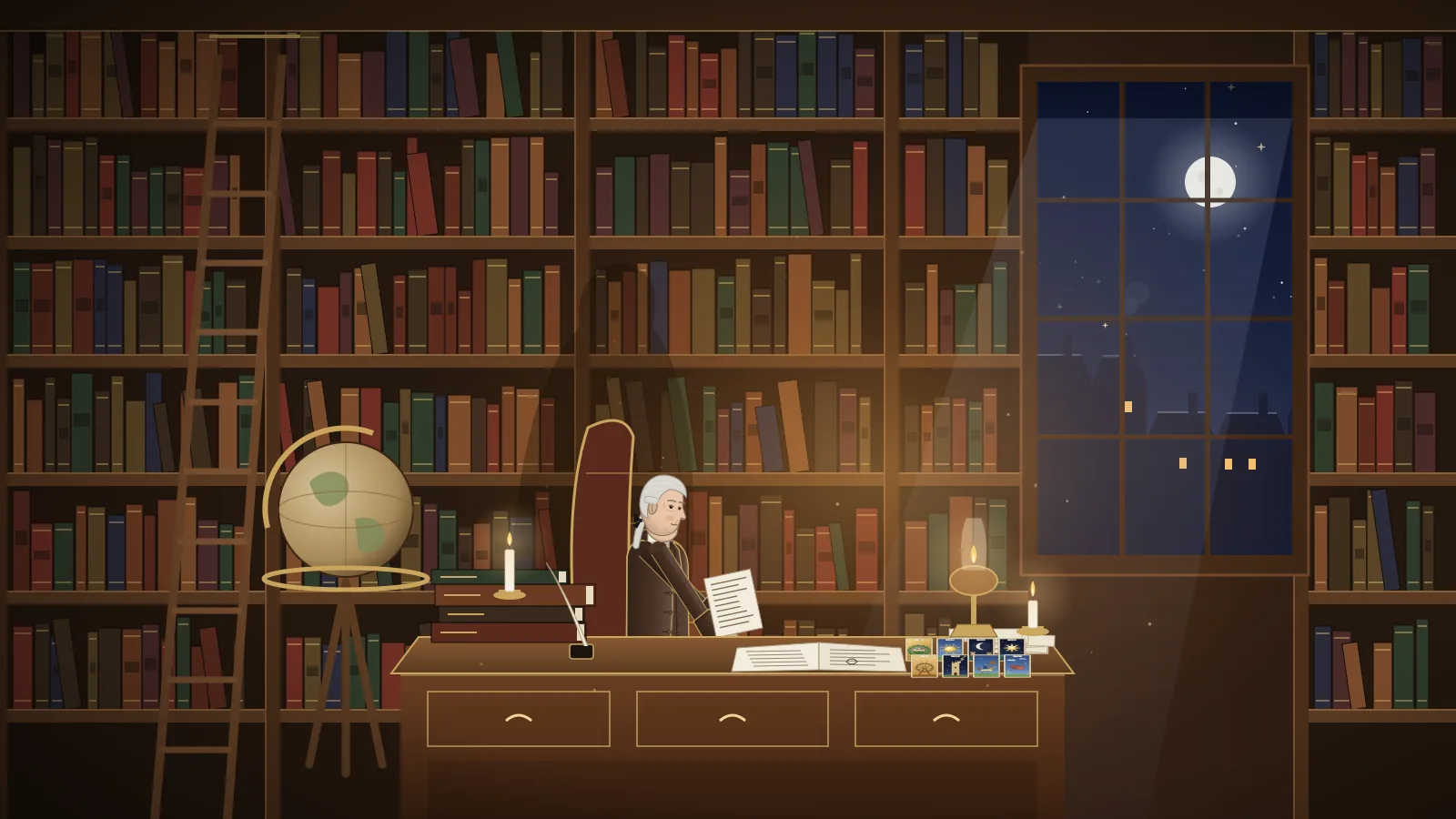
That story begins in Italy. On Friday, 16 September 1440, a Florentine named Giusto Giusti wrote in his diary about a gift. He had given the young lord of Rimini, Sigismondo Malatesta, then 23 years old, a pack of cards “for triumphs”, made in Florence with Sigismondo’s own coat of arms. They cost four and a half ducats.
In 1442, in Ferrara, the account books of the ruling Este family recorded “cards of triumphs” too. These two entries are among the earliest known mentions of the cards we now call tarot. Whether every early pack already looked like a later tarot is not certain, and where exactly the idea was first tried is not known.
What is clear is how the cards worked. Italian playing cards already had four suits: cups, coins, swords and batons. Then, in the northern courts, someone added a fifth suit of picture cards. These pictures were the triumphs. In play, any one of them could beat any ordinary card, however high. Our English word “trump” comes from “triumph”.
Our English word “trump” comes from “triumph”.
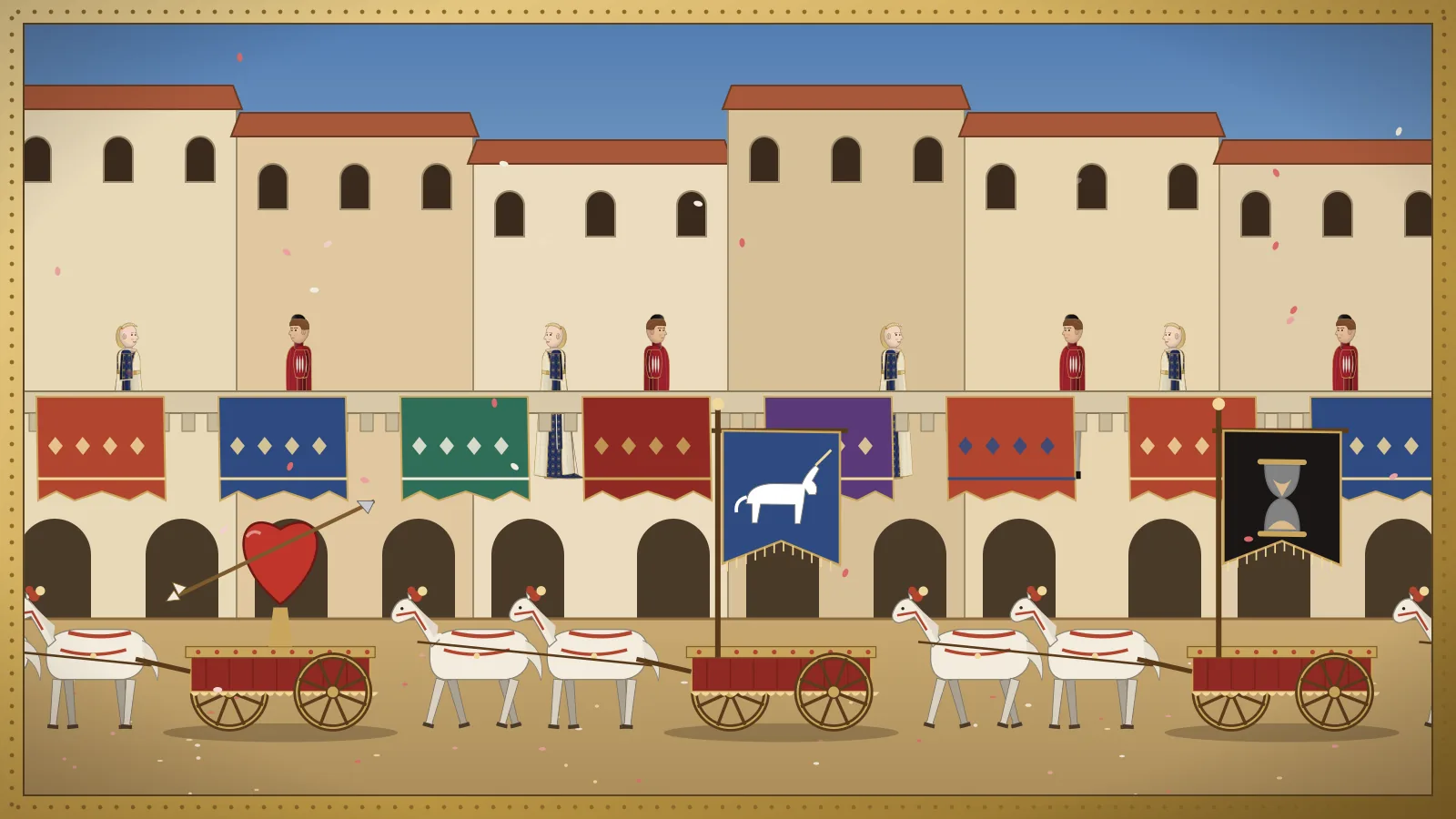
Where did the pictures come from? Many scholars think they echoed the triumphal parades of the Renaissance, when cities filled their streets with processions of allegorical figures. They also point to Petrarch’s poem the Triumphs, in which Love is overcome by Chastity, Chastity by Death, and Death by Fame. One picture beat another, just as in the game.
Chapter IIIwatch from 2:51
The Gold of Milan
In Milan, the dukes ordered packs painted by hand, with backgrounds of beaten gold. Many have been linked to the workshop of the painter Bonifacio Bembo and his family, though experts still debate which hands painted which cards.
The most complete surviving set was probably made for Francesco Sforza, who became Duke of Milan in 1450. It bore the emblems of his own family and of his wife’s, the Visconti. Its trumps show the Emperor and the Pope, Love and Death, the Wheel of Fortune, the Star, the Moon and the Sun, and, highest of all, the World. The Fool stood outside the order altogether.
To Renaissance Christians, these were familiar moral lessons: fortune turns, and death comes to everyone.
Of its 78 cards, 74 survive: 35 in the Morgan Library in New York, and the rest divided between two collections in Bergamo, the Accademia Carrara and the Colleoni family. Four are lost, among them the Devil and the Tower.
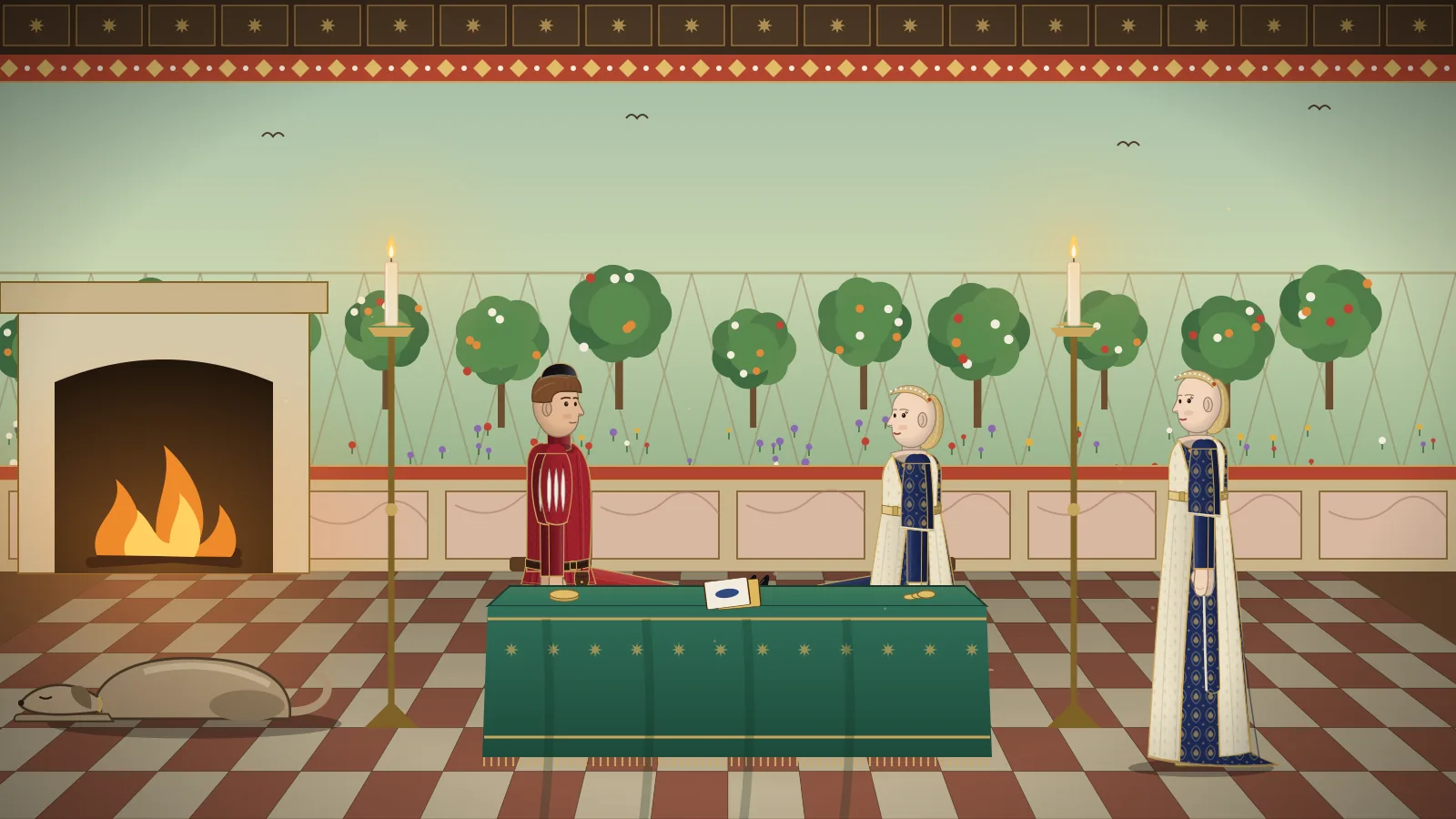
And these beautiful cards were played with. Lords and ladies sat at tables in the courts, counting tricks and points, as the gilded pictures passed from hand to hand. By around 1500, the game had a new name: tarocchi. No one is sure where the word came from. From it came the French word: tarot.
And these beautiful cards were played with.
Chapter IVwatch from 4:17
Over the Alps
The game travelled north across the Alps, to France, Switzerland and central Europe. It no longer needed a duke’s purse. Printers made cheaper packs from carved woodblocks, and coloured them quickly through stencils, so that ordinary townspeople could buy them.
In France, one design became standard, later called the Tarot of Marseilles. A pack printed by Nicolas Conver in 1760 is the ancestor of many still sold today.
For more than 300 years, the surviving evidence shows tarot cards used for one thing above all: playing games. No record from those centuries shows them used to read the future.
For more than 300 years, the surviving evidence shows tarot cards used for one thing above all: playing games.
Chapter Vwatch from 4:55
The Book of Thoth
So the pack on that Paris table was an old Italian game. But Court de Gébelin was not alone in seeing more. In the same volume, an essay by a nobleman, the Comte de Mellet, linked the 22 picture cards to the 22 letters of the Hebrew alphabet, and to telling fortunes.
Neither man offered real evidence. But the idea was beautiful, and it spread.
In Paris lived a former seed merchant turned print dealer, Jean-Baptiste Alliette. He wrote under his own surname spelt backwards: Etteilla. He had already written a guide to fortune-telling with ordinary cards. From 1783, he published the earliest known manuals for reading the tarot.
In 1788, his circle founded a society of interpreters of what he called the Book of Thoth, after the Egyptian god of writing. Around 1789 came his own pack, usually seen as the first tarot made for divination. The game of the Italian courts now had a second life, on the tables of Paris fortune-tellers.
In 1822, Jean-François Champollion deciphered Egyptian hieroglyphs. At last the old inscriptions could be read. Nothing in the Egyptian texts read since connects the tarot to Egypt.
But the legend no longer needed Egypt. In the 1850s, a former seminarian who called himself Éliphas Lévi made the tarot a key to all of magic. He had trained for the priesthood in Paris but left before ordination, and turned to the study of the occult. Lévi tied each trump to a Hebrew letter and to the Kabbalah, the Jewish mystical tradition. He claimed the cards went back to the time of Enoch.
But the legend no longer needed Egypt.
Chapter VIwatch from 6:40
Pixie's Pack
In 1888, in the London fog, three Freemasons founded the Hermetic Order of the Golden Dawn, a society for the study of ceremonial magic. Its members studied tarot with astrology and Kabbalah, and matched every trump to a Hebrew letter, a planet, a sign of the zodiac or an element.
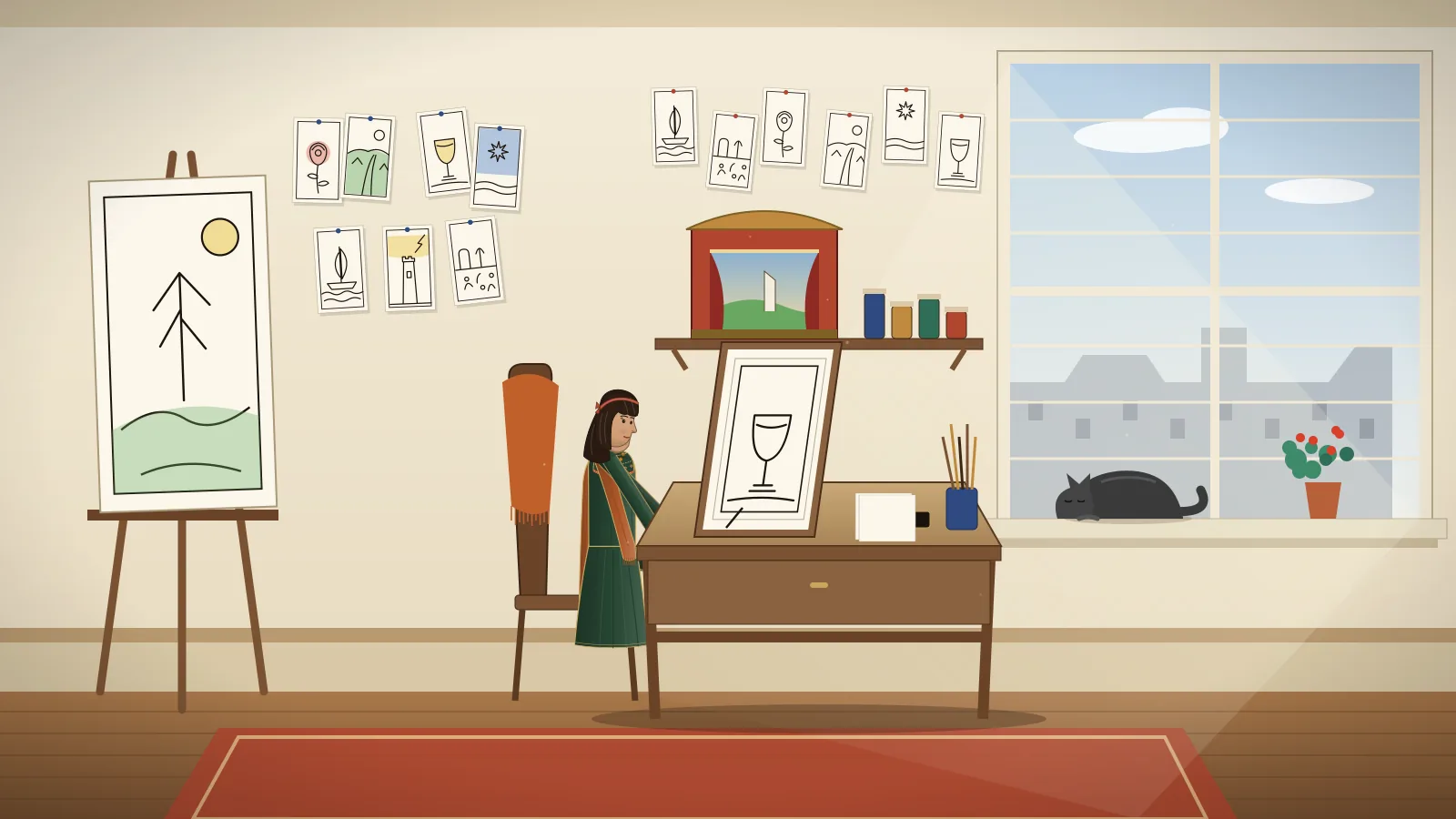
Among them was a young artist, Pamela Colman Smith. Born in London in 1878 to American parents, she had grown up partly in Jamaica, and studied art in New York. Her friends called her Pixie.
In 1909, another member, the writer Arthur Edward Waite, asked her to draw a new tarot pack. She finished it in a matter of months. Almost no pack before it had done this: she gave all 78 cards a scene, even the humble three of cups. Where most older packs showed only a row of cups or swords, hers showed people dancing, mourning, working and celebrating.
It is often suggested that she was inspired by an Italian pack of the 1490s, the Sola Busca tarot, which she may have seen in photographs at the British Museum.
The pack was published in London in December 1909, by William Rider and Son. Many found its pictures easier to read by intuition.
Smith was paid a flat fee. In a letter to the photographer Alfred Stieglitz, she wrote that she had just finished “a big job for very little cash”. For decades the pack was named after its publisher and author, though her monogram marks every card. Smith died poor in Cornwall in 1951. Today many call it the Rider-Waite-Smith pack.
She had just finished “a big job for very little cash”.
Chapter VIIwatch from 8:26
The Game Goes On
Meanwhile, historians began to search the archives. Among them was an Oxford philosopher who loved card games, Michael Dummett.
In 1980, in The Game of Tarot, and later with colleagues, he traced the cards through account books, letters and surviving packs. Most historians accept his conclusion: tarot was born in 15th-century Italy, for play.
And the game never stopped. In French clubs and Austrian cafés, people still play tarot and Tarock, often with packs whose trumps show everyday scenes and numbers rather than towers and stars.
Beside it lives the other tarot. Some readers believe the cards can reveal hidden influences or likely futures. Many others use them for reflection, often drawing on Carl Jung’s idea of archetypes, the figures and patterns he thought were shared by all human minds.
Controlled studies have not shown that readings predict events, and readers differ in what they claim. For many, the meaning lies in the stories people tell with the cards.
For many, the meaning lies in the stories people tell with the cards.
The World on that Paris table held no Egyptian secret. But its real story, from the courts of Milan to a reading table today, is remarkable in its own way. A scholar looked at a card and saw a lost book. What he held was something rarer: a game still played, almost 600 years after a young lord of Rimini opened his new pack of triumphs.