The story of the film
Mount Yudono and the Shōnai plain, Yamagata, northern Japan · c. 1680–1961
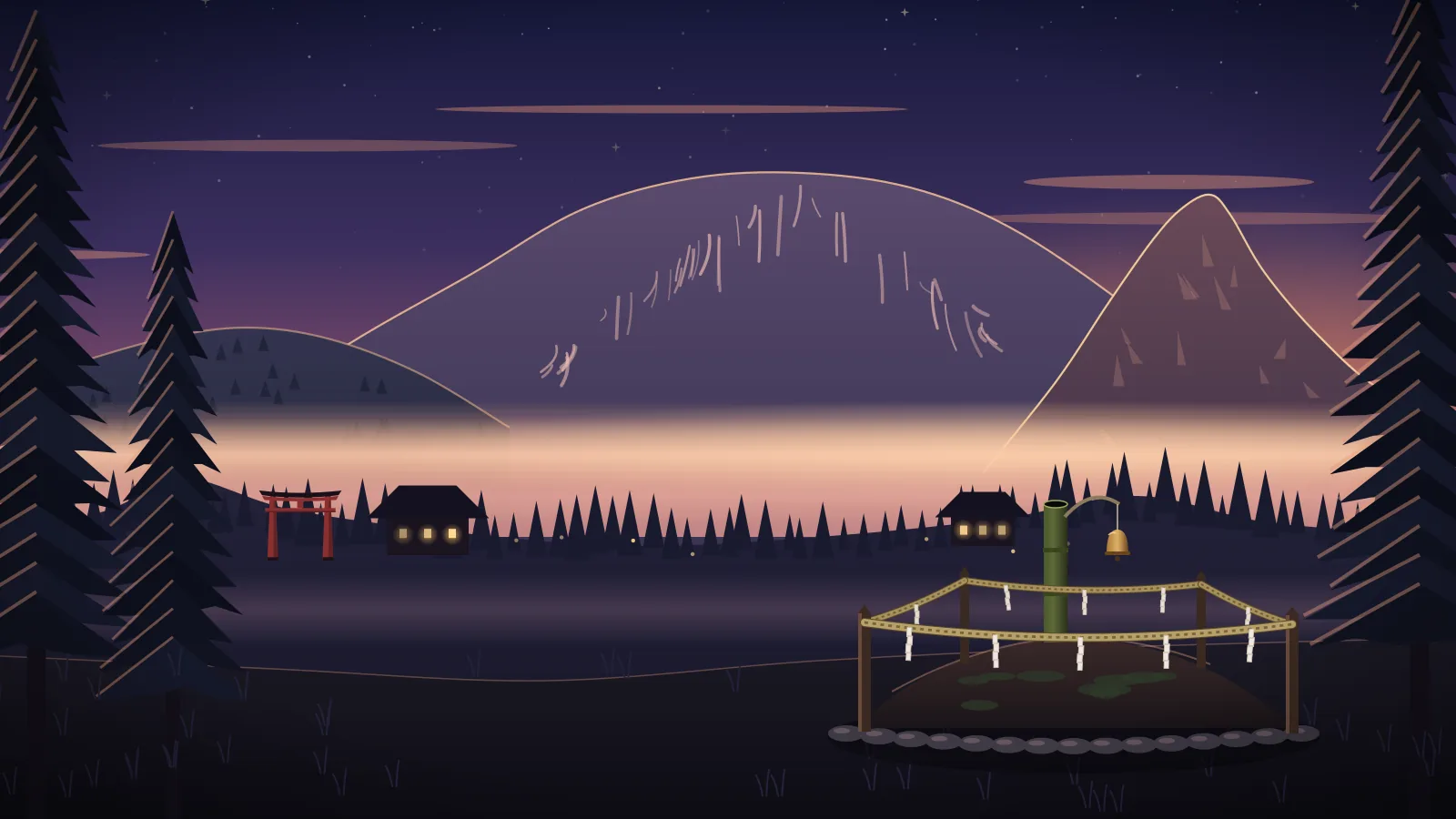
In 1783 the rice fields of northern Japan lay cold and grey. Year after year the harvest had failed, and the villages were starving. Near a temple at the foot of a sacred mountain, the story goes, an old man of 96 was lowered into a chamber under the earth.
Above him a bamboo tube rose out of the soil. And from it, every day, came the faint sound of a small bell.
Chapter Iwatch from 0:38
The Mountain of Silence
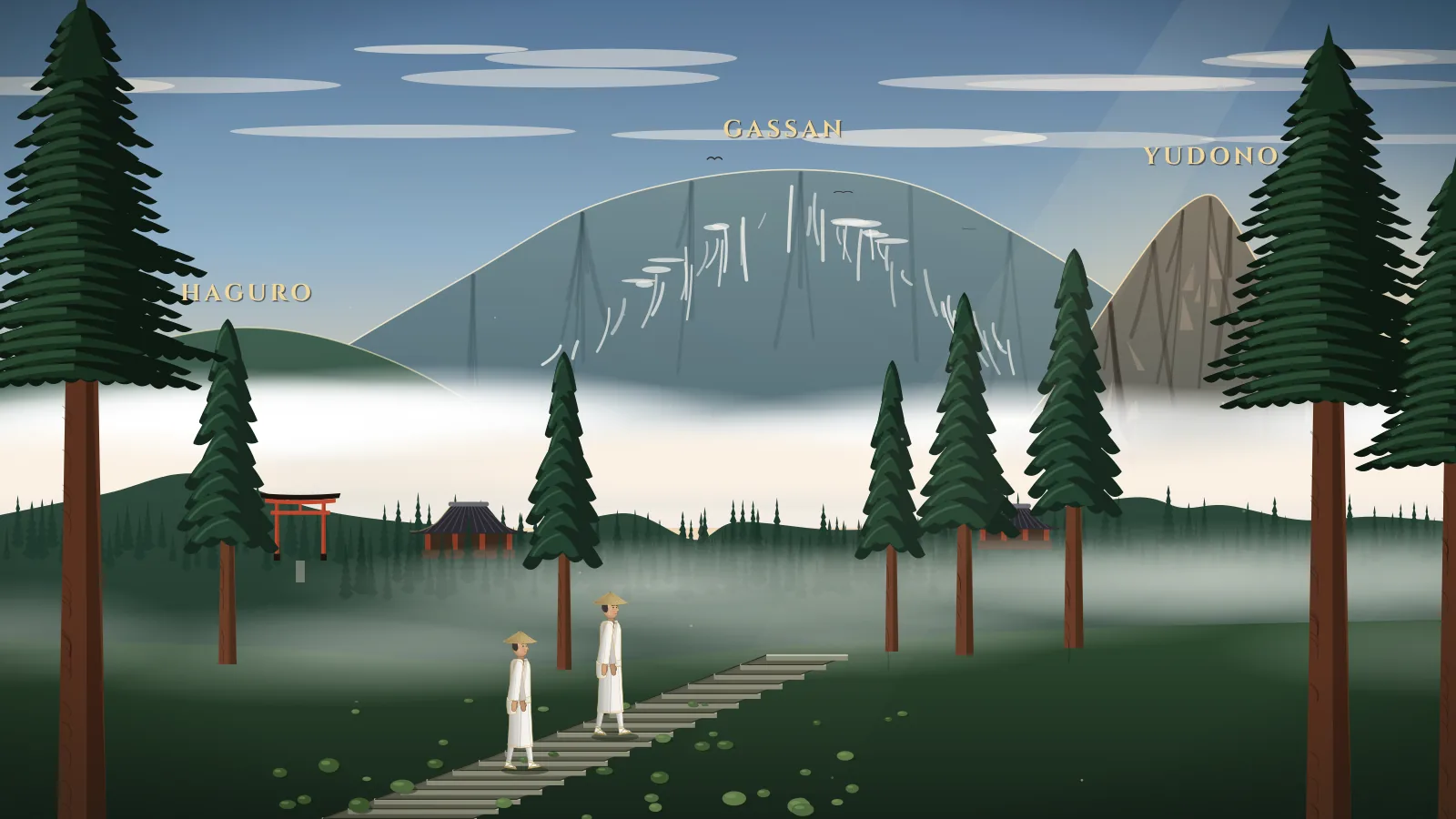
In the north of Japan’s main island rise three sacred peaks, the Dewa Sanzan: Mount Haguro, Mount Gassan and Mount Yudono. For centuries they belonged to Shugendō, a path of mountain ascetics that blended Buddhism with the worship of the local gods, the kami. Pilgrims in white climbed their slopes, and hermits lived in their forests.
The holiest of the three was Yudono. Its sacred object was not a building at all, but a great rock with a hot spring flowing over it. Pilgrims went up to it barefoot, and they were forbidden to speak of what they saw there. In 1689 the poet Bashō climbed the mountain on his long journey into the north. He wrote only that he could not tell of Yudono, and that it wet his sleeves.
He wrote only that he could not tell of Yudono, and that it wet his sleeves.
The temples of Yudono followed Shingon, a school of esoteric Buddhism brought to Japan by the monk Kūkai. Kūkai died on Mount Kōya in 835. But Shingon tradition says that he did not die. He entered an endless meditation, and waits there still for the Buddha of the future.
To this day, monks carry a meal to his mausoleum every day, along a path through the cedars and the stone lanterns. At Yudono, a few men hoped to follow his example, and to become a sokushinbutsu: a Buddha in this very body. Many of them took names ending in -kai, after Kūkai himself.
Chapter IIwatch from 2:07
The Tree-Eaters
Most of them were not great monks. Many were issei gyōnin: men of humble birth, often farmers, who vowed their whole lives to the mountain. They went from village to village collecting alms. They built bridges and roads, dug wells, and prayed for their neighbours in times of famine and disease.
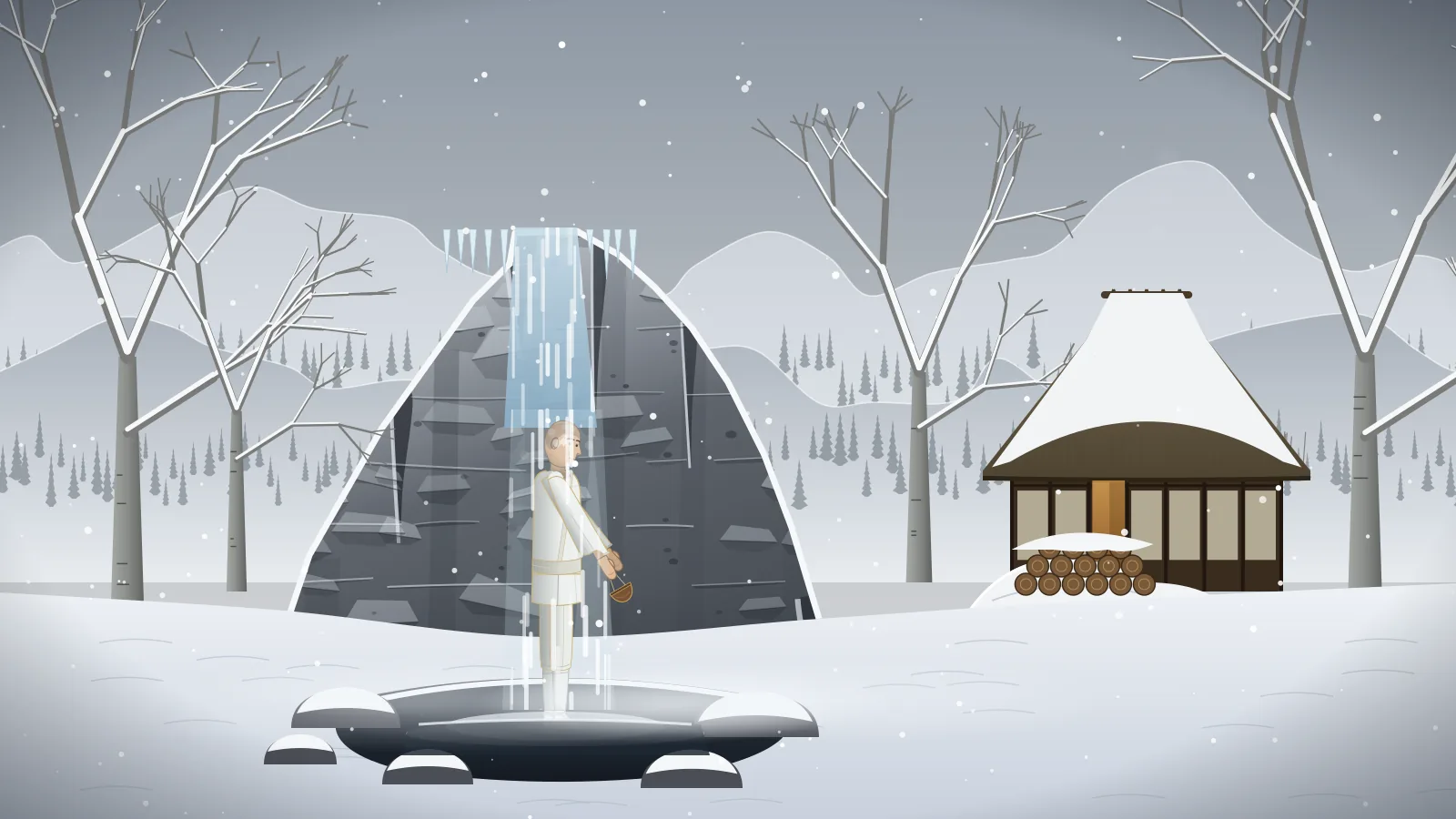
Their training was long. In a high valley called Senninzawa, the Marsh of the Hermits, they shut themselves away for retreats of a thousand days, even through the snows of winter. Stone monuments on the mountain still record these retreats. The men poured icy water over their bodies, chanted, and sat in meditation for hours.
In a high valley called Senninzawa, the Marsh of the Hermits, they shut themselves away for retreats of a thousand days.
And they gave up grain. The practice was called mokujikigyō, tree-eating practice: no rice, no cooked food, living mostly on nuts, seeds, roots and pine bark from the mountain. To believers, this was purification, a way of leaving the ordinary world behind. Modern scientists add another reading: over the years it stripped the body of the fat and moisture that cause decay.
Popular accounts say that some ascetics also drank a tea made from the poisonous sap of the lacquer tree. The story is widely repeated, but early sources say little about it.
Chapter IIIwatch from 3:31
The Bell in the Earth
One of these men was Shinnyokai. He was born in 1687, the eldest son of a farming family near the town of Tsuruoka, on the Shōnai plain. Why he came to the mountain, local stories disagree. For decades he lived as a gyōnin at Dainichibō, a temple at the foot of Mount Yudono.
Then came the great famine of the Tenmei era. Cold summers and ruined harvests killed tens of thousands across the northeast, perhaps many more. The temple says that Shinnyokai chose to become a living Buddha to help his people, and to end their suffering.
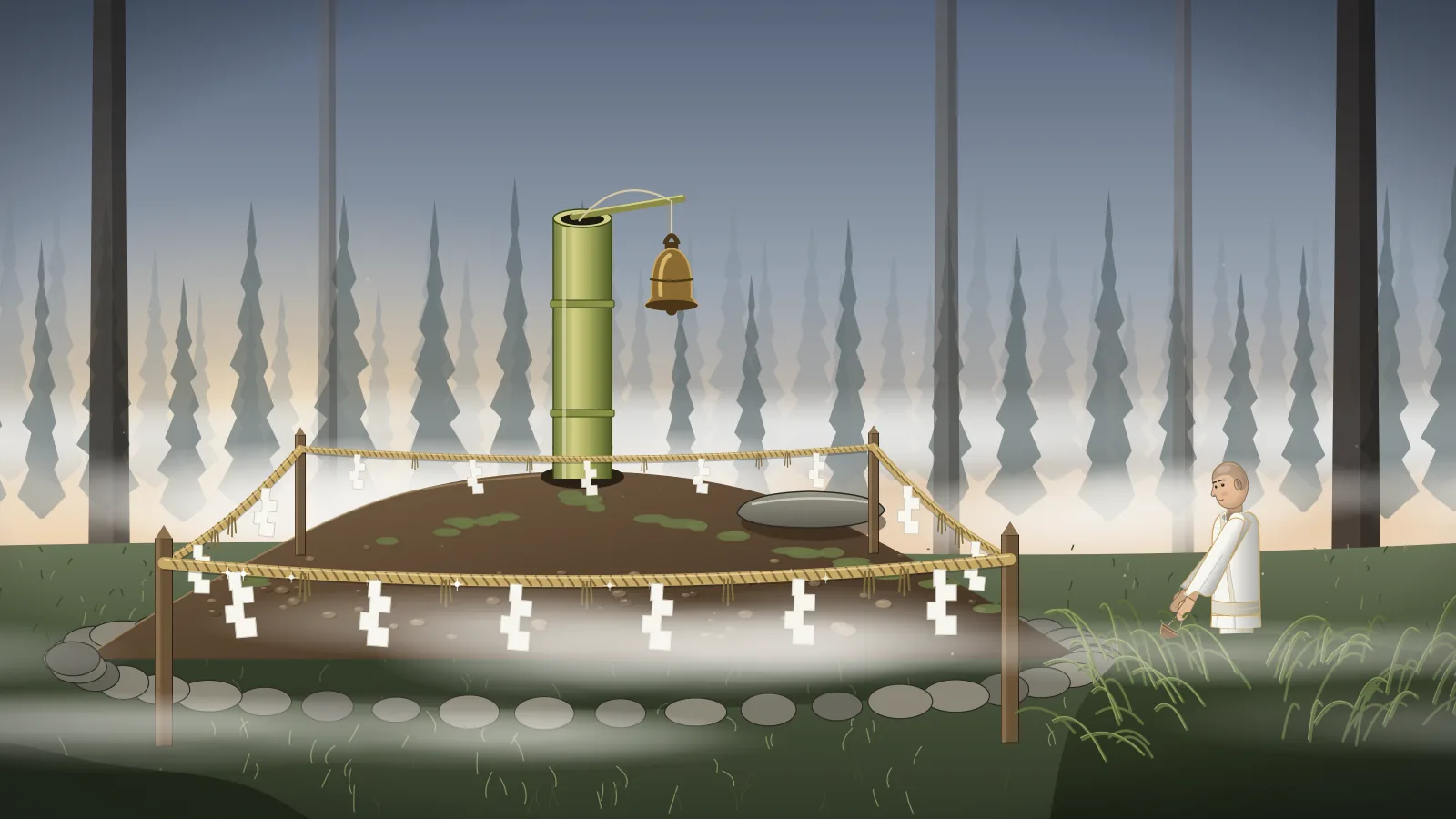
Tradition describes what came next. A pit about 3 metres deep was dug and lined with stone. A wooden coffin was lowered inside, and charcoal was packed around it to draw out the damp. The ascetic sat within, in meditation, and bamboo tubes reached up to the surface to let in air.
As the story is usually told, he rang a small bell each day, so that those above would know he was still alive. Then, one day, the bell fell silent. The disciples drew out the tubes and sealed the tomb.
Then, one day, the bell fell silent.
And then they waited, while the snow came and went over the mound. Accounts say 3 years and 3 months: more than a thousand days. When the tomb was opened, if the body had dried without decay, it was dressed in robes and enshrined as a living Buddha. If it had not, the tomb was closed again, and the man was honoured all the same. Tradition remembers far more failures than successes.
Shinnyokai still sits at Dainichibō, in a glass case. From time to time his robes are renewed in a ceremony, and pieces of the old cloth are given to pilgrims as charms.
Chapter IVwatch from 5:38
The Road Builder and the Records
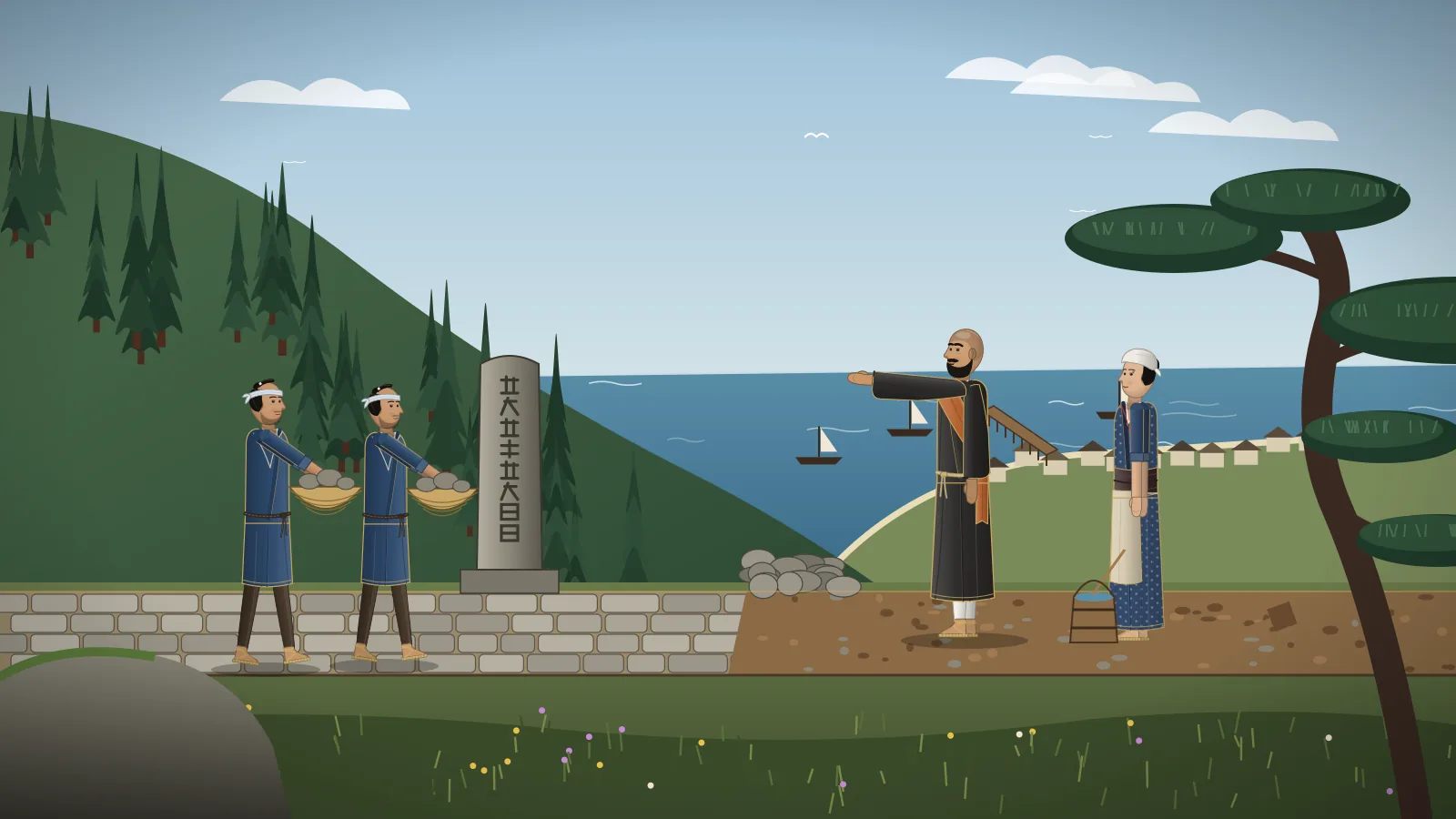
Not far away stands another temple, Chūrenji. Its living Buddha is Tetsumonkai, the most famous of them all. He began as a labourer on the river. The story goes that he killed two samurai in a quarrel and fled to the temple, where he took up the life of an ascetic.
He became a tireless gyōnin. He is said to have rallied thousands of volunteers to build a road from the port of Kamo, and nearly 200 stone monuments recall his works. Legend adds that when an eye disease was spreading in Edo, he offered one of his own eyes, praying for the sick.
Tetsumonkai died in 1829. For a long time, people believed that he too had gone down into the earth alive. But a historian who studied the temple records argues otherwise. Tetsumonkai, he found, died in his own temple, and his followers then dried his body, some accounts say over charcoal fires.
In 1960 a team of Japanese scientists and scholars began to study the mummies of the north. They confirmed that the bodies were genuine human remains, with signs of long fasting. But many, they found, had been dried or smoked by their followers after death.
No early document confirms that anyone was buried alive.
No early document confirms that anyone was buried alive, and the burial mounds that have been dug up held only skeletons. Many historians now see each living Buddha as the work of a whole community: the ascetic, and those who honoured him.
Chapter Vwatch from 7:15
The Last Living Buddha
Then Japan itself changed. From 1868 the new Meiji government separated Shinto from Buddhism, and in 1872 it banned Shugendō altogether. On the sacred mountains, Buddhist temples were turned into Shinto shrines, or closed. Haguro became a shrine. Only a few temples, like Dainichibō and Chūrenji, stayed Buddhist.
Under the new laws, entering the tomb alive came to be treated as helping a suicide, and opening a grave as a crime. Many accounts date the ban to 1879; others give different years.
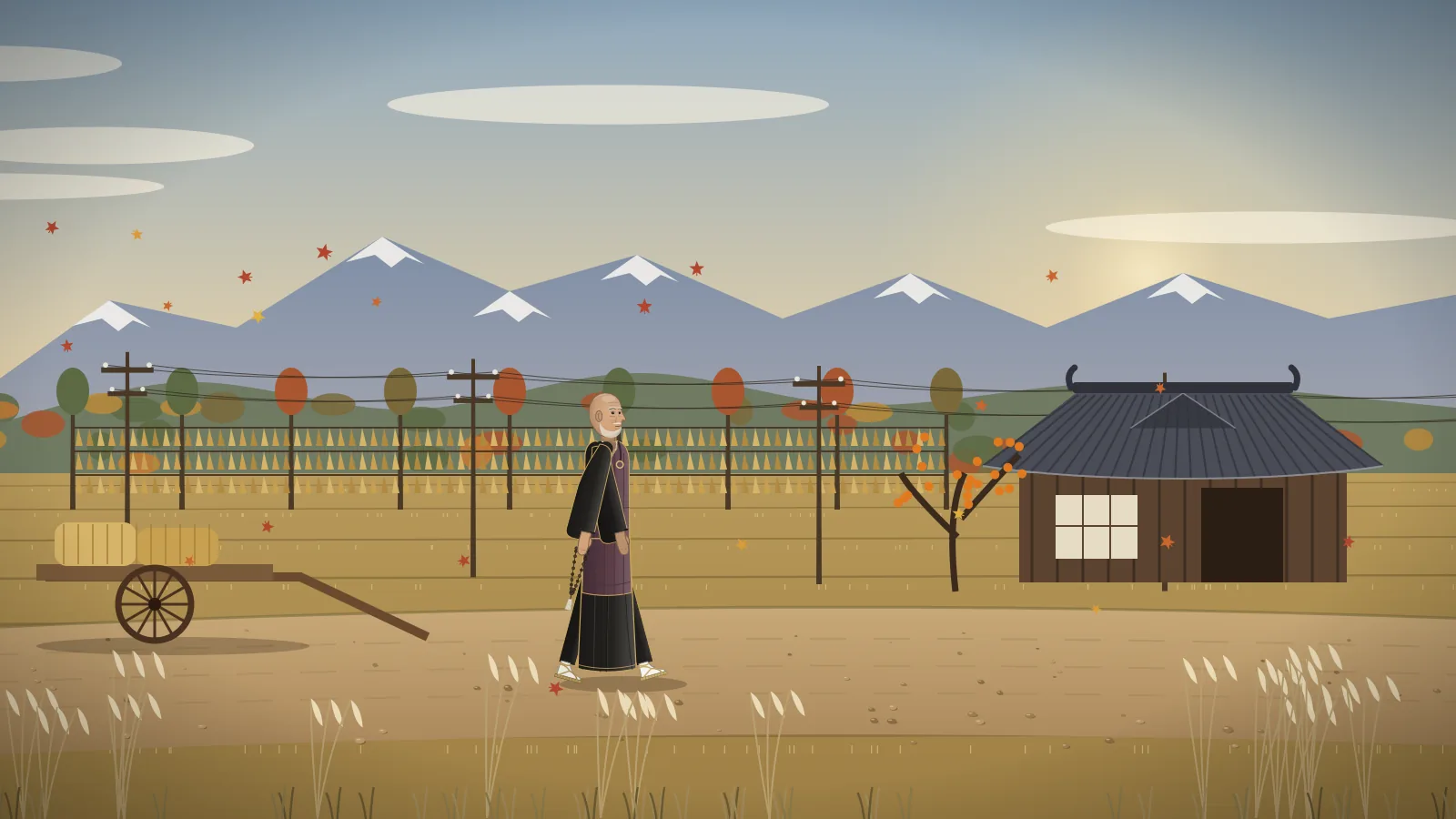
But one old ascetic did not give up. His name was Bukkai, and he had trained at Mount Yudono since the age of 16. In 1903, at Kannonji temple in the town of Murakami, he died at 76. One account says that he meditated in a stone casket underground until his breathing stopped; another, that the police forbade it, and he was buried after death.
He had asked to be raised 3 years later. By law, his followers could not. So he lay where he was, for 58 years.
So he lay where he was, for 58 years.
In 1961 researchers finally opened the tomb. Bukkai is usually counted as the last of the living Buddhas.
Chapter VIwatch from 8:38
Watchers over Shōnai
About 16 to 20 of these Buddhas are known in Japan today. Nearly half are in Yamagata, where the old devotion was strongest. Families still visit them, to pray for health, for a safe birth, or for relief from illness. Visitors are asked to treat them as saints, not as curiosities. Many Buddhist teachers never approved of such harsh austerity. The Buddha, they said, taught a middle way between indulgence and self-torment.
To the people of Shōnai, these men gave years of hunger and their own bodies for others.
But to the people of Shōnai, these men gave years of hunger and their own bodies for others. They had built the roads and dug the wells, and prayed through the famine years beside the starving.
Under the mountain, the bells have long been silent. Whether they ever rang, the records cannot tell us. What remains is the memory of men who went hungry for years, hoping, in their own way, to keep watch over their neighbours, as the rice fields turned green again below the sacred peaks.