The story of the film
Prague, the Rhineland, Chełm in Poland, and Israel · Biblical times to 1965, centred on Prague c. 1600
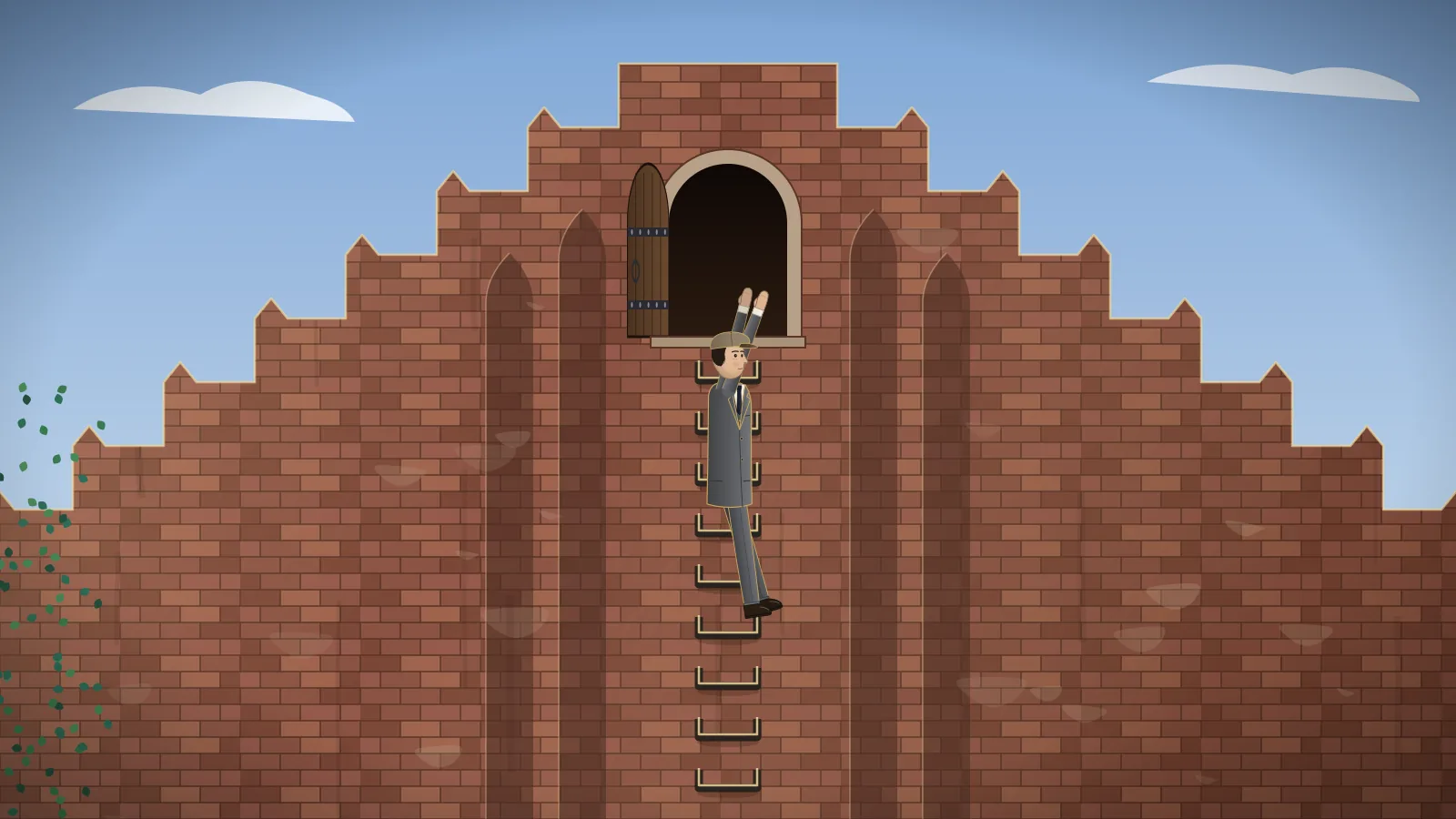
In the old Jewish quarter of Prague stands a synagogue more than 700 years old, with a tall, stepped brick gable. High on its wall, about 12 metres up, is a small door into the attic. No staircase leads up to it, only iron rungs set into the brick.
For well over a century, people have said that up there, under the roof, lies a giant made of clay.
Chapter Iwatch from 0:32
The Rabbi of Prague
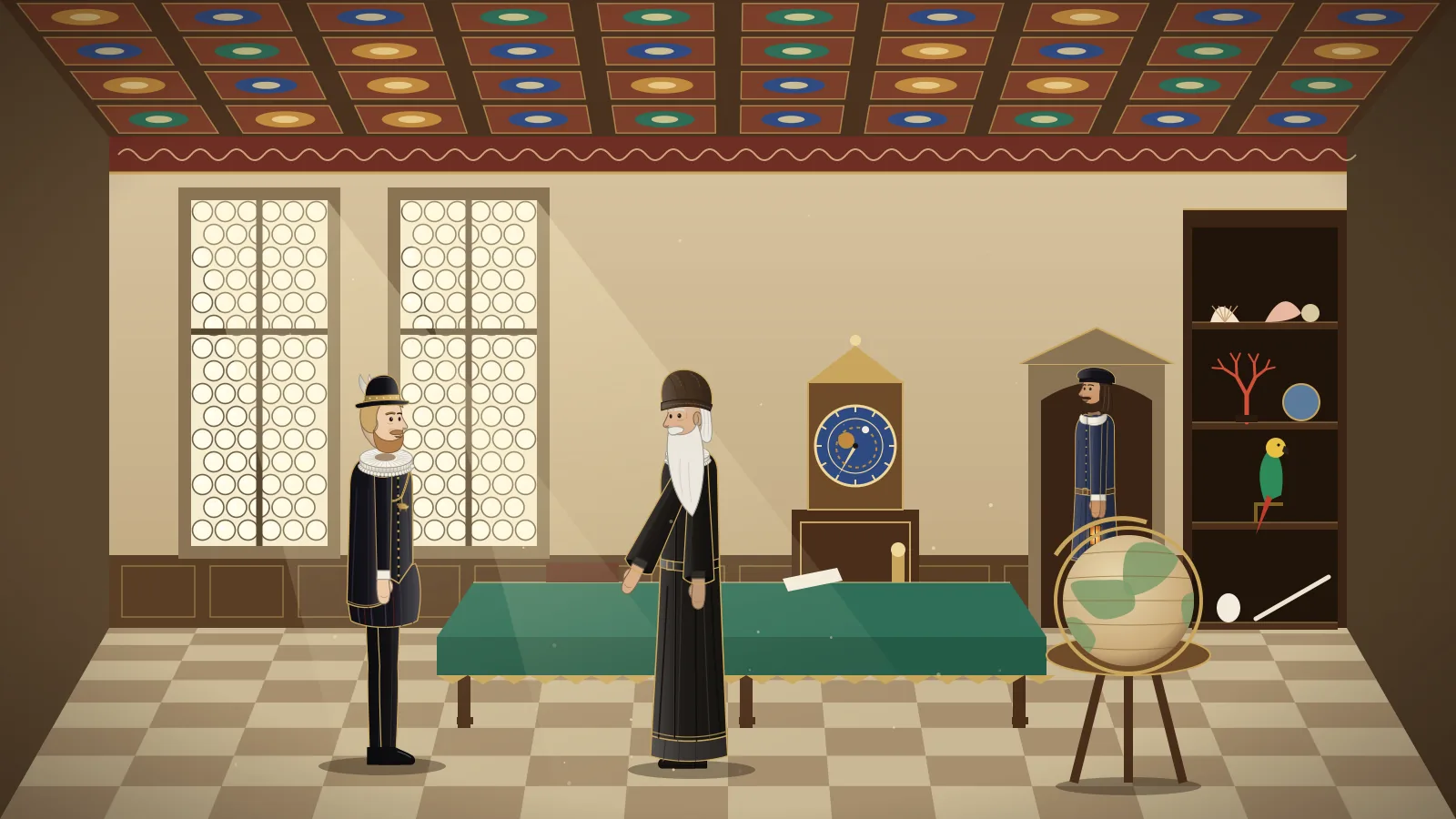
Around the year 1600, Prague was the home of the emperor Rudolf II, a city of astronomers such as Tycho Brahe and Johannes Kepler, of alchemists and collectors of wonders. Beside the river Vltava lay the Jewish Town: crowded lanes of narrow houses, with its own town hall, its synagogues and its cemetery.
Its most famous teacher was Rabbi Judah Loew ben Bezalel, known as the Maharal, from the Hebrew initials of “our teacher, Rabbi Loew”. He was a real man, born around 1520, probably in Poznań, who came to Prague in 1573, a great scholar of Jewish law, philosophy and mysticism.
On 23 February 1592 the emperor received him at Prague Castle. His pupil David Gans recorded the meeting, saying only that they spoke of hidden things. The Maharal died in 1609. He was buried in the Old Jewish Cemetery, under a tall stone carved with a lion.
In all his books, and in every record from his lifetime, there is not a single word about a golem.
In all his books, and in every record from his lifetime, there is not a single word about a golem.
Chapter IIwatch from 1:48
The Clay Man by the River
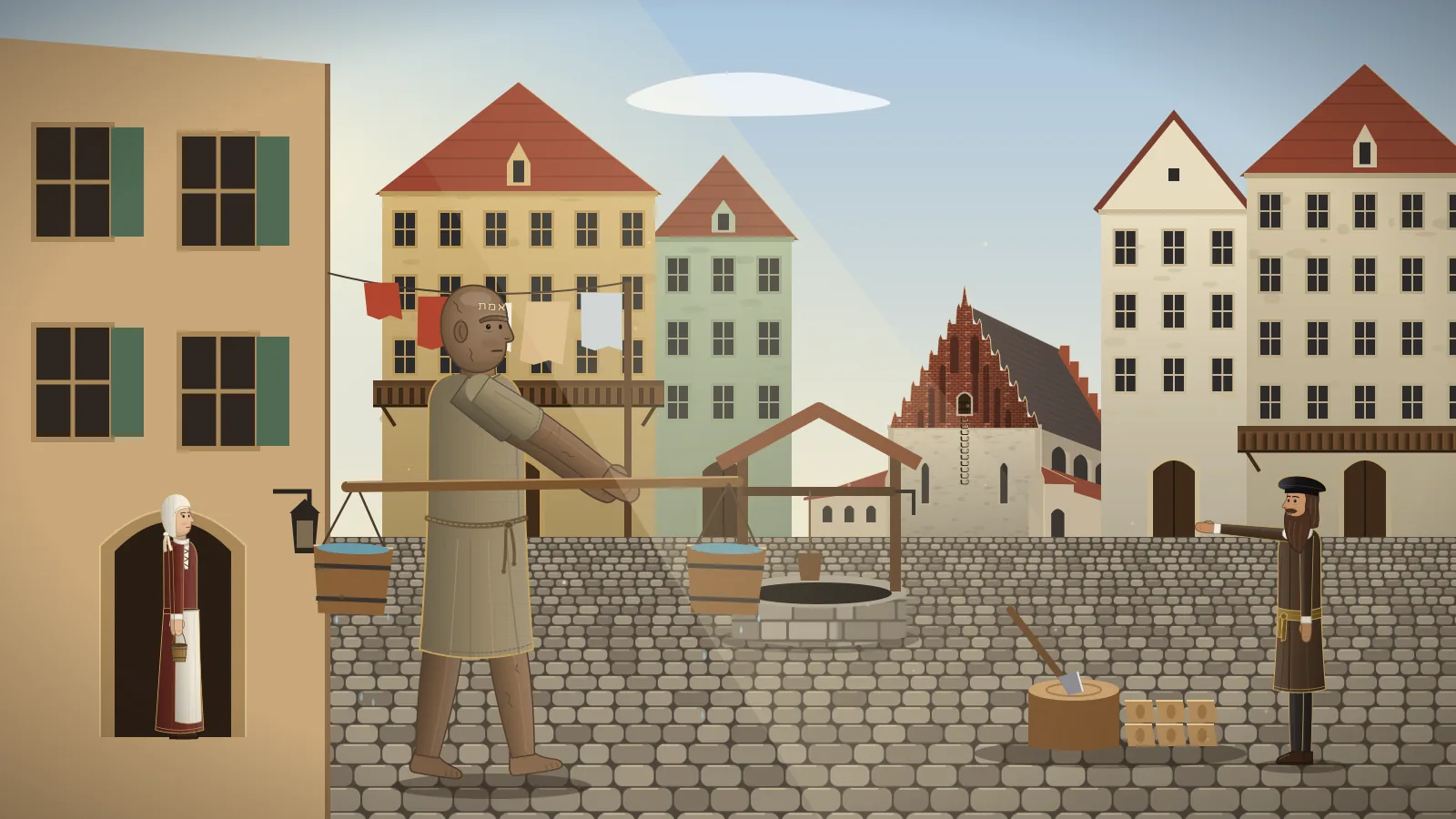
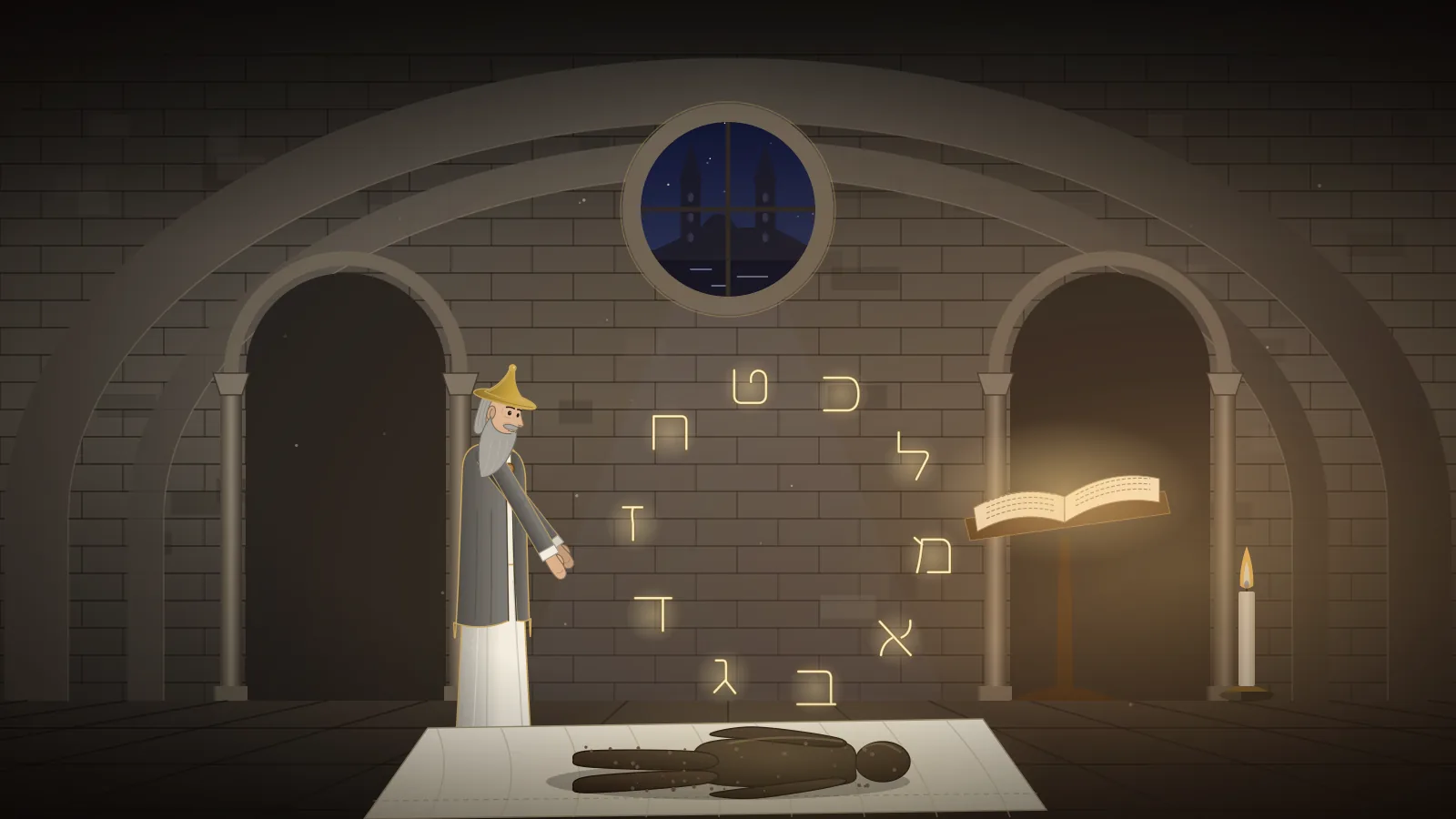
Yet here is the story told today. One night the rabbi went down to the river with two helpers, and shaped a man out of clay. They walked around the figure, reciting holy words, until the clay glowed like a coal in a fire.
In some versions a holy name was placed in its mouth. In others a word was written on its forehead: emet, אמת, truth. And the golem opened its eyes.
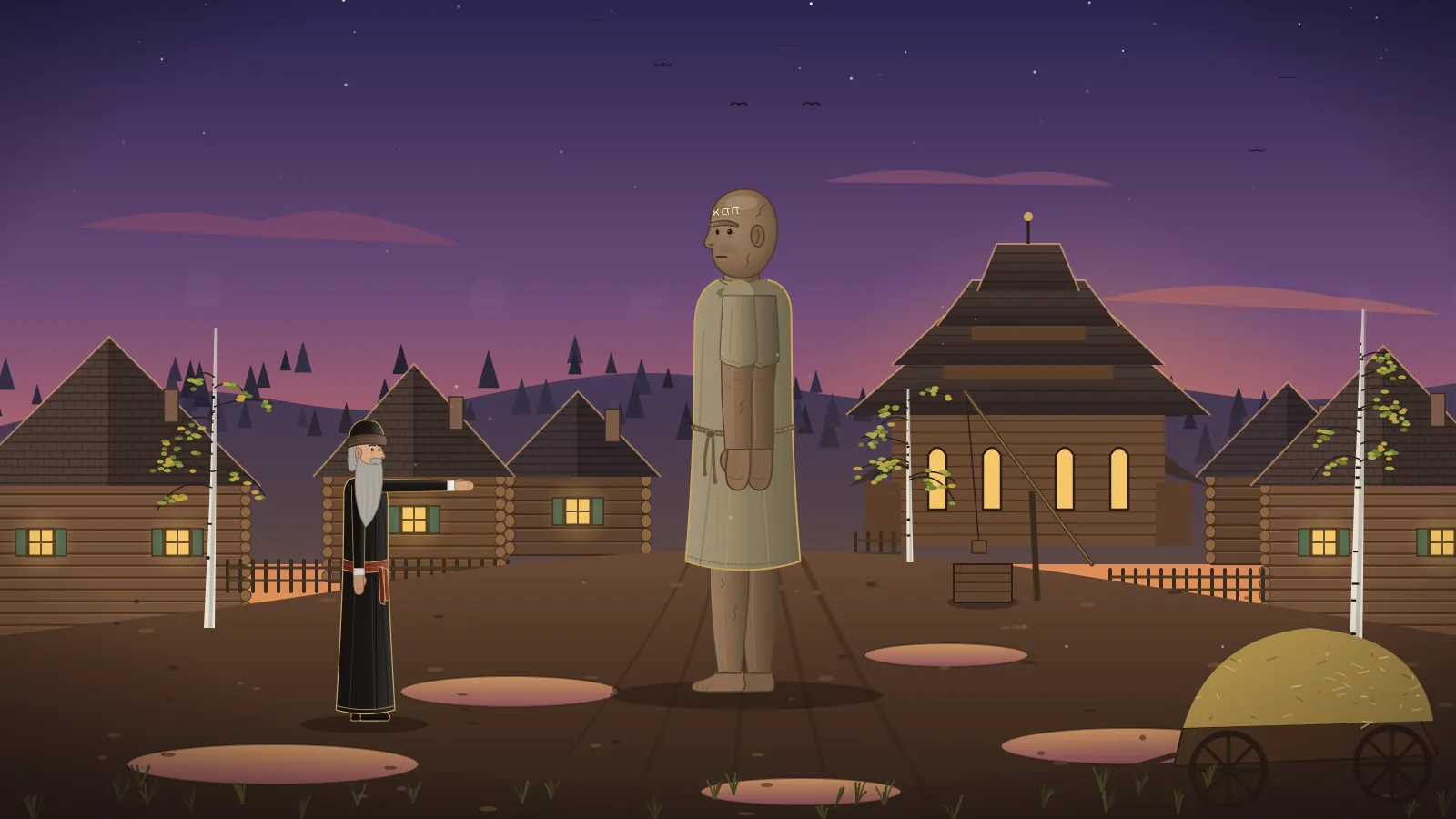
It was enormously strong, and obedient. It carried water, chopped wood, and guarded the Jewish Town at night. But it could not speak. Every Friday, before the Sabbath began, the rabbi took the holy name away, so that the golem, too, would rest.
One Friday evening, the story goes, he forgot. The congregation had gathered, and the psalm that welcomes the Sabbath was being sung. Left alone, the golem began to rage through the streets, overturning carts, while people ran indoors. Someone ran to the synagogue. The rabbi hurried out, stood in the golem’s path, and pulled the holy name away. The giant swayed, fell, and became a heap of clay once more.
The giant swayed, fell, and became a heap of clay once more.
The rabbi went back and had the Sabbath psalm sung again. In the Old-New Synagogue, people say, it is still sung twice. The clay, the story goes, was carried up into the attic, and the rabbi forbade anyone to go up there again.
Chapter IIIwatch from 3:36
Unformed Matter
It is a wonderful story. But its roots go back much further than Prague.
The word golem appears only once in the Hebrew Bible, in Psalm 139. The psalmist says that God saw his golem, his unformed body, before he was born. Golem meant raw, unshaped matter. Later it could also mean an unlearned person, or a clumsy fool.
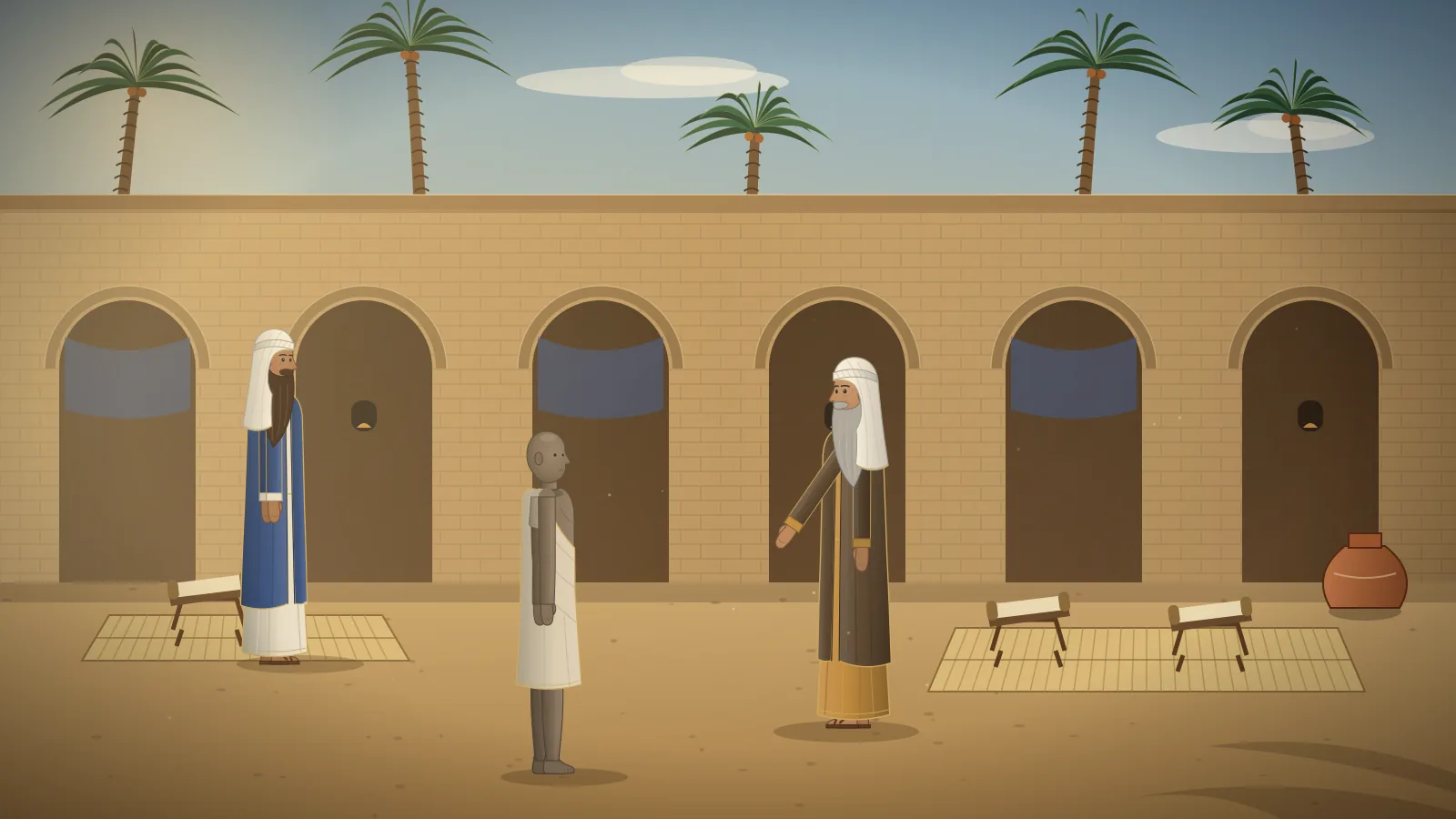
In the Talmud, the great collection of rabbinic teaching, Adam himself was a golem for one hour on the day he was made: a body of earth, not yet given a soul. The Talmud also tells a short, strange story. The sage Rava created a man, and sent him to Rabbi Zeira. Rabbi Zeira spoke to him, but the man did not answer. “You come from the magicians,” said the rabbi. “Return to your dust.”
“You come from the magicians,” said the rabbi. “Return to your dust.”
On the same page, two rabbis study a book every Sabbath eve, create a calf, and eat it. Later readers took that book to be the Sefer Yetzirah, the Book of Creation. It teaches that God made the world through 10 numbers and the 22 letters of the Hebrew alphabet. If letters were the building blocks of the world, later readers asked, could a holy sage, with God’s permission, use them to shape a living body?
Chapter IVwatch from 5:04
Truth and Death
In the 12th and 13th centuries, in the Rhineland, Jewish mystics known as the pious of Germany wrote down a rite for making a golem. One of them, Rabbi Eleazar of Worms, described shaping earth that had never been ploughed, and reciting combinations of letters, in purity.
For him it was a mystical experience, not a way to get a servant. Historians still debate whether anyone ever actually tried it.
Another medieval tale gave the legend its most famous detail. The prophet Jeremiah, it says, made a man with the words “God is truth” on his forehead. The man erased the first letter, aleph. Emet, אמת, truth, became met, מת, dead. And he warned his makers never to rival the Creator.
Emet, truth, became met, dead.
Chapter Vwatch from 6:03
From Chełm to Prague
By the 1600s a new kind of story had appeared, about a real rabbi: Elijah of Chełm, in Poland, who had died in 1583. He was said to have made a golem as a servant. In a letter of 1674, a Christian scholar reported that it bore the word emet on its forehead.
But it grew larger every day. In the account of Elijah’s descendant, Rabbi Jacob Emden, the rabbi feared it would destroy the world. He tore the holy name away, and the golem fell back into dust, though it scratched his face as it fell.
In 1808 the young German scholar Jacob Grimm printed this Polish tale in a Romantic literary paper, the Zeitung für Einsiedler, and German Romantic writers took up the golem. Then, in the 1830s and 1840s, writers in Prague and Germany, many of them Jewish, began to publish the story about another famous rabbi. More than 200 years after his death, the Maharal of Prague had become the master of the golem.
More than 200 years after his death, the Maharal of Prague had become the master of the golem.
The version most people know came later still. Around 1909 a Polish rabbi named Yudl Rosenberg published The Wonders of the Maharal. He claimed that it copied an old manuscript by the Maharal’s son-in-law, kept for three centuries in a library at Metz. No such manuscript has ever been found, and scholars regard the book as Rosenberg’s own creation.
In Rosenberg’s tales, the golem protects the Jews of Prague against the blood libel: the false accusation that Jews used Christian blood in their rituals. That lie had led to violence for centuries, and in Rosenberg’s own time it was being spread again, in Bohemia among other places. His golem was a guardian, born of a real fear.
Chapter VIwatch from 7:56
The Attic, the Screen and the Machine
And the attic? In the 1700s, the story goes, Rabbi Ezekiel Landau climbed up, came down shaken, and forbade anyone to follow. Around 1920 the Prague reporter Egon Erwin Kisch climbed into the attic himself, up the iron rungs. He found rubble and broken bricks, lime dust and the skeleton of a bird, and no golem.
Meanwhile Gustav Meyrink’s novel The Golem had appeared in 1915, and in 1920 Paul Wegener’s silent film gave the creature its famous look. That same year the Czech writer Karel Čapek published a play about artificial workers who rise against their makers. His brother Josef suggested their name: robots.
In one interview, Čapek called his robot the golem made flesh by mass production. Mary Shelley’s Frankenstein is often linked to the golem too, though there is no evidence that she knew the legend.
In 1965 a new computer in Israel, at the Weizmann Institute, was named Golem Aleph: Golem Number One. The historian Gershom Scholem, who chose the name, spoke at its dedication that June. He compared the old animation by the divine name with the binary code of the new machine. He ended by asking the machine to develop peacefully, and not to destroy the world.
If people learn to make something powerful in their own image, can they also stay wise enough to control it?
Today clay golems smile from shop windows in the Jewish quarter. And in the age of artificial intelligence, the old question sounds new again. If people learn to make something powerful in their own image, can they also stay wise enough to control it?
High above the street in Prague, the little door in the synagogue wall stays shut.