The story of the film
Yale College in New Haven, Connecticut, with Fort Sill in Oklahoma and Deer Island in the St. Lawrence River · 1832 to today
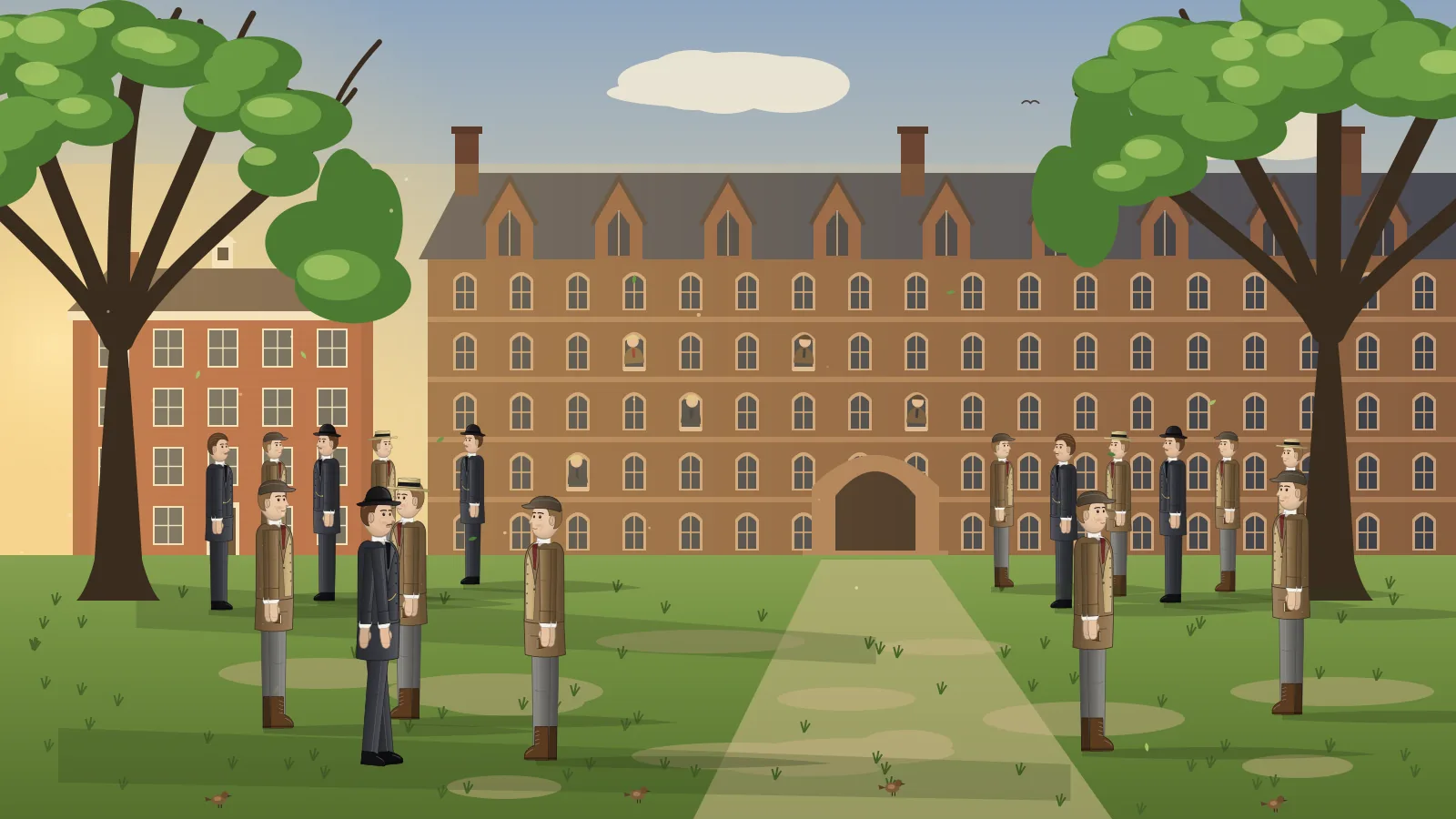
On a spring afternoon in May 1879, a crowd gathered under the tall elms of Yale College, in New Haven, Connecticut, to watch a curious ritual. Juniors stood waiting on the old campus. One by one, seniors walked up to chosen students, slapped them on the shoulder, and told them: “Go to your room.”
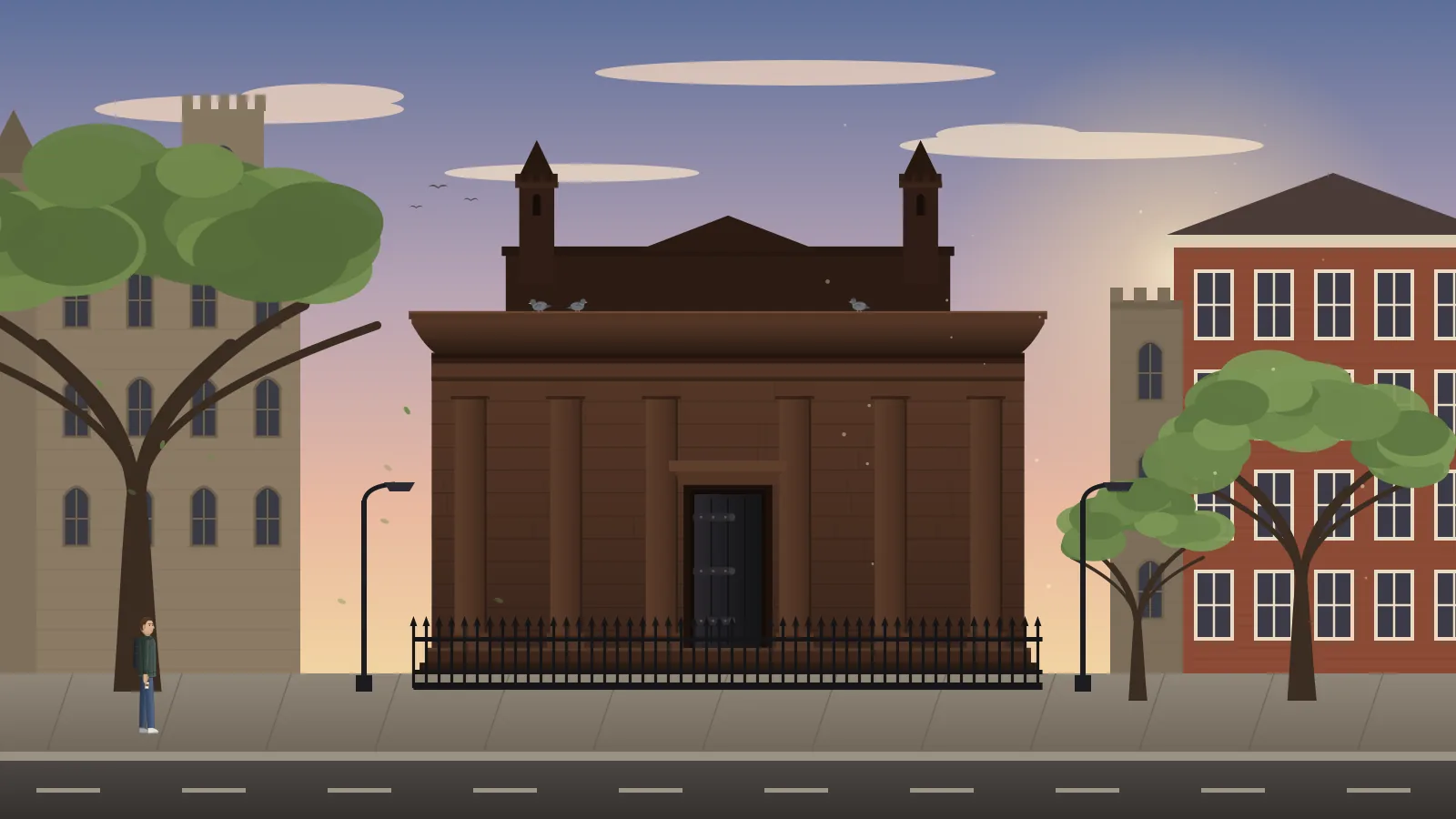
There, in private, came the offer. For many, the most coveted came from a society that met in a windowless hall on High Street, a building everyone called the Tomb. Its emblem was a skull above crossed bones, with the number 322. Its name was Skull and Bones.
Chapter Iwatch from 0:52
A College under the Elms
The story begins almost 50 years earlier, in 1832. Yale was then a small college: a single row of red-brick halls under the elms, facing the green of New Haven. Its students wore dark tailcoats and high collars. They studied Greek, Latin and mathematics, and went to chapel every morning.
Student life turned around three debating societies: Linonia, Brothers in Unity and Calliope. They kept libraries, held weekly debates, and competed fiercely for members.
Beyond the college, much of America was gripped by a movement against secret societies, born of fear of the Freemasons. In 1831, Yale’s chapter of the honour society Phi Beta Kappa voted to give up its secrets.
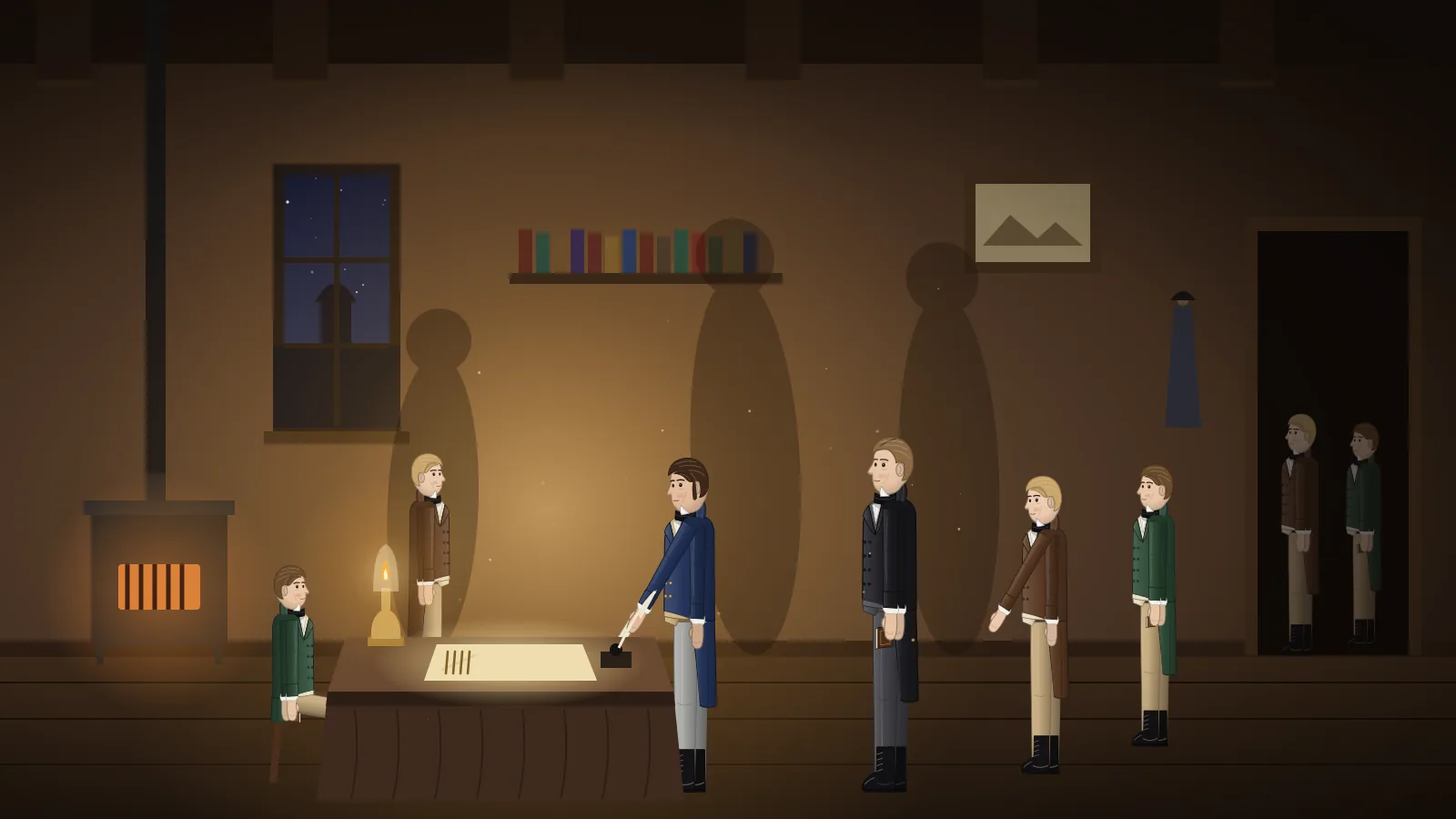
Then, in 1832, the debating societies fell out over that year’s Phi Beta Kappa honours. Feelings ran high among the seniors. One of them, William Huntington Russell, decided to form a society of his own. With his friend Alphonso Taft and thirteen classmates, he made a first “crowd” of fifteen.
Fifteen members a year, chosen from the class below: the number has been kept ever since.
Fifteen members a year, chosen from the class below: the number has been kept ever since.
Chapter IIwatch from 2:20
A Number and a Legend
Where had the idea come from? Members later told of a German origin. Russell, the story went, had studied in Germany, and brought home the customs of a German student corps. The story first appeared in print only decades later, and his study in Germany is not documented.
The number on the emblem was explained in the same spirit. 322, it was said, meant “founded in ’32, second corps”. Others pointed to 322 before Christ, the year the Athenian orator Demosthenes died, a reading that fits the society’s taste for classical learning. The society itself has never explained the number publicly.
No German parent society has ever been found. Historians treat all of these explanations as traditions, not as documented fact.
What is documented is that the founders went on to public lives. Russell ran a school with military drill in New Haven, became a general of the Connecticut militia, and was an abolitionist and a friend of John Brown. Alphonso Taft became a judge in Ohio, then Secretary of War, and Attorney General of the United States.
Chapter IIIwatch from 3:17
The Tomb on High Street
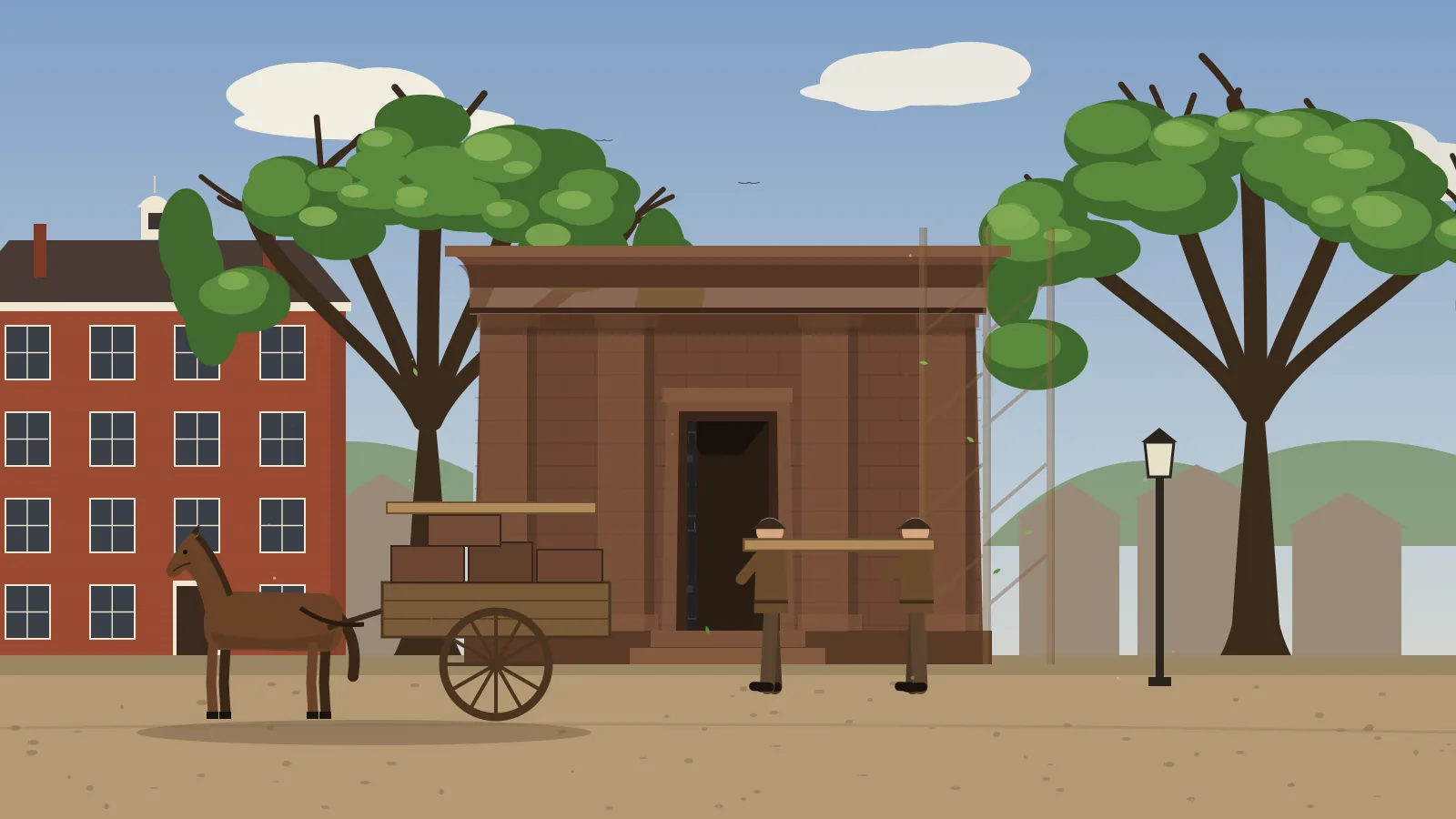
In 1856 the society built its own hall on High Street: a block of brownstone in a heavy, Egyptian-looking style, with no windows at all.
That same year, Russell and a younger member, Daniel Coit Gilman, incorporated the Russell Trust Association to own the society’s property. Gilman later became the first president of Johns Hopkins University.
The hall was enlarged in 1883, and again in 1903. Later Yale societies, such as Scroll and Key and Wolf’s Head, followed its model, and today Skull and Bones is one of many senior societies at Yale.
Inside, members took society names, some handed down by tradition, others taken from literature and myth. Outsiders were not admitted, and members were expected not to talk about what went on there.
Secrecy invited curiosity. In September 1876, a group of students calling themselves the Order of the File and Claw, after the tools they carried, broke into the Tomb at night. They mapped its rooms, and published a pamphlet describing what they had seen, including an inner room numbered 322. It was an early sign of how much the closed building fascinated everyone who walked past it.
Chapter IVwatch from 4:48
Tap Day
Three years later, in 1879, the choosing itself became a public show. The first Tap Day on record was held on 23 May, near Durfee and Farnham halls on what is now Yale’s Old Campus. Until then, offers had been made quietly in students’ rooms. Now Tap Day drew crowds, and it went on drawing them for decades, until the 1950s, when the offers moved quietly back into students’ rooms.
For those left standing when the crowd went home, it was a very public disappointment, and many on the faculty came to dislike the spectacle.
What happened after the tap is harder to know. Journalists, drawing on former members, describe two evening meetings a week in senior year, an elaborate initiation, and the custom of each member telling the others the story of his life, a custom meant to build lifelong trust.
The society has never published its rituals, and these accounts cannot be checked in detail.
The society has never published its rituals, and these accounts cannot be checked in detail.
Chapter Vwatch from 5:29
Presidents and Secretaries
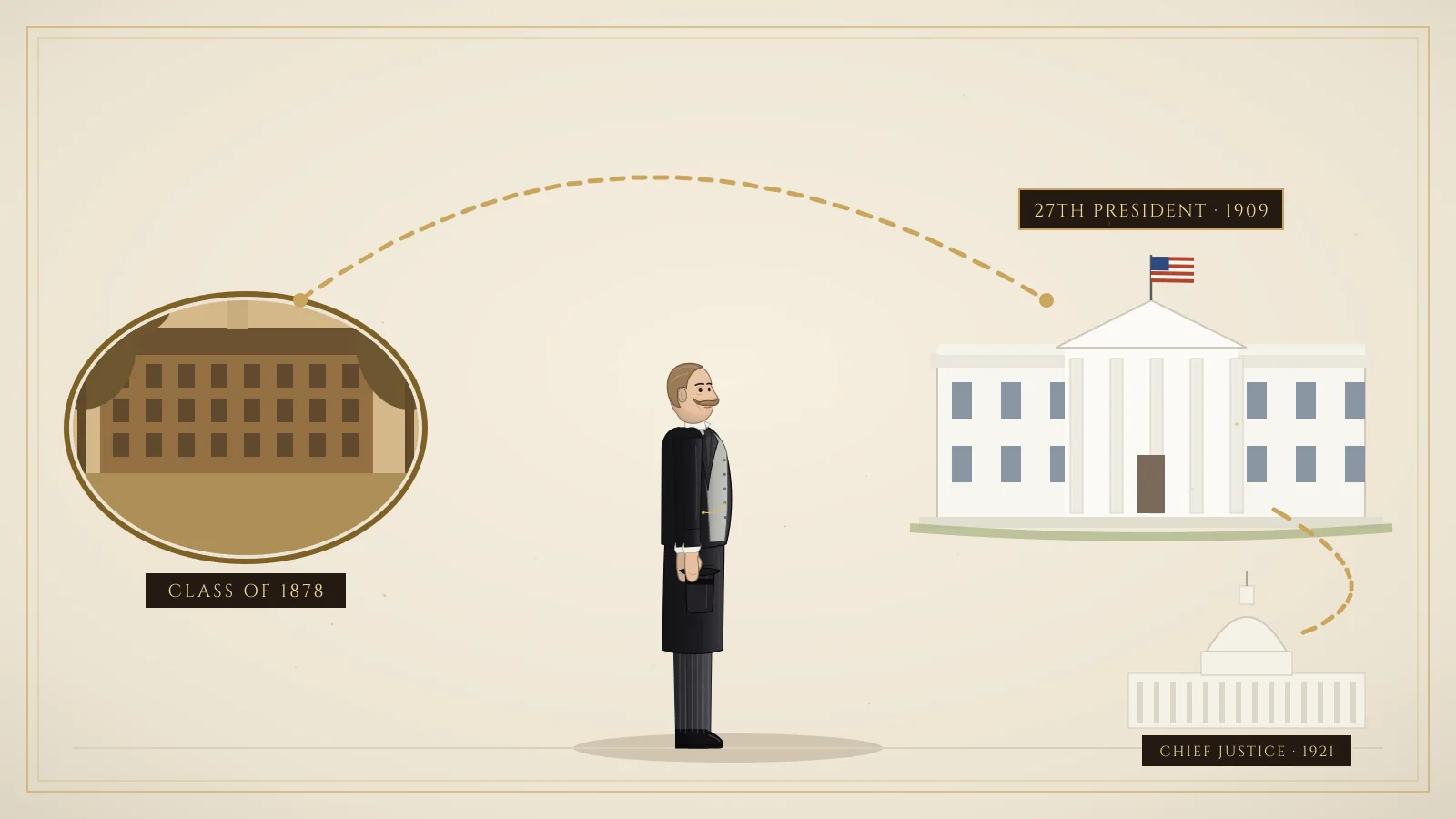
Alphonso Taft’s son, William Howard Taft, was tapped too, and graduated in 1878. He became the 27th president of the United States, and later Chief Justice.
Henry Stimson, of the class of 1888, served as Secretary of State, and twice as Secretary of War. Other members became senators, judges, publishers and cabinet officers.
In all, three members reached the White House. To many outsiders, such a record looked like more than coincidence.
Chapter VIwatch from 6:13
The Geronimo Legend
The most persistent legend leads to Fort Sill, Oklahoma. There, in 1909, the Apache leader Geronimo died, still a prisoner of war, and was buried in the post’s Apache cemetery. He had surrendered in 1886, and spent his last years in exile, far from the mountains of his homeland in the Southwest.
In 1918, during the First World War, Yale volunteers trained at the fort, in the artillery. That year, a Bonesman wrote to a fellow member, passing on a boast that members there had taken Geronimo’s skull for the Tomb.
The letter came to light in Yale’s archives in 2005. But its writer had not been at Fort Sill himself: the story was second-hand, and no remains have ever been shown to be Geronimo’s. Historians doubt the story.
In 2009, descendants of Geronimo sued to recover any remains. In 2010, a federal judge dismissed the case on legal grounds, without ruling on whether the story was true.
Chapter VIIwatch from 7:24
An Island and a Theory
Far from the rumours, the society kept a summer retreat: Deer Island, about 40 acres of woods and rock among the Thousand Islands of the St. Lawrence River, near Alexandria Bay in New York. Like the Tomb, it is owned by the Russell Trust Association. New members, the accounts say, are brought there in the summer before their senior year, to meet the older generations of the society.
In 1977, a long article in Esquire magazine brought the society’s customs, as former members and outsiders described them, to a wide public.
From the 1980s, some writers claimed that Skull and Bones secretly steered American policy, or formed part of a world plot. Some even tied it to the Bavarian Illuminati. No document supports any such link. The society’s origins are well explained by Yale’s own student rivalries.
In a way, the old American fear of secret societies, the fear that had stirred the country in 1831, had simply found a new home.
Historians answer the larger claim simply. For generations, Yale educated a large share of the American elite. A club that picked its best-connected students was bound to have powerful alumni. And there is no evidence of a shared agenda. Members have often stood on opposite sides of elections, parties and public life.

Chapter VIIIwatch from 8:59
The Tomb Today
The society changed, too, though slowly. Yale College had admitted women in 1969, but the Tomb stayed all-male. In 1991, the seniors tapped seven women.
The alumni board changed the locks. In a postal vote, alumni backed the change, 368 to 320. Then a group led by the writer William F. Buckley Jr. went to court, and won a temporary order against the change. That autumn, in October, a second vote settled the matter, and the women took their places, as members of the class of 1992. Since then, Skull and Bones has chosen women and men alike.
The records show a student club: fifteen seniors a year, about 2,800 members since 1832, a trust, a hall and an island. They show alumni who mattered to one another, and sometimes to the country. The legends show something else: how much Americans have wondered about the networks behind their leaders.
Today the Tomb still stands on High Street, its iron door shut, as students hurry past. For admirers it stands for tradition and loyalty. For critics, it stands for privilege.
Each spring, fifteen new names are chosen, quietly now. And the windowless hall keeps what it has always kept best: its own story.