The story of the film
Podolia, Vilna, Volozhin, Pressburg, Kraków, Jerusalem, Bnei Brak, Brooklyn, London and Antwerp · 18th century–today
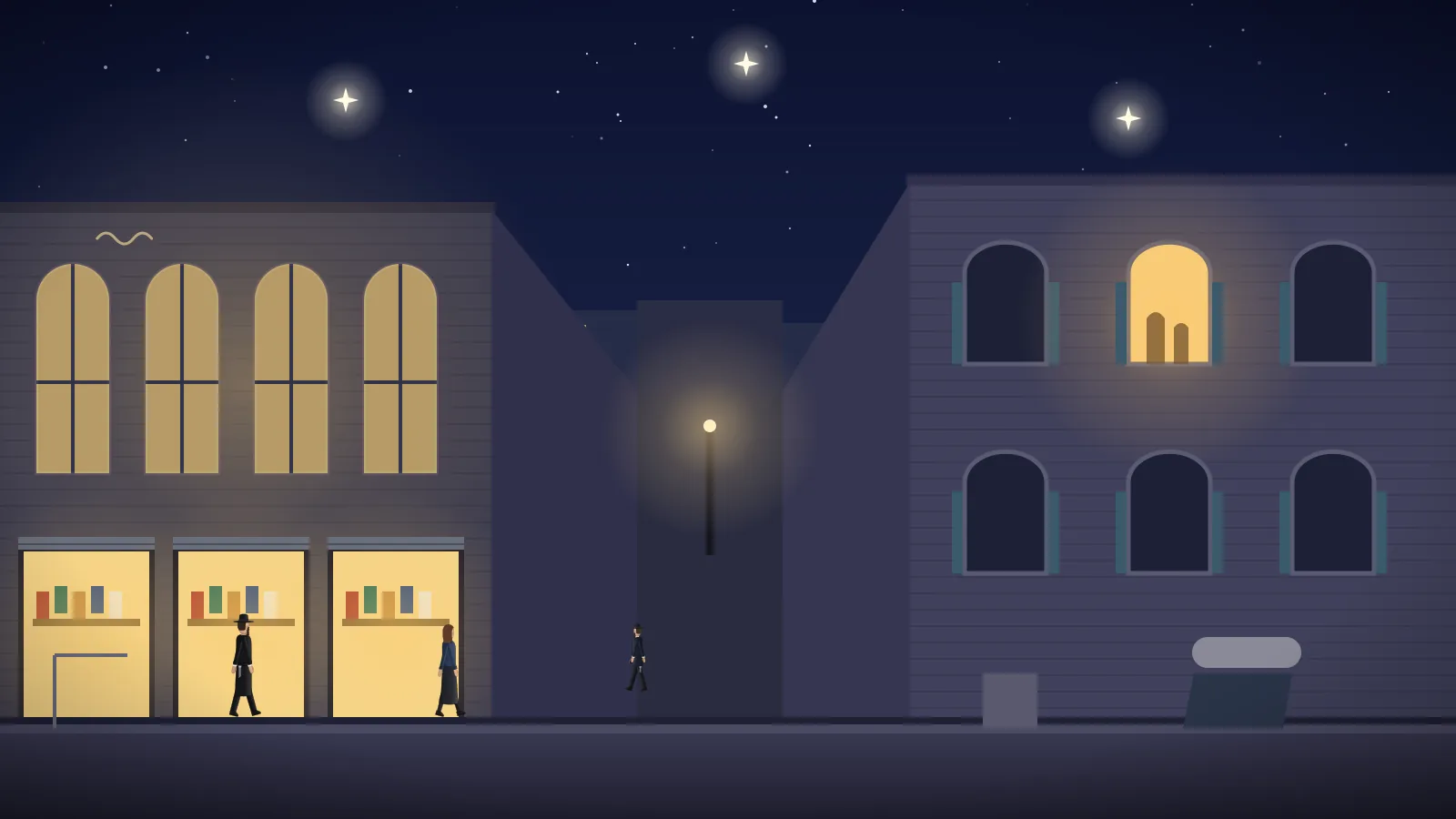
It is Friday afternoon in Mea Shearim, in Jerusalem, and the late sun turns the pale stone gold. Shutters come down on the small shops, braided challah loaves are carried home, and the narrow lanes begin to empty. Men in long black coats and black hats hurry to the synagogues. Some wear the round fur hat of the Hasidim, the shtreimel, kept for Sabbaths and festivals. In the windows above, women light the Sabbath candles before sunset, and small flames appear one after another across the stone façades. Until the stars come out on Saturday night, there will be no work, no travel, no switching of lights. To understand the people who keep this day, we begin with their name.
Chapter Iwatch from 0:46
Those Who Tremble
They are often called ultra-Orthodox Jews. Many of them feel that “ultra” suggests extremism, and prefer their own name, Haredim. It comes from a verse of Isaiah: “hear the word of the Lord, you who tremble at his word.”
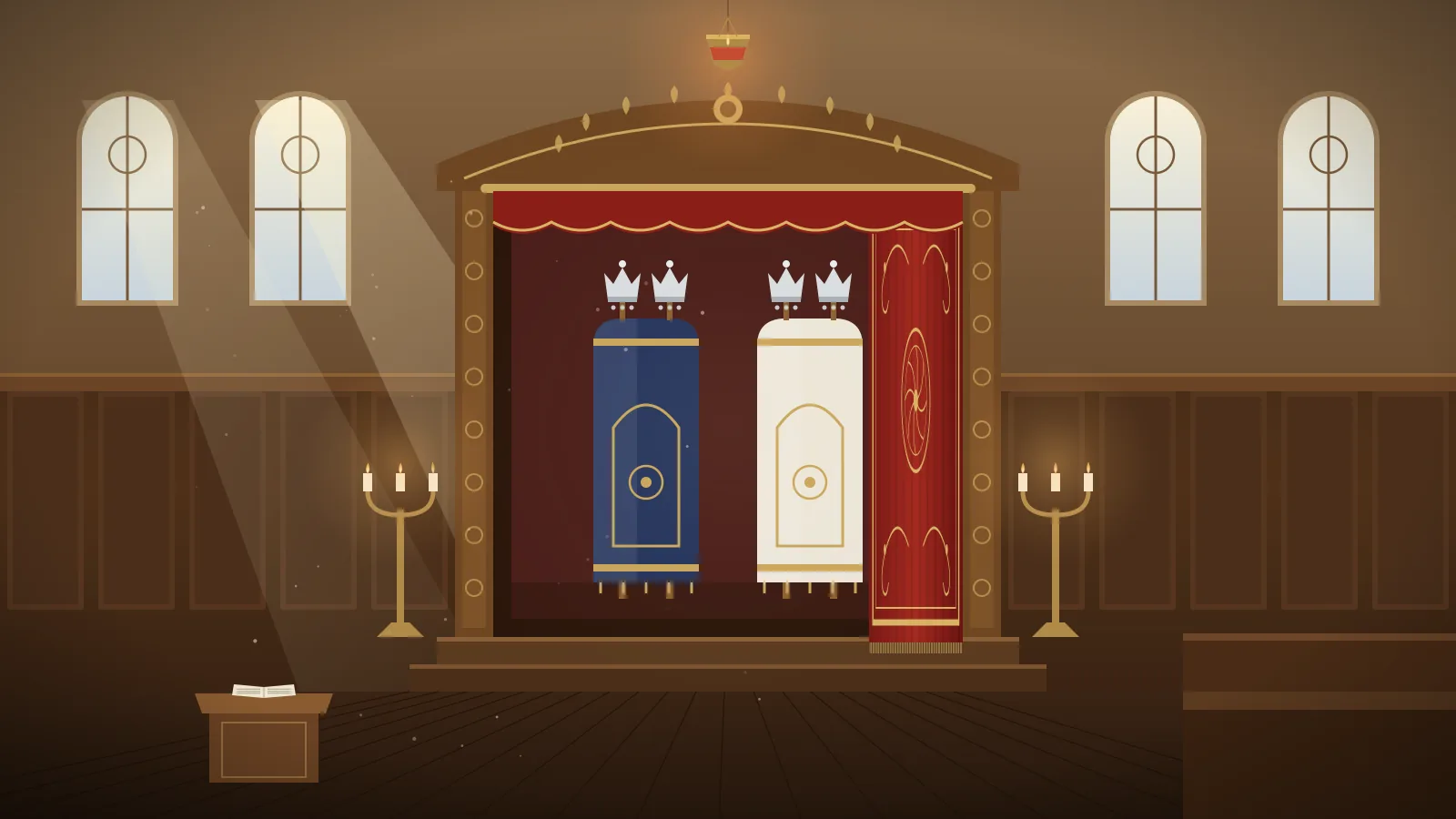
A Haredi is one who trembles: a Jew whose whole life answers to the commandments of the Torah. In the synagogue, the Torah scrolls stand in the holy ark, closed and wrapped in their velvet mantles.
There are more than two million Haredim in the world today, and over half of them live in Israel. Jews have always had strictly observant communities, but the Haredim as a distinct group took shape in the nineteenth century. Their roots go back further still.
Chapter IIwatch from 1:16
Joy and Learning
The story begins in eighteenth-century Eastern Europe, among the woods and wooden villages of Podolia, now in Ukraine. There a healer and teacher called the Baal Shem Tov, the “Master of the Good Name”, taught, Hasidic tradition says, that God could be served with joy, by simple people as well as by scholars.
After his death in 1760, at Medzhybizh, his disciples spread Hasidism across Poland and Ukraine. Each community gathered round a rebbe The spiritual leader of a Hasidic community, often from a hereditary dynasty. Glossary, a leader whose role often passed from father to son.
In Lithuania, the great scholar Rabbi Elijah, the Vilna Gaon, gave his life to study, and saw the new movement as a danger. His followers were called Mitnagdim, opponents.
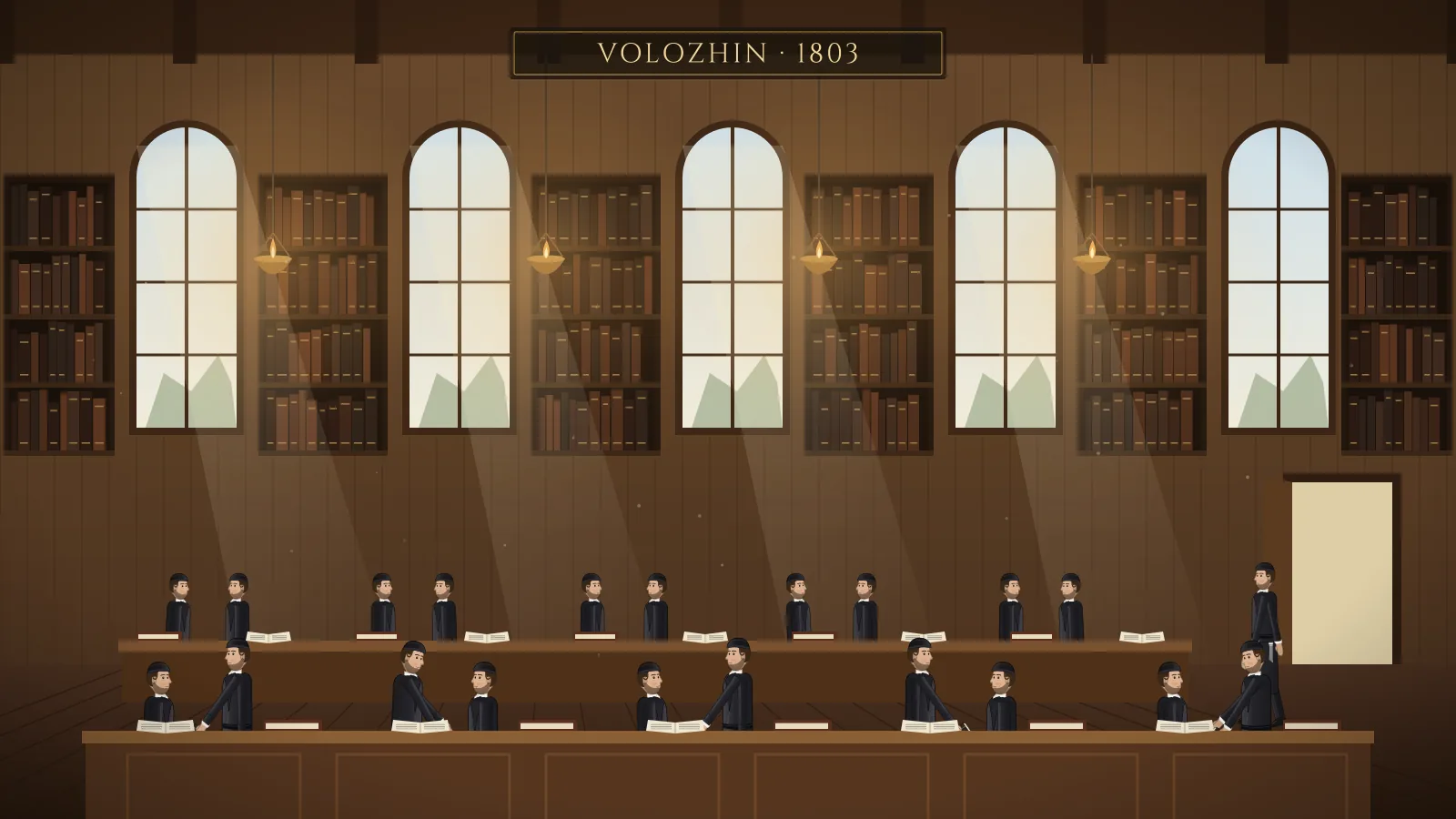
In 1803 his student Rabbi Hayyim founded a yeshiva at Volozhin, where young men studied the Talmud The great collection of rabbinic law and discussion, completed around 500–600 CE, studied alongside the Bible. Glossary day and night. It became the model for the great Lithuanian academies of Torah study.
Chapter IIIwatch from 2:11
Firmer Lines
Then the world changed. As Jews in Central and Eastern Europe gained civil rights, many went to secular schools, took up their neighbours’ dress and languages, and founded Reform congregations that changed the prayers and the law.
Traditionalist rabbis answered by drawing firmer lines. In Pressburg, today Bratislava, Rabbi Moses Sofer, known as the Hatam Sofer, taught that “the new is forbidden by the Torah”. His students carried that outlook across Hungary.
Old rivals, Hasidim and Lithuanians, now stood together. Historians such as Samuel Heilman and Menachem Friedman see here something new: not the old way of life preserved, but a conscious answer to the modern age.
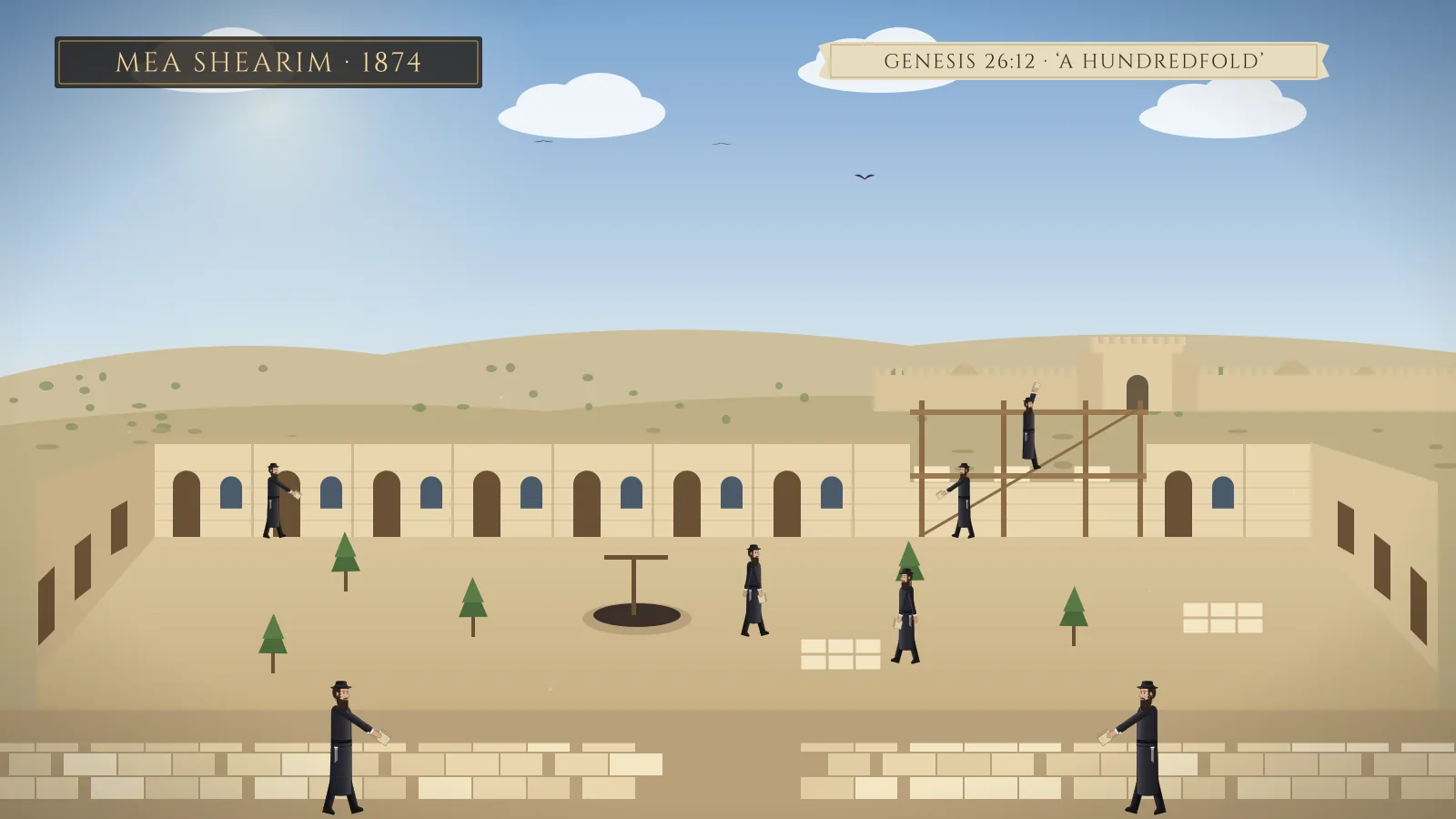
In 1874, pious families built a new quarter outside Jerusalem’s old walls, rows of stone houses around courtyards. They named it Mea Shearim, “a hundredfold”, from a verse in Genesis read in the week of its founding.
In 1912, at Kattowitz, today Katowice in Poland, traditionalist leaders founded Agudath Israel, to defend a life of Torah in public affairs. Among its most revered leaders was the Chofetz Chaim, a Lithuanian scholar and the author of a much-loved book of Jewish law.
In Kraków, in 1917, a seamstress named Sarah Schenirer opened a school for religious girls in a modest room. Her Beis Yaakov movement spread across Poland, and it still teaches Haredi girls today.
Chapter IVwatch from 3:42
The Silence
Then came the Holocaust. Between 1939 and 1945, most of the Haredi heartland of Europe was destroyed, and its rabbis, students and families were murdered.
Whole towns of learning fell silent, their study halls empty, their books closed.
Whole towns of learning fell silent, their study halls empty, their books closed.
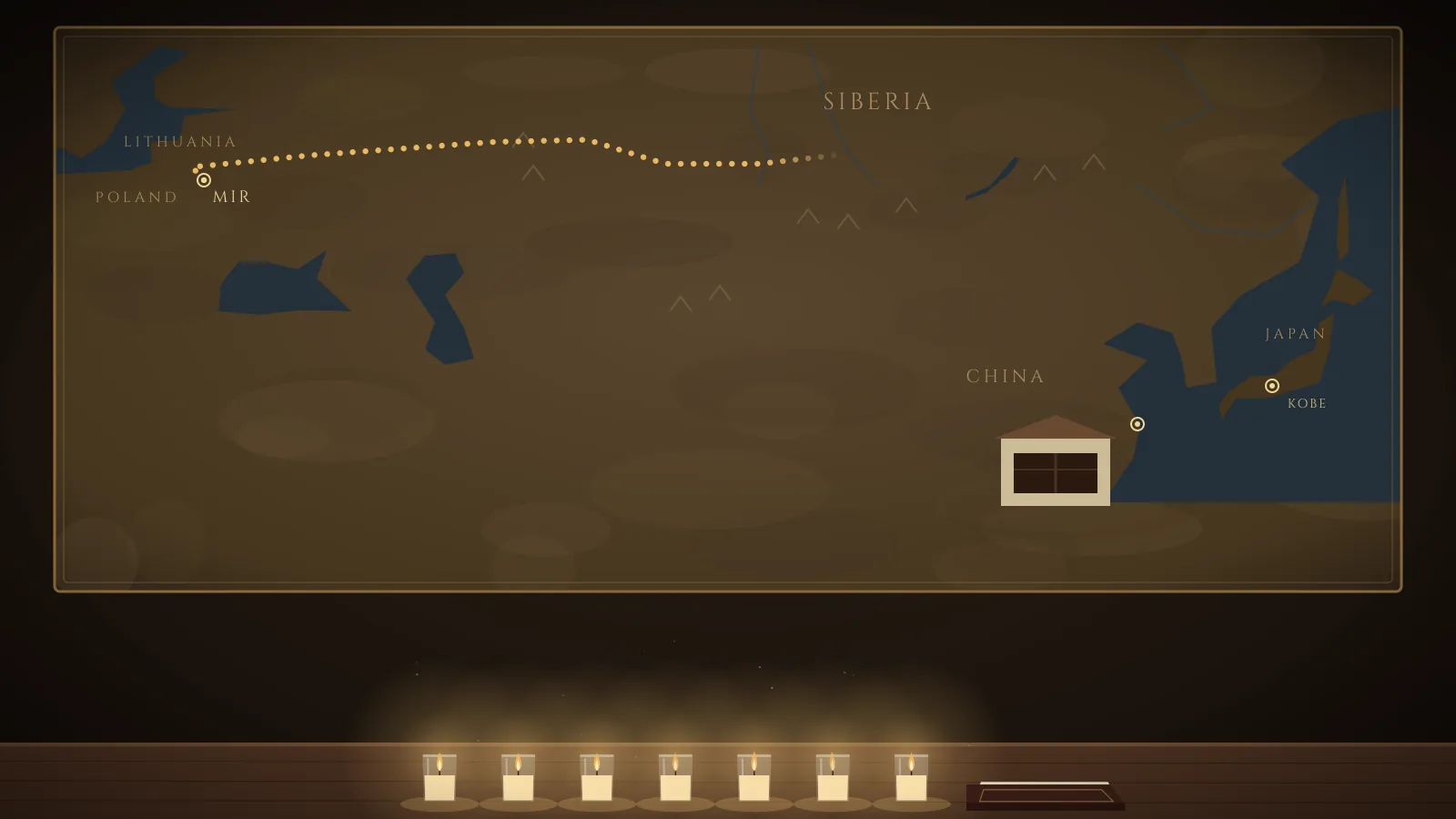
A few escaped. The students of the Mir yeshiva crossed Siberia to Japan with transit visas from the diplomats Sugihara and Zwartendijk, and spent the war in Shanghai, still studying.
To the survivors, it seemed that the world of Torah had almost ended.
Chapter Vwatch from 4:20
Rebuilding
Survivors, and those who had escaped, rebuilt that world from almost nothing: in Jerusalem and Bnei Brak, in Williamsburg and Borough Park in Brooklyn, in Stamford Hill in London, and in Antwerp, Manchester and Montreal.
Bnei Brak, near Tel Aviv, was founded among orchards in 1924 by religious settlers from Poland. The scholar known as the Chazon Ish settled there in 1933, and after the war he guided Haredi society in the new State of Israel.
In 1946 the Grand Rebbe of Satmar, Joel Teitelbaum, reached Brooklyn. In Williamsburg he rebuilt his court, which became one of the largest in the Hasidic world.
The rebuilding succeeded beyond anyone’s hopes. Today’s yeshivas hold more students than those of pre-war Europe ever did.
The Haredi world that grew from these places is not one body. Hasidim follow their rebbes, in courts named after the European towns where their dynasties began, like Belz, Ger and Satmar. The Lithuanian, or Litvish, stream looks to the heads of the great yeshivas. Sephardi Haredim, whose families came from the Middle East and North Africa, rose to prominence under Rabbi Ovadia Yosef, born in Baghdad in 1920. In 1984 their party, Shas, entered Israel’s parliament with four seats.
They share one law, but differ in prayer rite, dress, music and leadership. The cut of a coat or the shape of a hat can show which community a man belongs to.
Chapter VIwatch from 6:00
A Life of Study and Family
For men, the highest ideal is the study of Torah. In the yeshiva, students learn in pairs, a chavruta, arguing aloud over a page of Talmud, until the hall roars with voices. After marriage, many go on to a kollel, a study hall for married men, supported by stipends and their wives’ work.
Haredi women usually run the household and often earn much of its living, as teachers, in offices and increasingly in technology.
Dress is modest for men and women alike: dark suits and hats, long sleeves and long skirts. Married women cover their hair with a scarf or a wig, a sheitel.
Marriages are arranged through a shidduch, an introduction by families or matchmakers, and couples often marry around twenty. Under a canopy beneath the open sky, the groom breaks a glass, remembering the destroyed Temple. Then men and women dance in separate circles, divided by a screen, a mechitza The partition or gallery that separates men and women during prayer in Orthodox synagogues. Glossary. Married life follows the laws of family purity, kept in part through the mikveh, the ritual bath.
Food follows the strictest rules of kashrut The Jewish dietary laws; food that meets them is kosher. Glossary, with meat and milk kept apart, in separate dishes, often under the supervision of the community’s own rabbinical courts.
On Sabbath nights in a Hasidic court, followers crowd onto tiered stands around the rebbe’s table, the tish, singing slow melodies, while the rebbe shares out food from his plate.
Families are large. In Israel, a Haredi woman has on average about six and a half children, and over half the community is under twenty. Many Hasidic families speak Yiddish at home.
Communities keep their own schools, charities and ambulance services. Television is shunned, and the internet allowed only with filters, often on rabbi-approved “kosher” phones.

Chapter VIIwatch from 8:08
Questions for Israel
That growth has made the Haredim a central question in Israel. In 2025, the Israel Democracy Institute counted about 1.45 million Haredim there, some 14 per cent of the population.
As the state was founded, David Ben-Gurion let a few hundred yeshiva students defer army service. Today the deferral covers tens of thousands, and in June 2024 the Supreme Court ruled unanimously that a blanket exemption had no legal basis. Haredi leaders hold that Torah study protects the Jewish people, and that army life would endanger their way of life. Many other Israelis argue that the duty to serve should be shared equally. The debate continues.
The Institute found that about half of Haredi men in Israel are in paid work, little changed in a decade, while Haredi women work almost as often as other Jewish women. In 2023, about a third of Haredi families lived in poverty.
Many Haredi boys’ schools teach few secular subjects. Critics, among them economists, say this leaves men unprepared for work. Haredi educators answer that Torah comes first, and that parents should choose.
The separate roles of men and women are debated too. Critics point to women left out of Haredi newspapers and public life; many Haredi women say they value their roles, and more of them enter modern professions.
There are tensions with other Jews, over the Sabbath in public life, over conversion, and over prayer at the Western Wall. Some groups, like Satmar and the Edah HaChareidit, reject the Zionist state on religious grounds; Haredi parties, both Ashkenazi and Sephardi, have served in many of its governments.
Newcomers who become observant are called baalei teshuvah, returners. Those who leave, sometimes said to be “off the derech”, the path, may lose ties with family. Organisations in New York, Jerusalem and London help them, and the community itself increasingly discusses it.
Chapter VIIIwatch from 10:24
Legend and Record
Legend says the Haredim preserve the old Jewish village unchanged, that none of them work, that all are Hasidim, and that all oppose Israel.
The records show a modern society, rebuilt after the Holocaust and in many ways stricter than the communities it remembers. It is varied in its streams and in its politics. Most Haredi women work, and a large share of men are employed, especially in the United States and Britain. And study, prayer and family still come first.
Back in Mea Shearim, it is Saturday night, and three stars have appeared. A child holds up a braided candle with many wicks, and a blessing, the havdalah, ends the Sabbath. The flame is put out in a little wine. The shops open again, and the week begins. Across the street, in the study hall, the voices go on.