The story of the film
Kagoshima and Nagasaki, the Sotome coast, Urakami, Hirado, Ikitsuki and the Gotō Islands, Japan · 1549–today
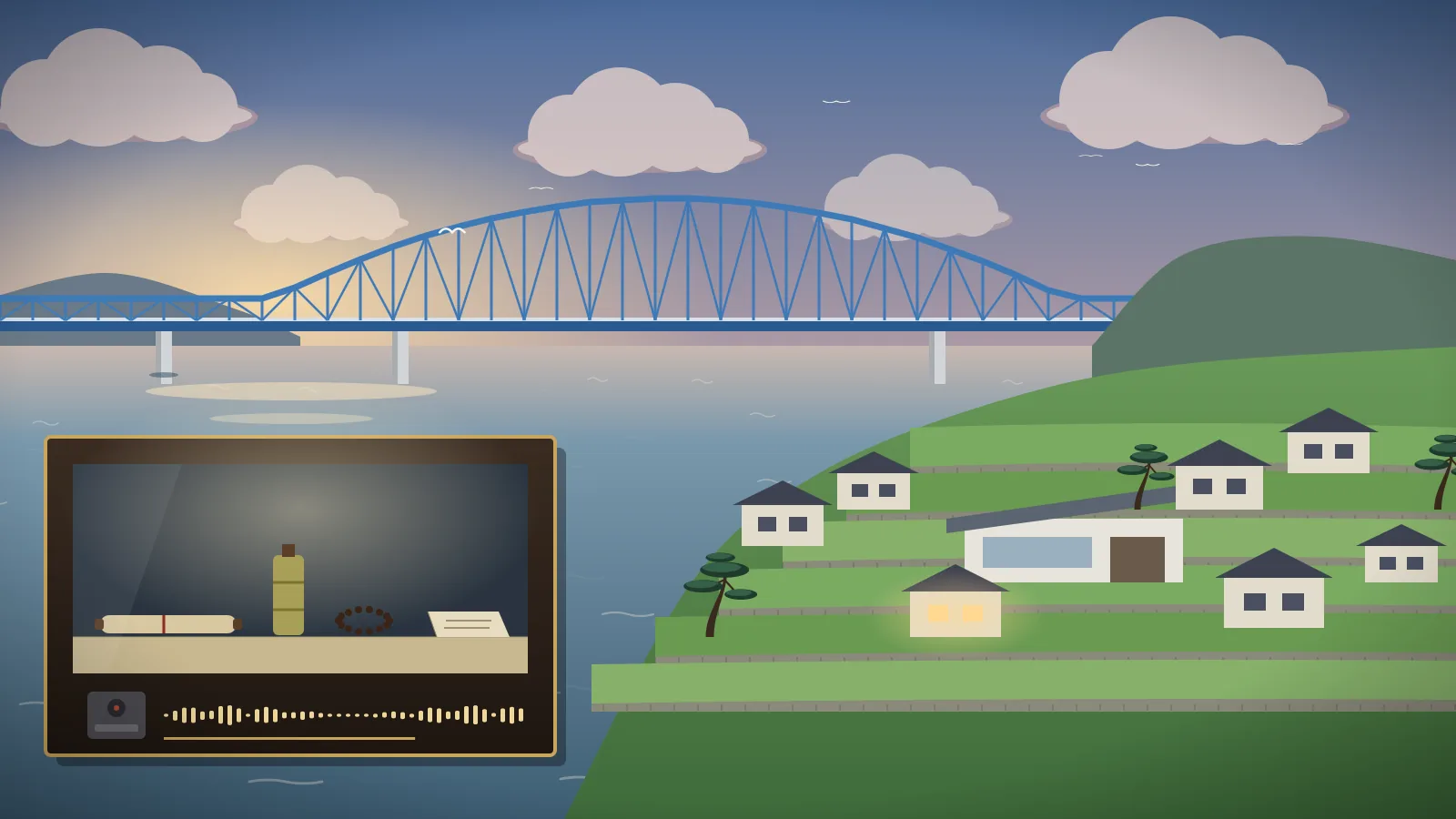
On a winter night on the Sotome coast, north-west of Nagasaki, a farmhouse closes its shutters early. By an old calendar kept in secret, tonight is Otaiya, the great night of Christmas. The family gathers in a back room. No priest will come. None has come for generations. Softly, so that the neighbours cannot hear, they begin prayers in words they no longer fully understand. They are hidden Christians, the Kakure Kirishitan. For some two and a half centuries their faith was a crime in Japan, and they kept it anyway.
Chapter Iwatch from 0:47
Black Ships and Summer Winds
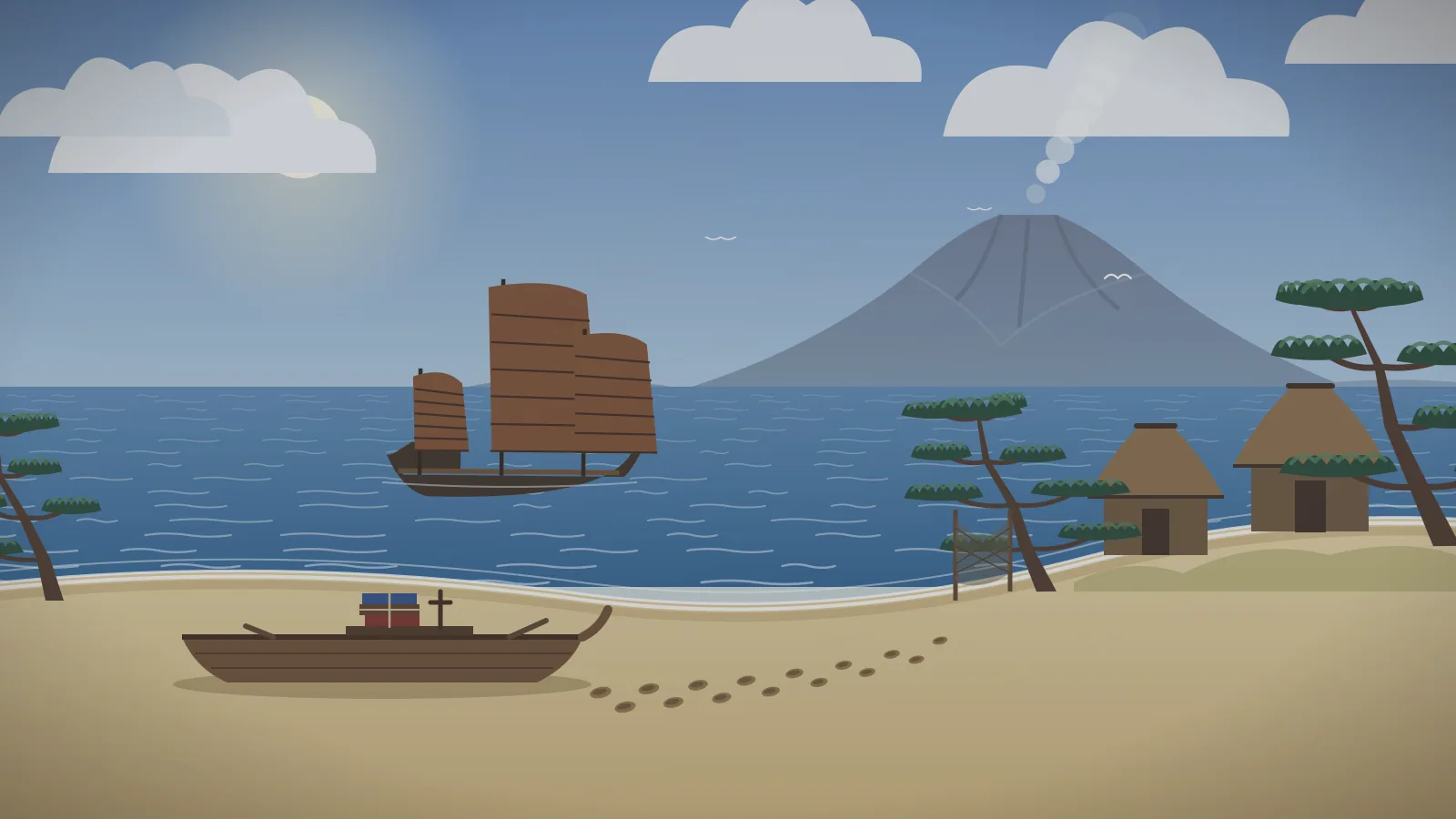
The story begins on 15 August 1549, when the Jesuit missionary Francis Xavier stepped ashore at Kagoshima, in southern Kyushu. He had come on a Chinese junk, and his guide was a Japanese convert, Anjirō.
Japan was then divided among rival warlords. Some of them welcomed the missionaries, partly for their faith, and partly for the Portuguese trade that came with them. Several lords of Kyushu were baptised. In 1580 one of them, Ōmura Sumitada, handed the port of Nagasaki to the Jesuits.
Nagasaki grew into a town of churches and busy wharves. The great Portuguese ships, which the Japanese called the black ships, came in with the summer winds. By the early 1600s, historians estimate, Japan had around 300,000 Christians, most of them in Kyushu.
But as Japan was reunified, its new rulers grew wary of a faith that owed loyalty to a foreign church. In 1587 Toyotomi Hideyoshi ordered the missionaries to leave. At first the order was loosely enforced. Then, on 5 February 1597, twenty-six Christians, most of them Japanese, were put to death on a hill above Nagasaki.
Chapter IIwatch from 2:15
The Ban
In 1614 the shogunate founded by Tokugawa Ieyasu banned Christianity throughout Japan. Missionaries were deported. Churches were pulled down. Believers were ordered to renounce their faith, and many who refused were executed.
In 1637 the peasants of Shimabara and Amakusa rose in revolt, many of them Christians. In the spring of the next year, the rising ended in the ruins of Hara Castle, on its headland above the sea.
The ban grew harsher still. Portuguese ships were barred from Japan in 1639, and in 1644 the last priest known to be at large was captured. From then on, the Christians of Japan were on their own.
Chapter IIIwatch from 3:10
A Country That Watched
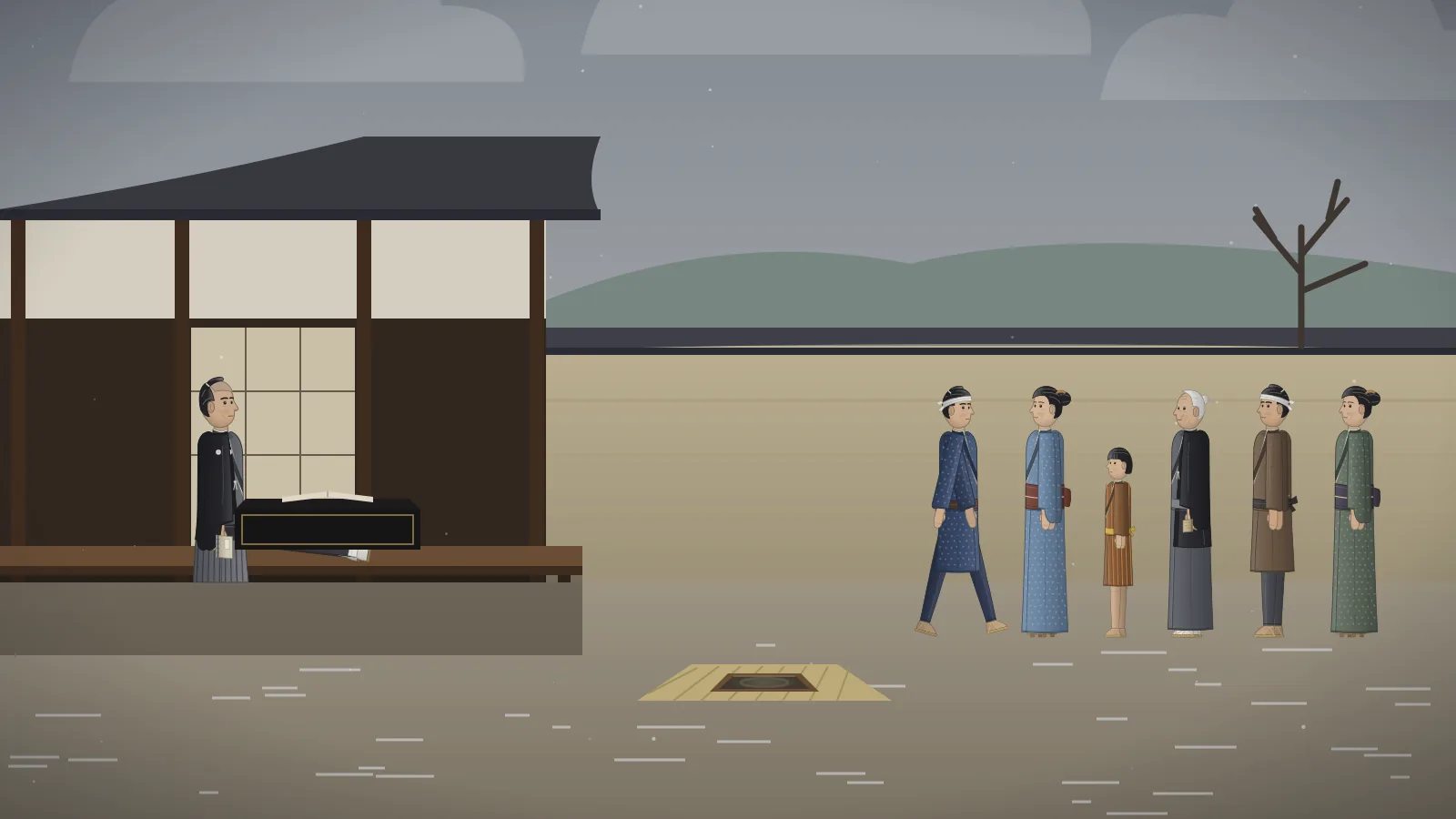
No one could openly be a Christian now. Every household had to register at a Buddhist temple, and the temple vouched that its families were not Christians.
Wooden notice boards stood at crossroads, offering silver to informers. One board, of 1711, promised 500 pieces of silver for reporting a missionary, and smaller sums for reporting other Christians, or anyone who knowingly lived with one.
In Nagasaki, from about 1629, people were made to step on an image of Christ or the Virgin Mary, called a fumie An image of Christ or Mary that people in Edo-period Japan were made to tread on to prove they were not Christians. Glossary. In 1669 the Nagasaki magistrate had twenty brass plaques cast for the purpose. Year after year, families stepped on the worn plaques while officials watched.
Many hidden Christians did step on them, and afterwards, at home, they prayed to be forgiven.
Many hidden Christians did step on them, and afterwards, at home, they prayed to be forgiven. The guilt of that yearly step was part of their faith for generations.
Chapter IVwatch from 3:59
Villages Without Priests
Yet in villages around Nagasaki, at Urakami, along the Sotome coast, and on the islands of Hirado and Ikitsuki, families went on handing down the faith in secret.
Without priests, they kept only what lay people could do. Baptism, which any Christian may give, became the central rite. Each community chose its officers: a baptiser who poured the water, a leader who recited the prayers, and a keeper of the calendar.
The calendar keeper worked out the dates of Christmas, of Easter, and of the fasts, so that each feast could be kept on its proper night. In Sotome the calendar is linked with Bastian, a Japanese catechist of the 1650s, who taught in the villages of that coast.
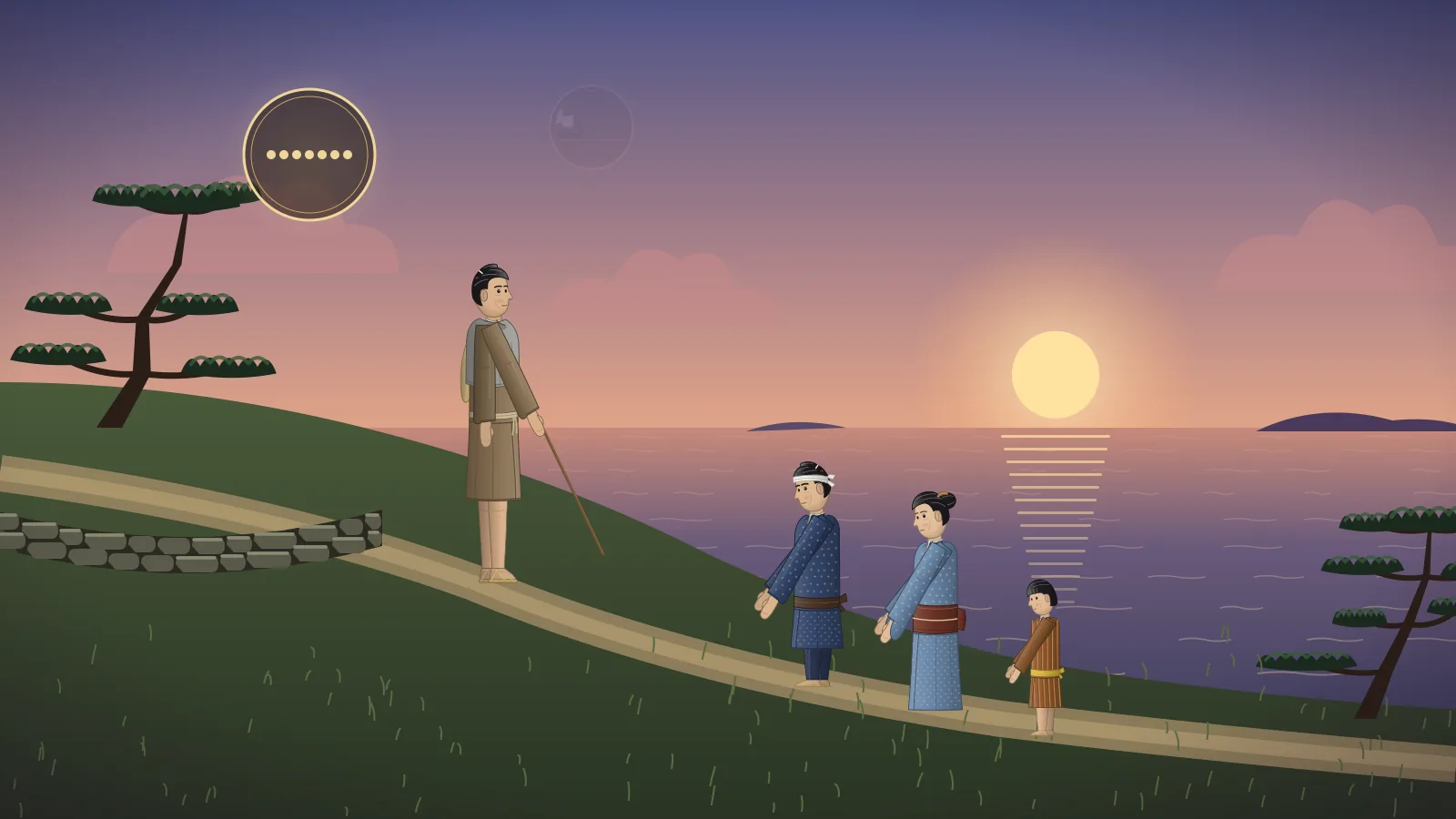
Tradition remembers four prophecies of Bastian. For seven generations, his people would suffer. Then priests would come by black ship, and hear their confessions. Christians would sing their prayers aloud. And on the road, others would step aside to let them pass.
The prophecies live in local memory, not in records of the time. But they gave the villages something to wait for, and they were passed down along with the calendar itself.
Chapter Vwatch from 5:12
Prayers, Images and Closet Gods
Prayers were learned by heart. They were called orasho, from the Latin oratio, and they mixed Japanese with Latin and Portuguese words. Over the generations their meaning blurred. On Ikitsuki, “Ave Maria” became “Abe Maruya”. The words were treasured as sacred sounds, passed from mouth to ear.
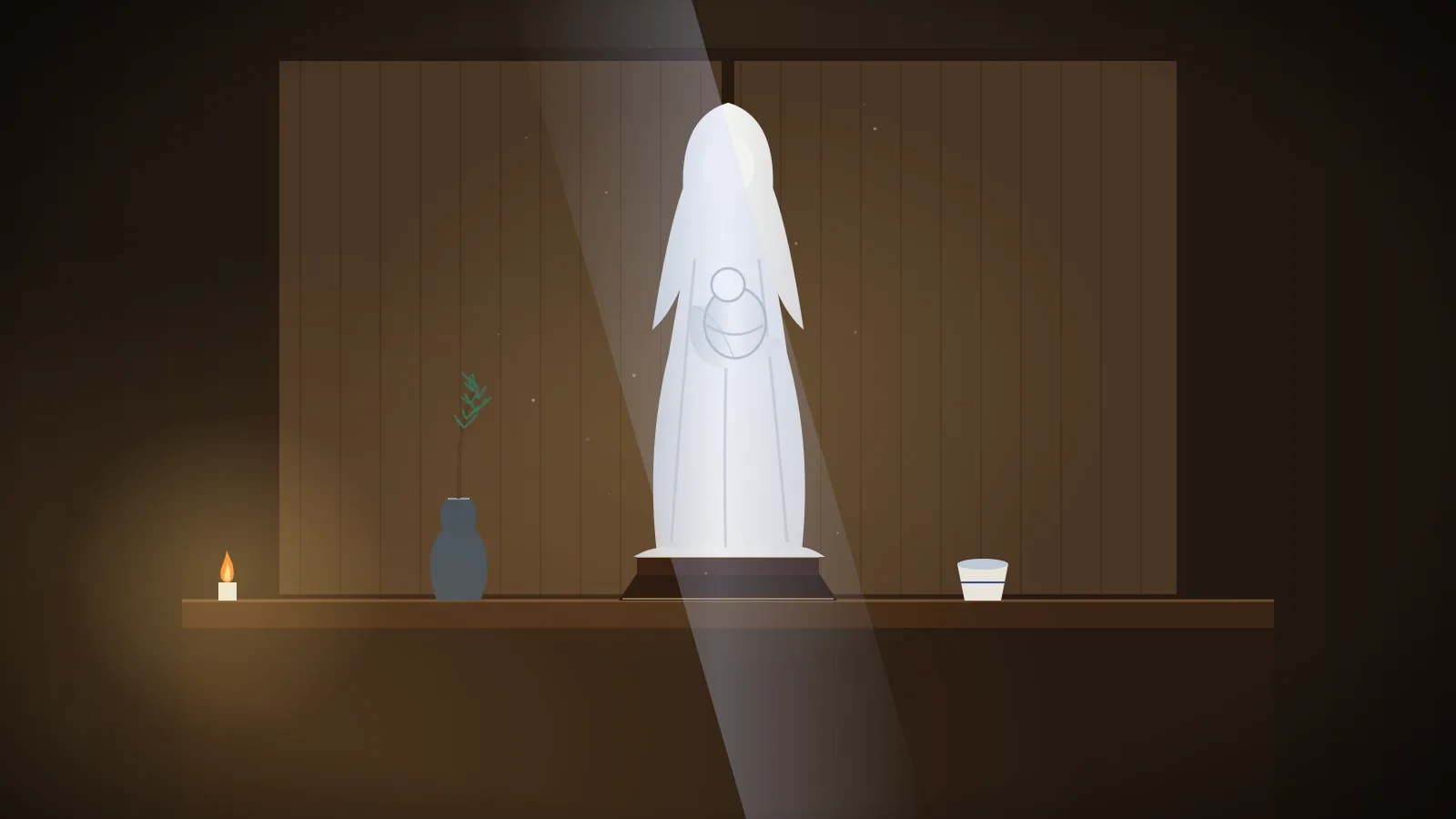
Holy images had to be hidden. White porcelain figures of the Buddhist Kannon holding a child were venerated as the Virgin Mary. Today they are called Maria Kannon. Many were ordinary statues made in China.
What made them Christian was the faith of those who prayed before them.
What made them Christian was the faith of those who prayed before them.
On Ikitsuki, painted scrolls and holy objects were kept in closets, behind plain sliding doors. They were called nando-gami, the closet gods. When the doors slid shut, the room looked like any other.
Outwardly, the hidden Christians lived as Buddhists. They took part in temple funerals and rites, and quietly added their own prayers. Some communities kept a scripture called Tenchi Hajimari no Koto, “The Beginning of Heaven and Earth”. It retold biblical history, from the Creation onward, in a Japanese setting.
In 1797 the lords of Ōmura and Gotō agreed to move farmers from crowded Sotome to the Gotō Islands. Many of those who sailed were hidden Christians. They settled on steep, poor land at the edges of older villages, and took their calendar, their prayers and their memory of Bastian with them.
Chapter VIwatch from 6:57
The Day at Ōura
In the 1850s, after more than two centuries of near isolation, Japan opened its ports to the Western powers, and foreigners in Nagasaki were allowed their own churches.
French priests of the Paris Foreign Missions Society had a small wooden church built at Ōura, on a hillside above the harbour, with three slim octagonal towers. It was meant for the foreigners of the port, and it was dedicated on 19 February 1865.
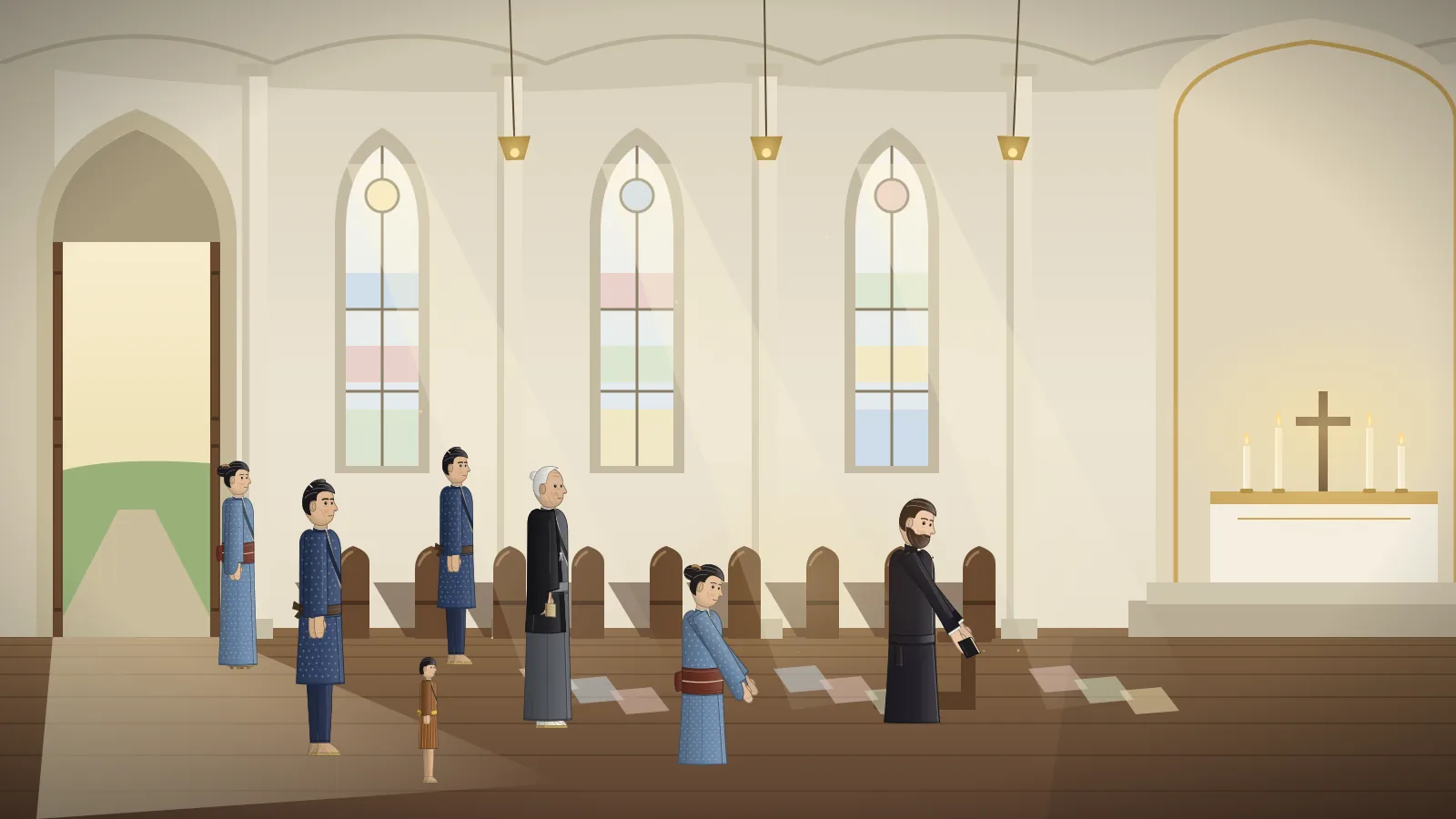
Less than a month later, on 17 March, a group of villagers from nearby Urakami came to the church, and Father Bernard Petitjean let them in. As he knelt in prayer, a woman of the group came close. According to the priests’ accounts, she told him that their hearts were the same as his.
Then they asked where the statue of Santa Maria stood. He led them to it. After some two hundred and fifty years, the hidden Christians had found the Church of their ancestors again.
Many remembered Bastian’s prophecy of priests arriving by black ship. Word spread quietly from village to village, and thousands of hidden Christians made themselves known.
Chapter VIIwatch from 8:13
Exile and Return
But the ban was still in force. In 1867 Urakami families refused Buddhist funerals for their dead, and the authorities began to arrest them.
The new Meiji government went further. From 1868, about 3,400 Urakami Christians were sent into exile in distant domains. More than six hundred died there.
Western governments protested. In 1873 the public notices banning Christianity came down, and the exiles came home.
Many hidden Christians now joined the Catholic Church. In Urakami, the returned families spent thirty years building a great cathedral of brick and stone. In 1945 the atomic bomb dropped on Nagasaki left it in ruins. It has since been rebuilt.
Chapter VIIIwatch from 9:11
Those Who Stayed Apart
Others chose a different path. For them, the prayers and objects of their ancestors were the faith itself. To give them up for the priests’ religion would betray those who had kept them through persecution. So they stayed apart, and they are often called Kakure, or Hanare Kirishitan.
In the twentieth century their numbers fell steeply, as young people moved to the cities and the long chain of oral teaching broke. On Ikitsuki and in a few other places, small groups still keep the old rites, and local museums have recorded their prayers.
In 2018 UNESCO listed twelve Hidden Christian sites of the Nagasaki region as World Heritage, from the ruins of Hara Castle to Ōura Church.
It is often said that the hidden Christians preserved the Catholicism of the sixteenth century unchanged. Scholars such as Christal Whelan and Stephen Turnbull show something else. Over two and a half centuries, their faith grew into a religion of its own, shaped by Buddhist and Japanese folk practice, and by the ancestors who had kept it alive.
On the Sotome coast, a winter morning comes, and the shutters open. The night’s prayers are over, said as softly as ever. Most of those who prayed left no name in any record. What survived them was a whisper, handed from parent to child, one Christmas night at a time.