The story of the film
Nasu, Kyoto, Edo (Tokyo) and the Japanese countryside · 8th century to 2022
In March 2022, on a volcanic hillside at Nasu, north of Tokyo, steam drifted over grey rocks that smelled of sulphur. Among them lay a great dark boulder, bound with a thick straw rope. For centuries, people had called it the Sesshō-seki: the killing stone.
That month, visitors found it broken in two, the sacred rope lying loose on the ground beside it. According to legend, the stone held the spirit of a nine-tailed fox.
Chapter Iwatch from 0:39
The Fox at the Edge of the Fields
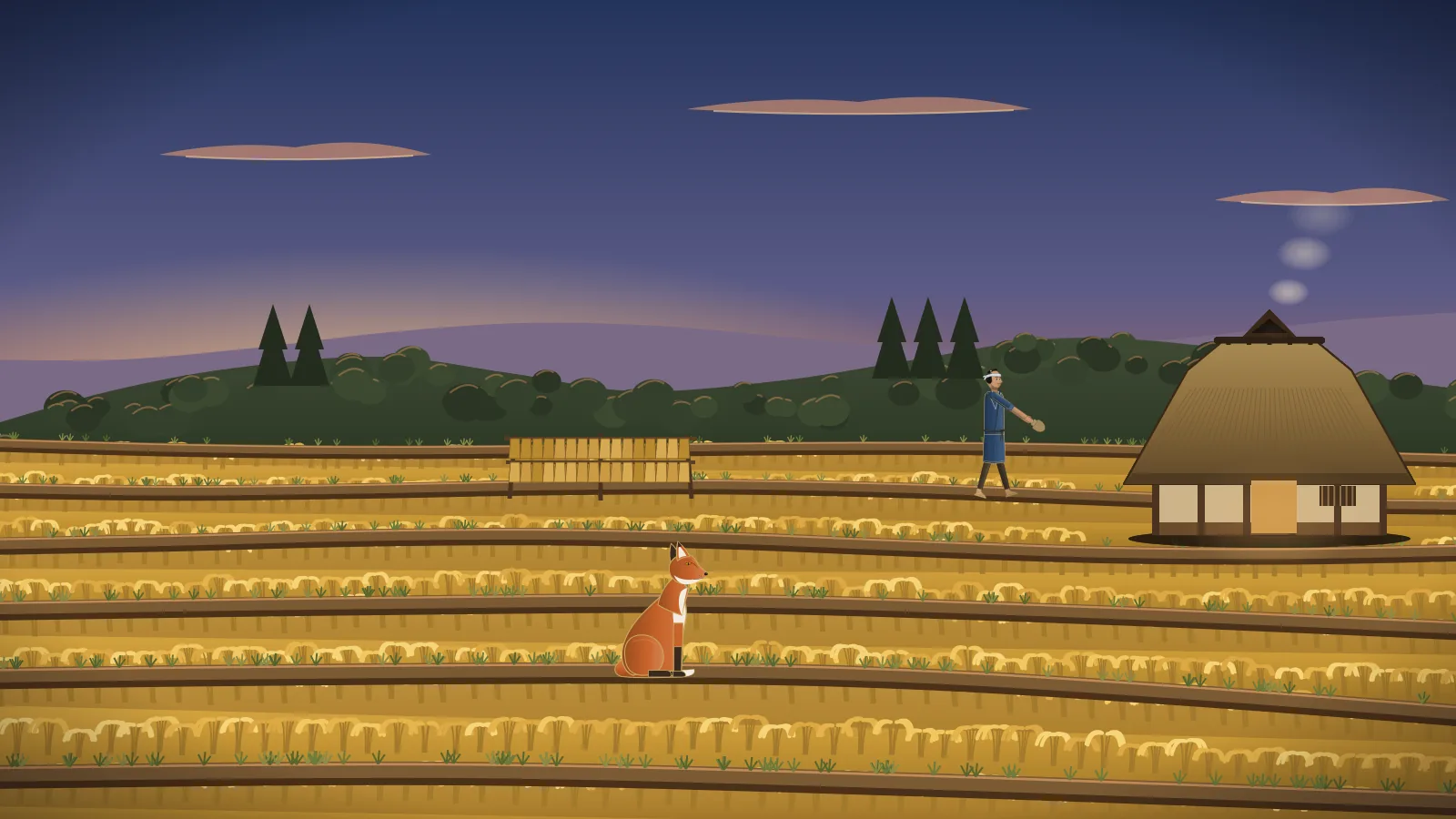
To understand that fox, the story begins with an ordinary one. The red fox lives all across Japan, and for centuries it was the farmer’s neighbour. It came out at dusk, slipping along the edges of the rice fields. It hunted the mice that ate the harvest, and at night it cried with a strange, high voice.
Guardian of the rice, and creature of the dark: that double nature, many historians think, helps to explain everything that followed.
Guardian of the rice, and creature of the dark.
Japan also inherited stories from China, where fox spirits were already old. An ancient book of wonders told of foxes with nine tails. A 4th-century book said that a fox of 50 could become a woman, at 100 a beautiful one, and at 1,000 years it rose to heaven. Later storytellers added that the older a fox, the stronger it was, and the more tails it grew, until it had nine.
The oldest known Japanese fox tale comes from the Nihon Ryōiki, a collection of Buddhist tales from the early 800s. A man in Mino province met a beautiful woman in a field, and married her. She bore him a son. But the family dog barked at her, again and again. One day, frightened, she turned into a fox and leapt onto the hedge.
Because they shared a child, her husband asked her to come back and sleep beside him. Come and sleep: kitsu-ne. That, says the tale, is why the fox is called kitsune. It is a folk explanation, not true word history. But it set a pattern that would last for centuries: the fox wife who loves her family, and must leave when she is found out.
Chapter IIwatch from 2:33
The Messengers of Inari
The fox’s most honoured role is tied to a mountain in southern Kyoto. According to shrine tradition, the kami Inari was first worshipped there in 711.
A legend tells of Hata no Irogu, who shot his arrows at a rice cake. The cake became a white bird and flew away to the mountain. Where it came to rest, rice grew. Rice growing is ine nari in Japanese, and the tale links those words to the name Inari, kami of rice, and later of prosperity.
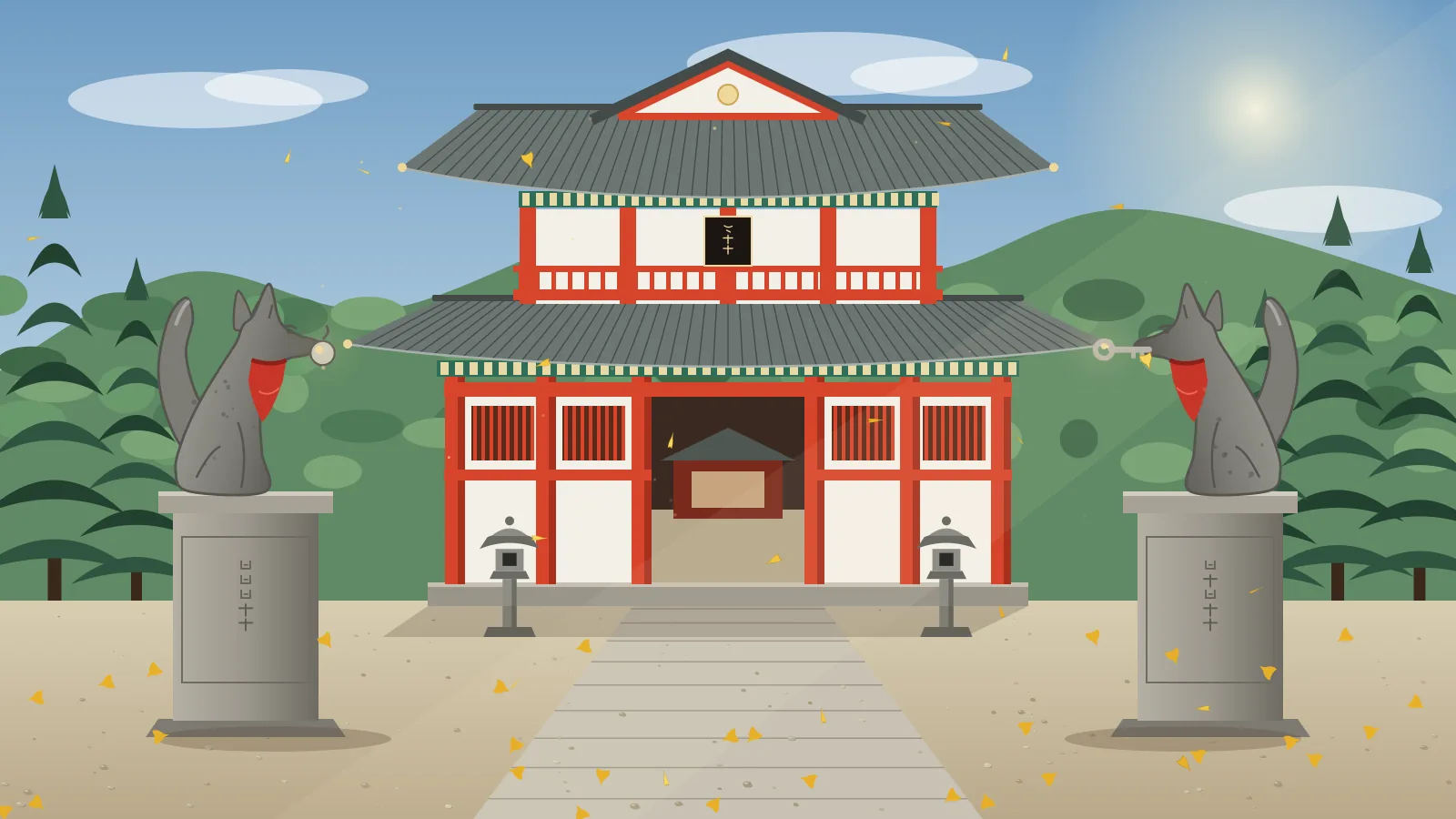
Today that place is Fushimi Inari Taisha, head of some 30,000 Inari shrines. About 10,000 vermilion torii climb its slopes, the gifts of families and businesses.
About 10,000 vermilion torii climb its slopes.
At the gates sit pairs of stone foxes. One often holds a jewel, the other a key, said to be the key to the rice store. In Shinto teaching, the foxes are messengers of the kami, not Inari itself. In popular devotion, the two have often blurred together.
Worshippers left fried tofu, said to be the foxes’ favourite food. Buddhists honoured Inari too, linking the deity with Dakiniten, who rides a white fox. By the Edo period, little Inari shrines stood beside fields, in shops and on rooftops, almost everywhere.
Chapter IIIwatch from 4:07
Fox Fires in the Dark
Not every fox served the kami. Wild foxes, folklore said, loved to trick people, and around 1100 a court scholar recorded their mischief in Kyoto. Foxes could take human shape, conjure phantom houses and feasts, and light ghostly flames in the dark: kitsunebi, fox fire.
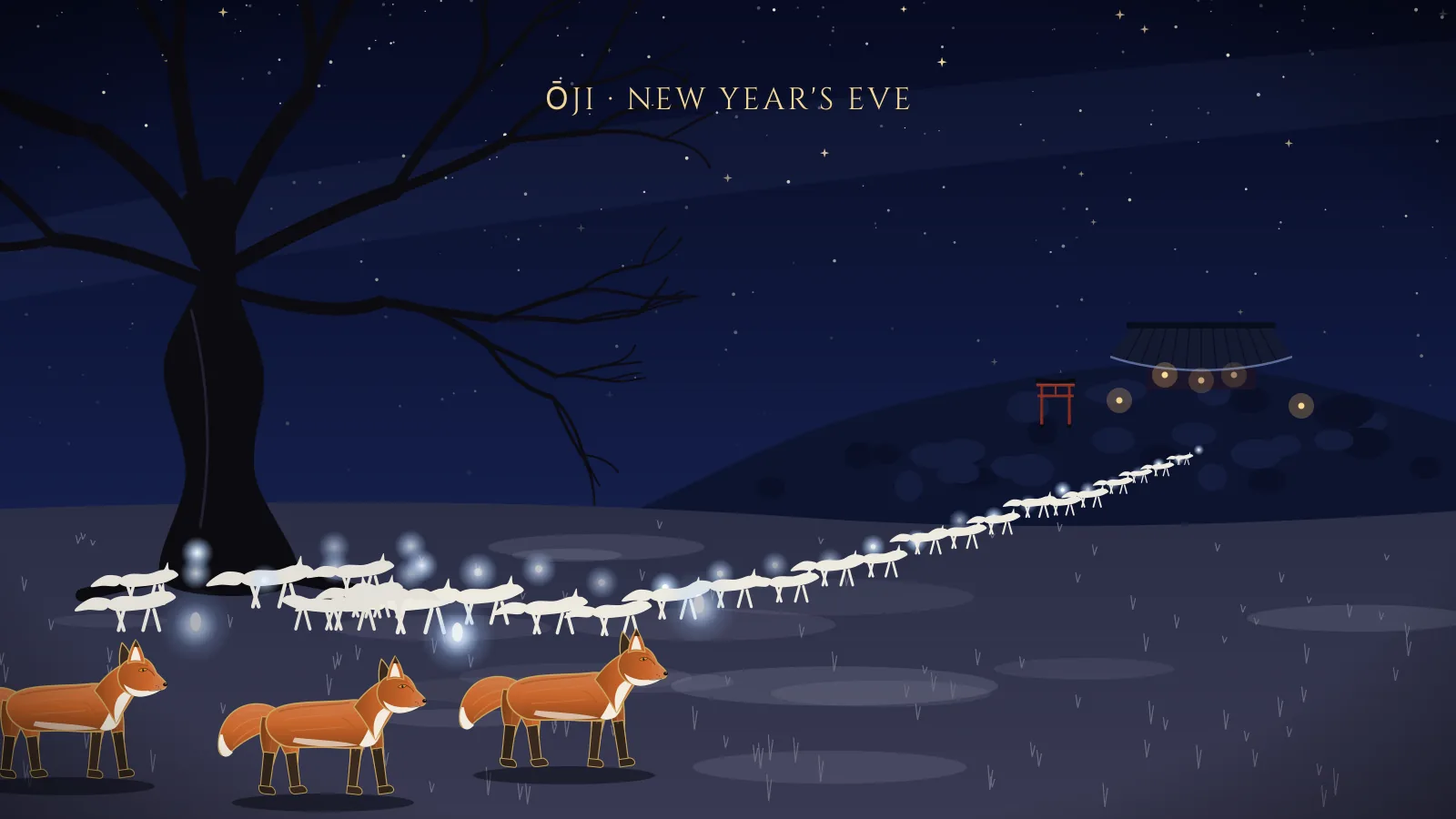
At Ōji, outside Edo, foxes were said to gather at a great tree on New Year’s Eve. Farmers read the coming harvest in their fires. In 1857 the artist Hiroshige printed that night: dozens of foxes beneath a bare tree, each with a small flame.
Farmers read the coming harvest in their fires.
Even the weather belonged to them. When rain fell from a sunny sky, people said that a fox’s wedding was passing by.
Chapter IVwatch from 5:01
The White Fox of Shinoda
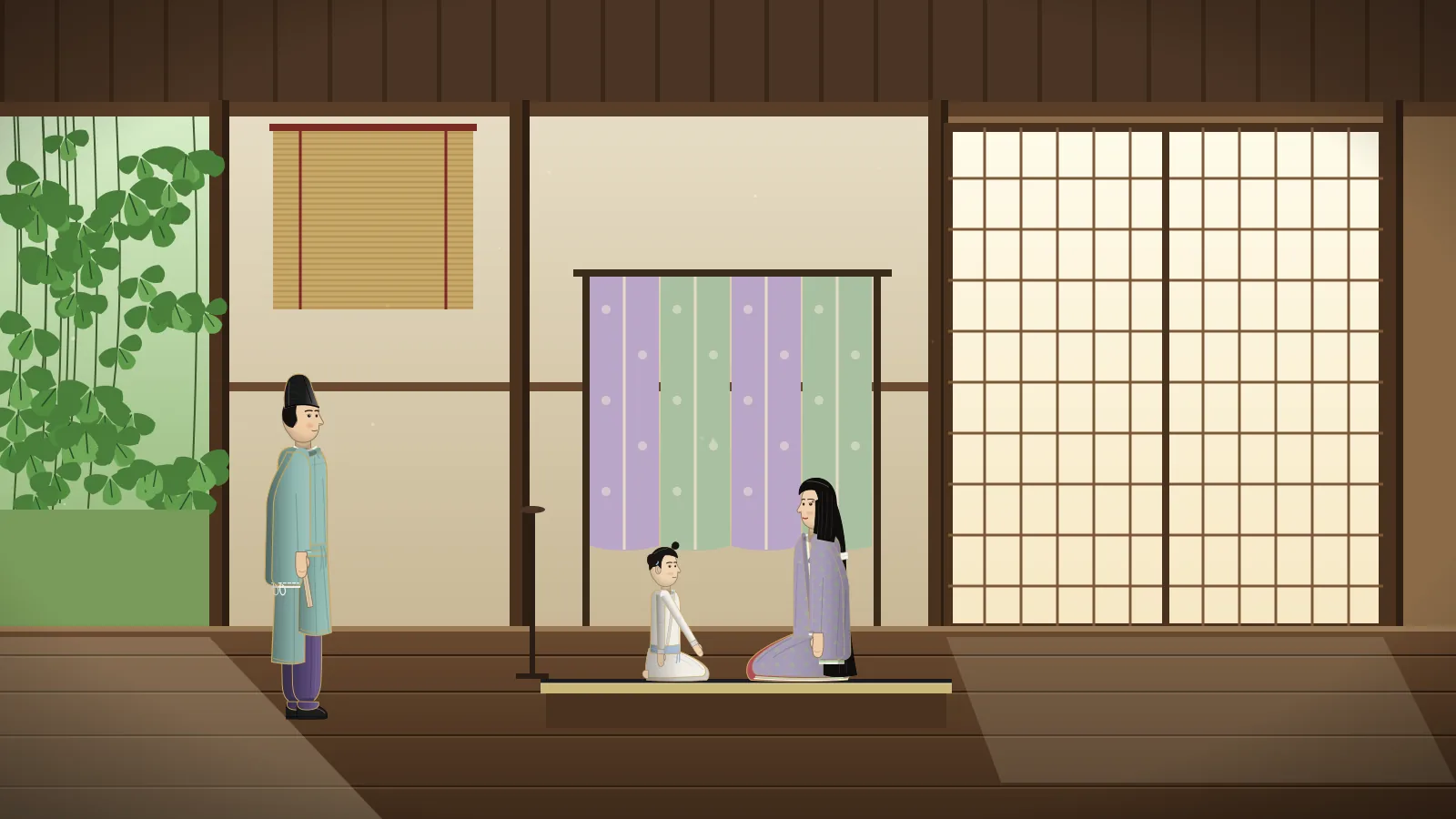
Some foxes were loving. In the forest of Shinoda, the story goes, a young nobleman named Abe no Yasuna saved a white fox from hunters. Soon after, a woman called Kuzunoha came into his life. They married, and she bore him a son. It was the old pattern of the Mino tale once more: a fox wife, a child, and a secret that could not be kept for ever.
When her secret was discovered, she had to leave. Before she went, she wrote a poem on the paper screen of the house: if you long for me, come and seek me in the forest of Shinoda.
If you long for me, come and seek me in the forest of Shinoda.
A puppet play of 1734 made the tale famous. On stage, as she writes, her hands turn back into paws, and she finishes the poem with the brush held in her mouth.
Her son, the legend says, became Abe no Seimei, the most famous diviner of the Heian court. Seimei was a real man. His fox mother belongs to legend.
Chapter Vwatch from 6:00
The Lady and the Killing Stone
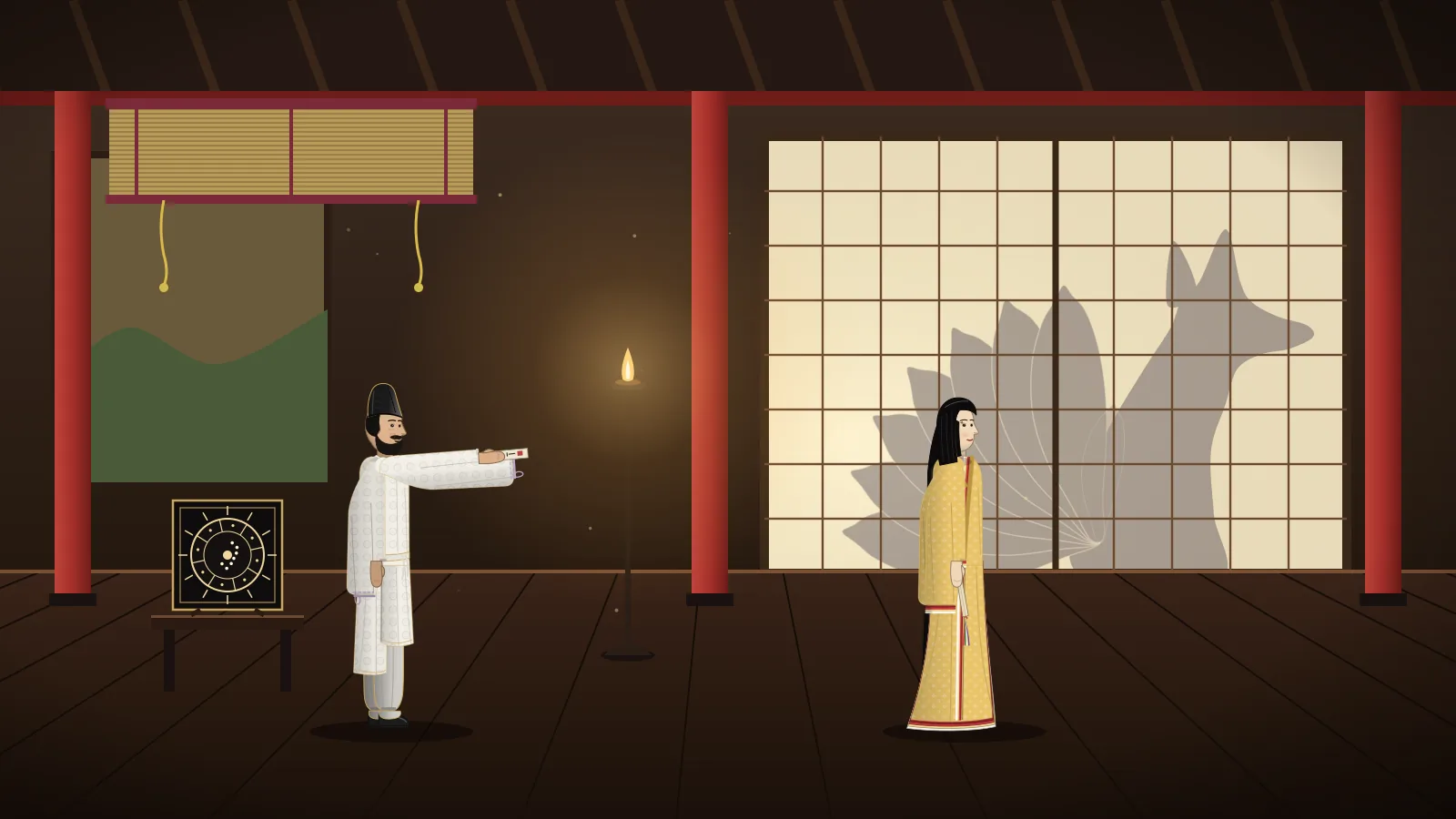
The most famous fox was not loving. In a legend that took shape in the 14th and 15th centuries, a beautiful woman appeared at the court of the retired emperor Toba. Her name was Tamamo-no-Mae. She could answer any question, it was said, and the emperor favoured her. Then he fell mysteriously ill.
A court diviner, Abe no Yasunari, declared that she was a fox, one who had already ruined rulers in India and China. Unmasked, she fled east, to the wide plain of Nasu. Warriors rode after her, and there, the story says, the fox was struck down.
But her spirit passed into a rock that killed every living thing that touched it. By the Edo period, storytellers had given her nine tails. In later versions, and in a Noh play, a Zen monk named Gennō broke the rock and brought her spirit peace. One piece, people said, stayed at Nasu, and that was the stone that later travellers came to see, bound with its rope among the steaming rocks.
Her spirit passed into a rock that killed every living thing that touched it.
In 1689 the poet Bashō came to see it. Poisonous vapour still rose there, he wrote, and dead bees and butterflies lay so thick that they hid the sand. Many now think the answer lies in volcanic gases seeping from the hillside, which can kill insects and small animals.
Chapter VIwatch from 7:31
A Burden, Not a Story
Fear of foxes could also hurt real people. Folk belief told of kitsunetsuki, possession by a fox, when a person, often a young woman, was said to act strangely. Families called on priests and mountain ascetics to drive the fox out.
Some households were even said to keep foxes that harmed their neighbours. These families, the kitsunemochi, could be shunned for generations, and found it hard to marry. For them, the belief was not a story. It was a burden.
For them, the belief was not a story. It was a burden.
From the late 1800s, doctors began to describe fox possession as an illness of the mind. Slowly the belief faded, though its stigma lasted much longer, and the families who had carried it were not quickly freed from it.
Chapter VIIwatch from 8:24
Foxes of Today
Today the fox is mostly a friend. Millions visit Fushimi Inari each year, and many buy small wooden plaques shaped like a fox’s face, to draw on and to write a wish. Udon topped with sweet fried tofu is called kitsune udon. Rice in tofu pouches is inari-zushi, named after the same offering.
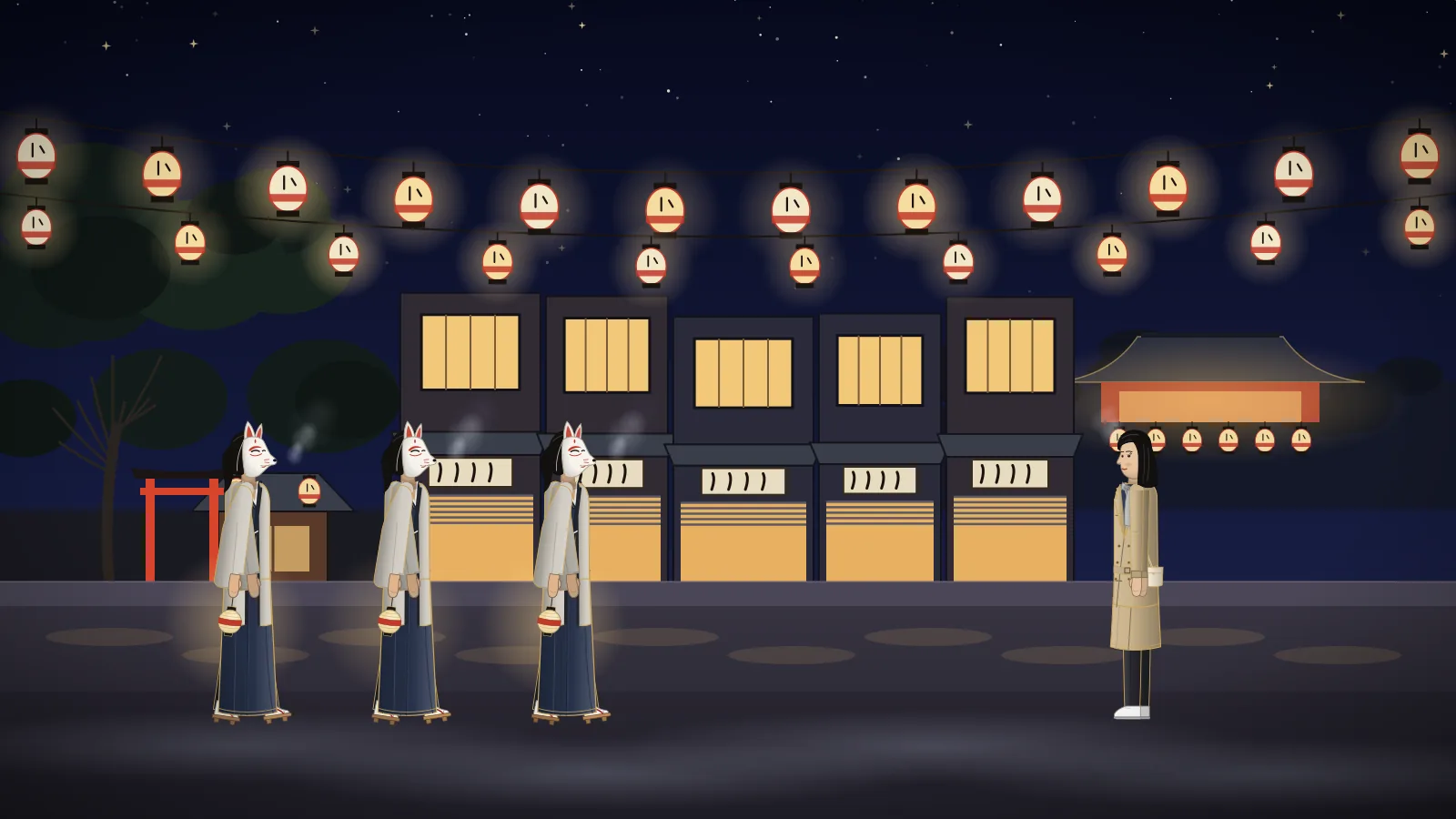
At Ōji, since 1993, people in fox masks have walked to the shrine at midnight on New Year’s Eve, like the foxes in Hiroshige’s print. And across the world, nine-tailed foxes run through manga, anime and games, mixing Japanese, Chinese and Korean traditions.
People in fox masks have walked to the shrine at midnight on New Year’s Eve.
As for the stone, it had been cracked for years, and water had probably seeped in. On 26 March 2022, a local priest held a ceremony to calm the fox’s spirit. He waved a wand of white paper streamers over the two halves, and a single drum sounded across the hillside.
In Japan, the fox was never simply good or evil. It was a clever neighbour at the edge of the fields, living between the human world and the world of the kami.
On the hill at Nasu, the killing stone still lies in two halves, wrapped in steam. The priest’s rite had been offered for the fox of the legend. And at dusk, by a field somewhere, an ordinary fox slips into the grass, just as it did when the farmers first watched it hunting at the edge of the rice.