The story of the film
Mount Gerizim and Nablus, Samaria, Damascus and Cairo, Jaffa, Holon and Kiryat Luza · 8th century BCE–today
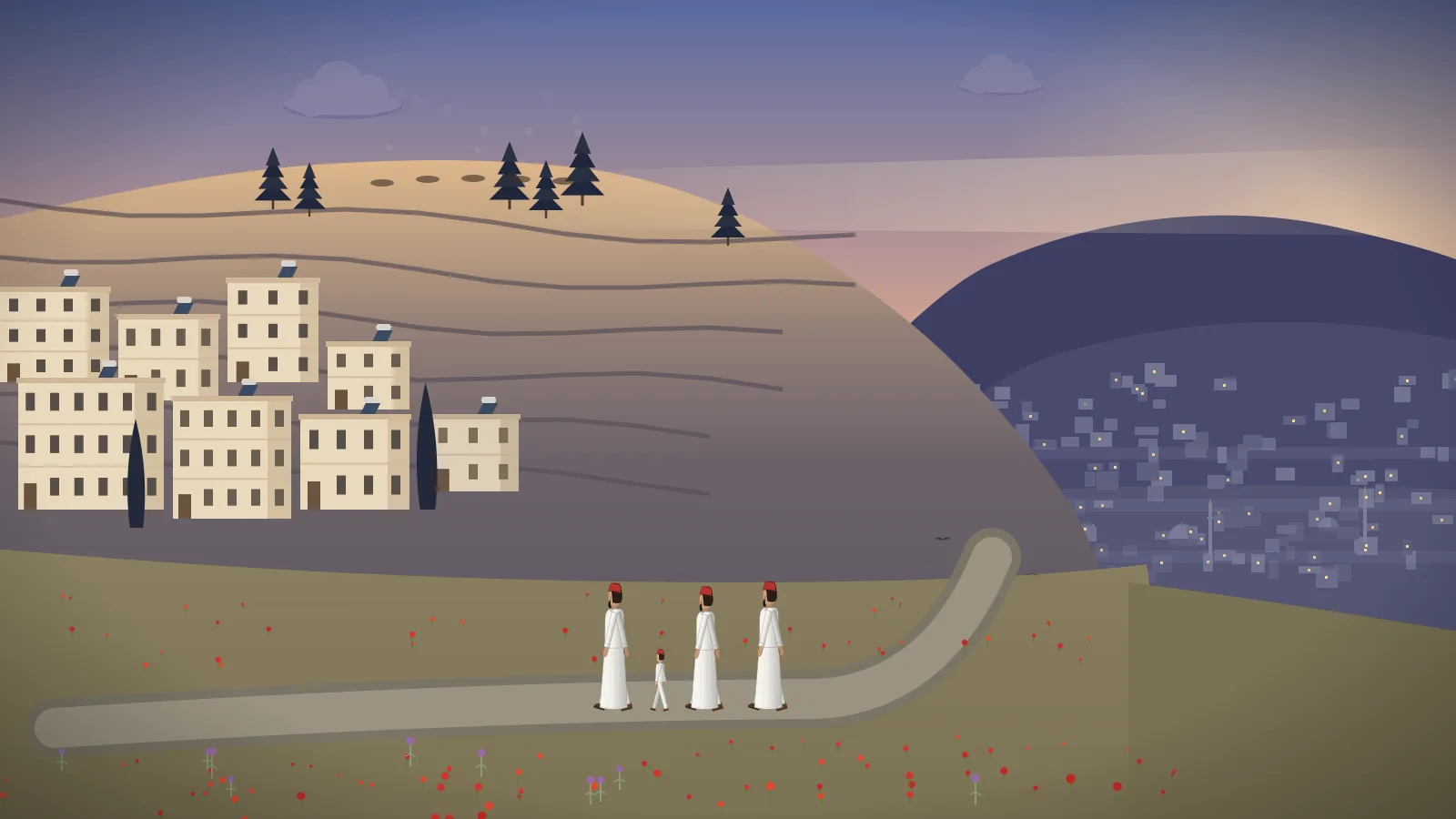
It is the eve of Passover on Mount Gerizim, above the city of Nablus. On the slope stands Kiryat Luza, a small village of white stone houses, and today the whole village is outdoors. Families walk up the road to an open field near the summit, men and boys dressed in white. Many have come from Holon, near Tel Aviv, to stand with their relatives on the mountain. As the sun goes down, under the direction of the high priest, the lambs are sacrificed, as the book of Exodus commands, and smoke rises from fire pits dug in the ground. For one night the whole people is together in one place, and it is a good place to begin its story.
Chapter Iwatch from 0:41
The Keepers
They call themselves Shamerim, the keepers, for they believe they have kept the law of Moses faithfully since ancient times. Today they number about nine hundred, half on this mountain and half in Holon.
The Samaritans are not Jews, and they say so firmly. They are Israelites of their own tradition, with their own Torah, their own priests and their own holy mountain. Scholars such as Reinhard Pummer treat them as a separate branch of the Israelite tradition. Jews and Samaritans grew from the same ancient root, and they share Moses, the Sabbath and the laws of the Torah. But they are two branches, and they have been apart for more than two thousand years.
Samaritan faith rests on five principles: one God; Moses, his only prophet; the Torah, his law; Mount Gerizim, his chosen place; and a day of judgement and reward. They accept no other books of the Hebrew Bible, neither the prophets nor the later writings, and they have no part in the rabbinic tradition of the Talmud The great collection of rabbinic law and discussion, completed around 500–600 CE, studied alongside the Bible. Glossary. And they await the Taheb, a restorer like Moses, who will come at the end of days.
Chapter IIwatch from 1:54
Between Two Mountains
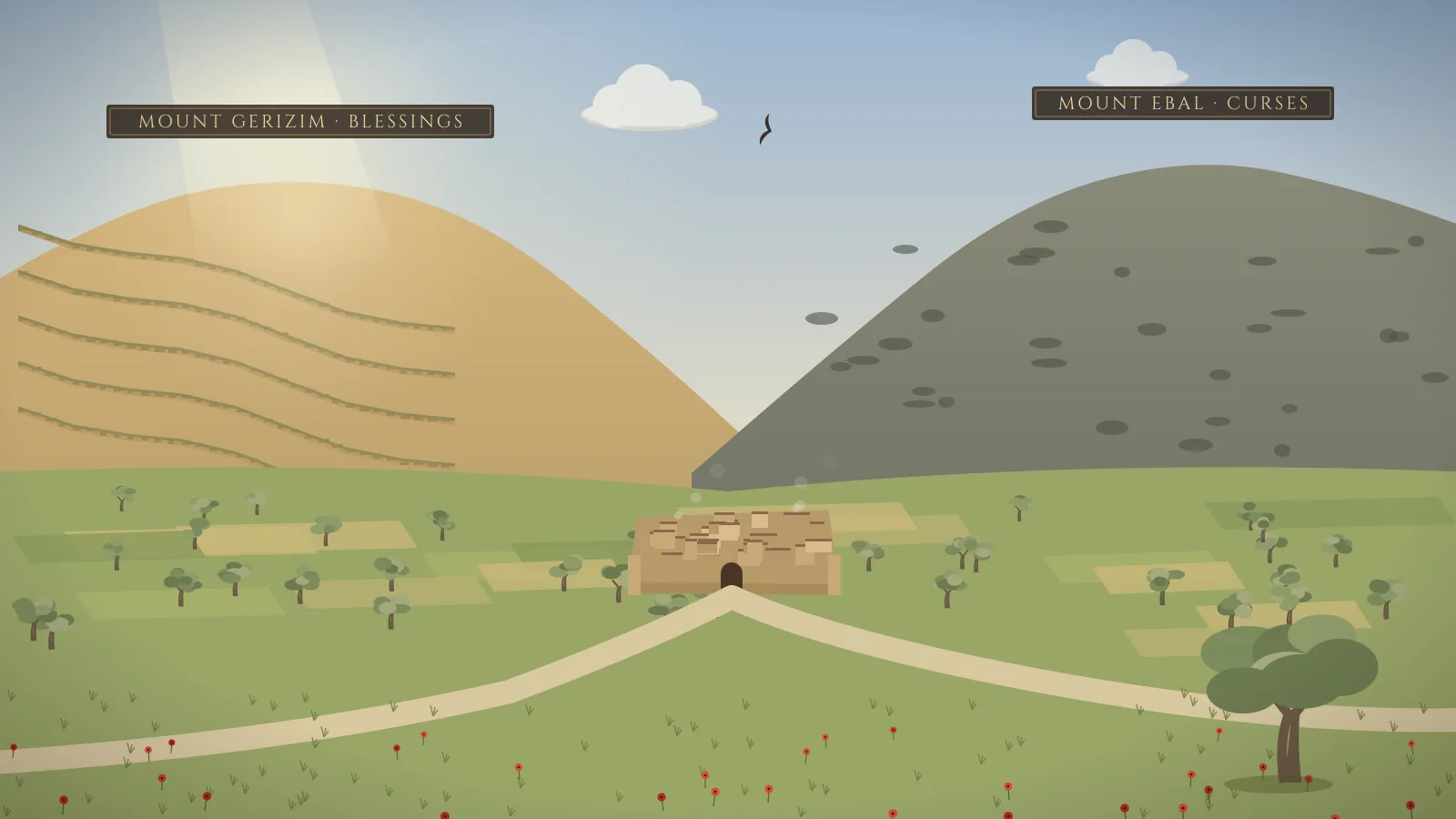
Their story begins in the valley of Shechem, between two mountains. In the book of Deuteronomy, the blessings were proclaimed from Gerizim, and the curses from Mount Ebal across the valley. To the Samaritans, Gerizim has been the true sanctuary of Israel ever since.
In their own account, they descend from the northern tribes of Ephraim and Manasseh, and from priests of the tribe of Levi, who never left the land. In their view the split did not begin with them, but with the priest Eli, who moved the sanctuary to Shiloh, and later with the Jews who chose Jerusalem instead.
In 722 BCE Assyria conquered the northern kingdom of Israel and its capital, Samaria, and carried part of its people away. What came next is told in two ways.
The Second Book of Kings tells that foreigners were settled in the place of the exiles. Later Jewish writers called the Samaritans Kutim, after Cuthah, one of the cities those settlers came from.
Modern historians, such as Gary Knoppers and Magnar Kartveit, mostly see it differently. The Samaritans, they find, descend largely from northern Israelites who stayed, and the parting from the Jews came slowly, over centuries.
Chapter IIIwatch from 2:57
The Temple on Gerizim
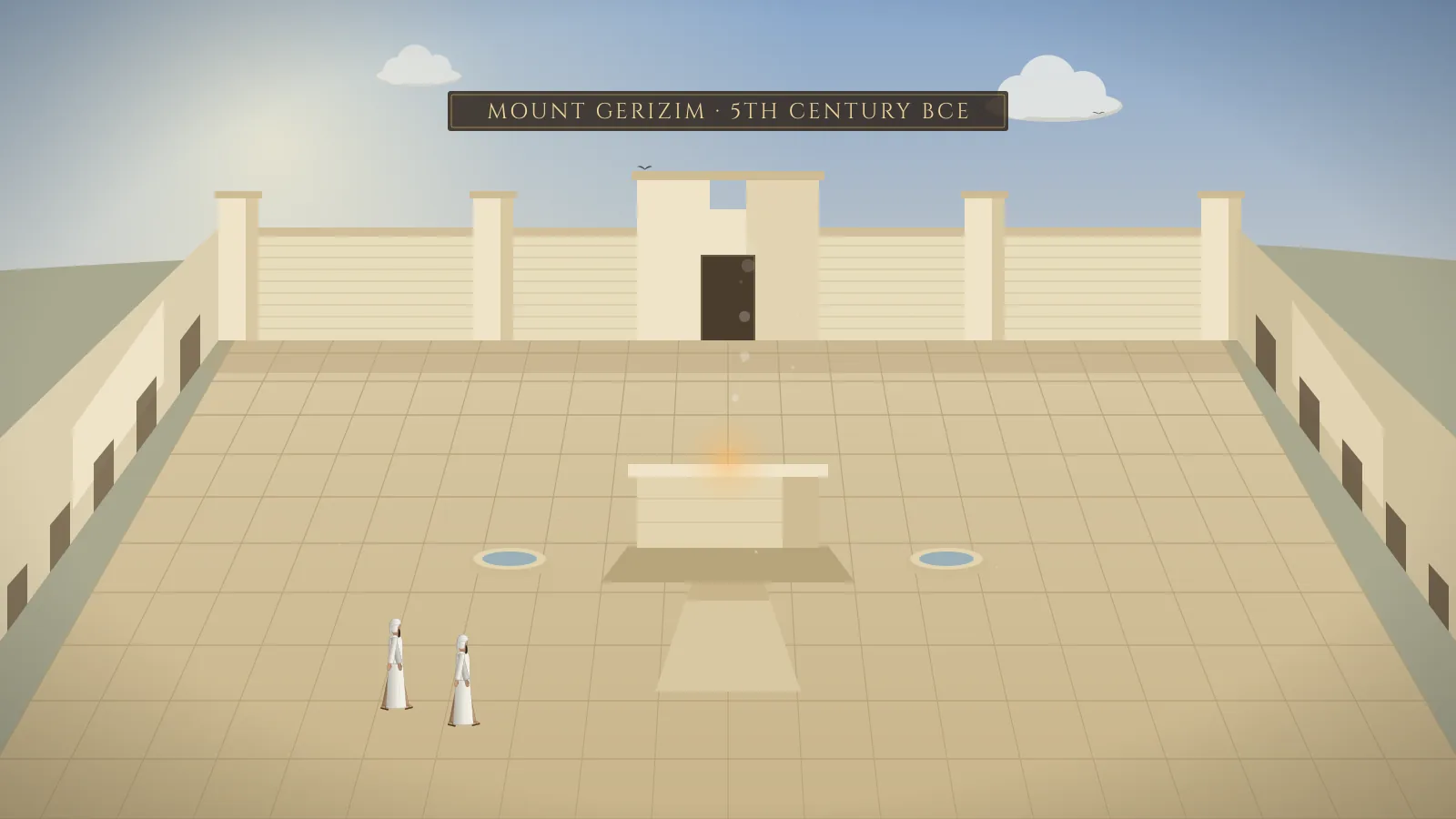
On the summit of Gerizim, Israeli archaeologists uncovered a sacred precinct and a temple, with strong walls and gates around a broad courtyard and an altar. They date it back to the fifth century BCE, under Persian rule, though some scholars argue for a later date for its first phase.
In the late second century BCE, the Judean ruler John Hyrcanus destroyed it. The break between the two peoples grew deeper, and it never fully healed.
By the time of the Gospels, Jews and Samaritans often kept apart. The point of Jesus’s parable of the Good Samaritan, in the Gospel of Luke, a stranger who stops to help a wounded traveller, rests on that old hostility. Through that story, the name of this small people became, in many languages, a word for kindness to strangers.
Chapter IVwatch from 3:45
Hard Centuries
In late antiquity the Samaritans were a sizeable people, with towns and villages across the land and communities in Egypt and Syria. Their leader Baba Rabba, of the third or fourth century, is remembered for reorganising the priesthood and the synagogues.
In the fourth century the poet Marqah wrote hymns and a great commentary, the Tibat Marqe. His words are still sung in Samaritan prayer.
Then came hard centuries. In 484 the Samaritans rose against the Christian Byzantine Empire, and the revolt was crushed. After it, the emperor Zeno had a church to Mary built on the summit of Gerizim, and the Samaritans were barred from their own holy mountain. A greater revolt, in 529, ended with great loss of life.
Under later rulers, many Samaritans became Christians or Muslims. Small congregations lived on for centuries in Damascus and Cairo, while the heart of the people stayed in Nablus, at the foot of the mountain.
The community kept its own memory. In 1355 the chronicler Abu’l-Fath gathered its history into a book in Arabic, by then the everyday language of the Samaritans.
Chapter Vwatch from 5:08
The Scroll and the Priests
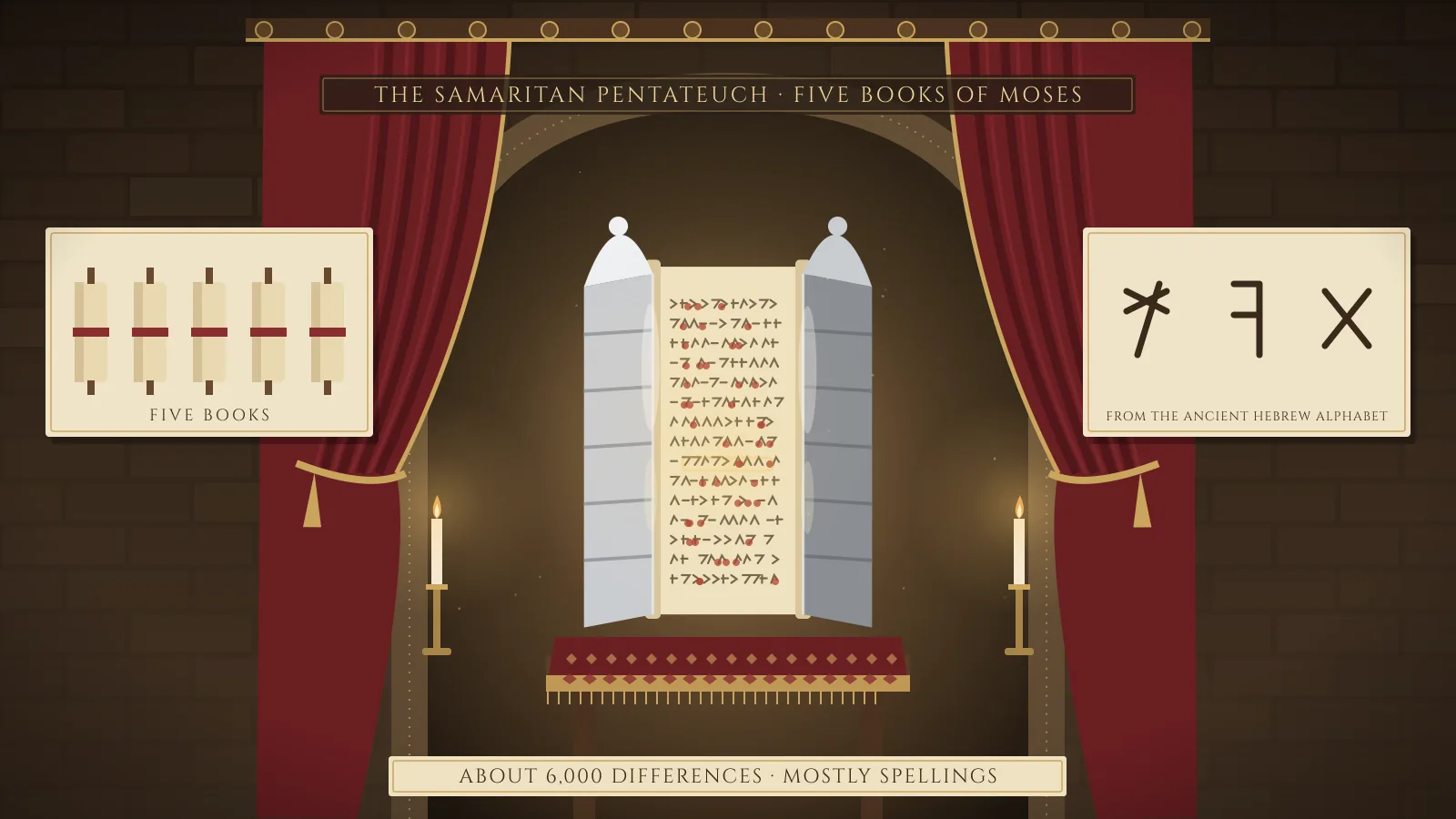
Their greatest treasure is the Samaritan Pentateuch, the five books of Moses, written in a script that descends from the ancient Hebrew alphabet, the one used before the Jewish return from Babylon.
It differs from the Jewish text in about six thousand places, most of them small spellings. The most important difference names Gerizim as the place for the altar.
For a long time scholars dismissed it as a corrupted copy. Then the Dead Sea Scrolls were found in the caves of Qumran, and showed that many of its readings go back to an older form of the Hebrew Bible.
The community treasures the Abisha scroll, which it holds was written by Abisha, a great-grandson of Aaron. Scholars who have studied it date it to the Middle Ages. To all, it is a precious and very old manuscript.
At the head of the people stands the high priest, the eldest of the priestly family, who serves for life. He keeps the calendar, interprets the law and leads the festivals. Until 1624 the high priests traced their line from Aaron’s son Eleazar. When that line died out, the office passed to priests descended from his brother Itamar, and it has stayed with them since.
Chapter VIwatch from 6:30
Near Vanishing
By 1917, war, conversion and hardship had brought the Samaritans to their lowest point: about one hundred and forty-six people, most of them in the old town of Nablus. Few peoples have come so close to vanishing, and lived on.
The twentieth century brought recovery. Some families had settled in Jaffa, and in the mid-1950s a Samaritan neighbourhood was founded in Holon, near Tel Aviv, with support from Israeli scholars and officials.
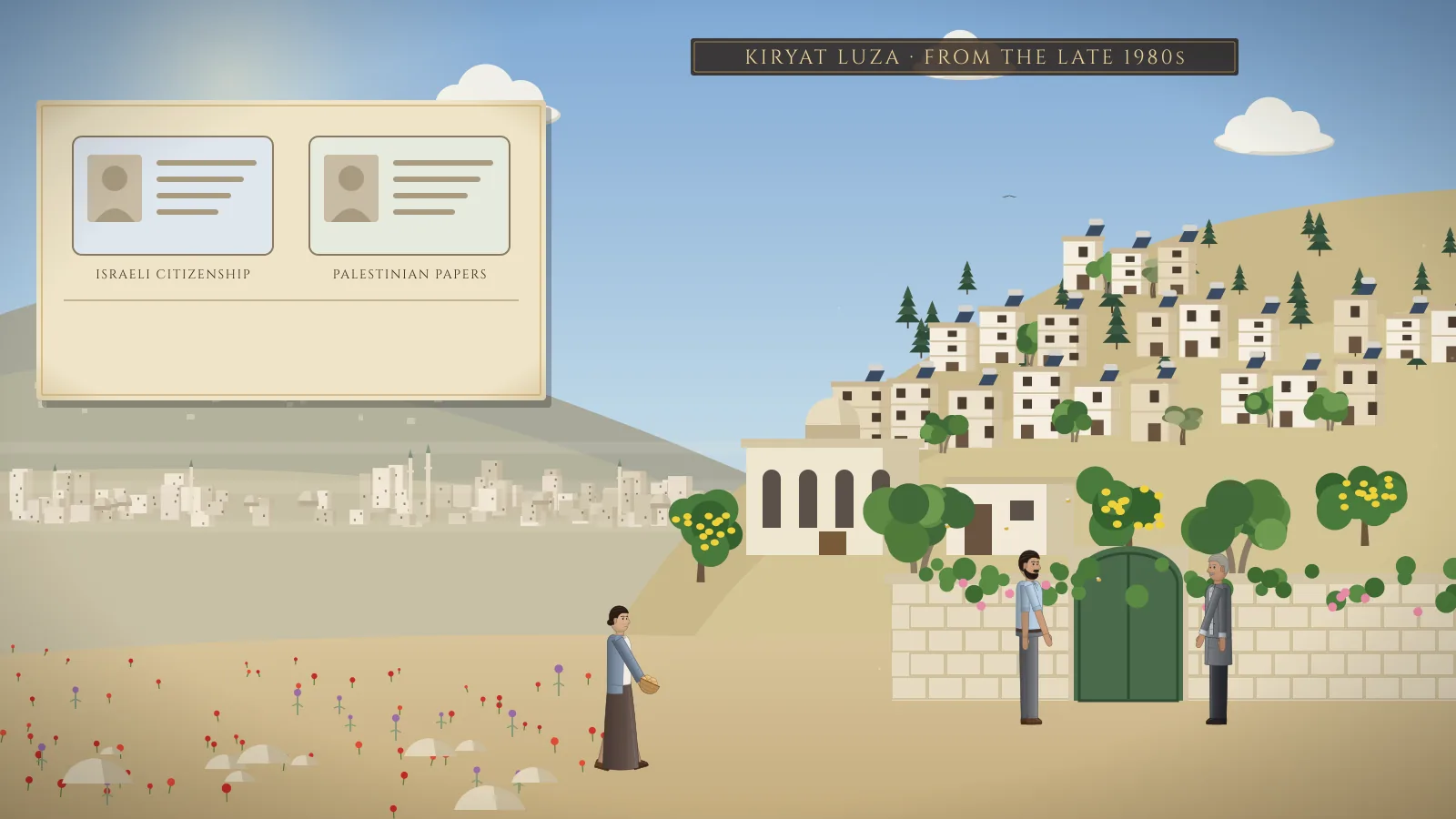
From the late 1980s, the Nablus families moved up the mountain to their own village, Kiryat Luza, in the West Bank, close to the holy places.
Most Samaritans hold Israeli citizenship, and those on Gerizim also carry Palestinian papers. Living across one of the region’s sharpest divides, they keep friendly ties on both sides. At Passover in 2025, one of their priests described the community in a few words:
A bridge of love and peace between peoples.
At home, families on the mountain mostly speak Arabic, and families in Holon mostly speak Hebrew. In prayer, all of them use Samaritan Hebrew and Aramaic, and the two communities meet for every festival.
Chapter VIIwatch from 7:52
The Samaritan Year
The Sabbath is kept with great strictness. No fire is lit and no one travels. On Friday evening and Saturday morning, men pray in long white robes in the synagogue, and families spend the day in prayer, rest and study.
The Samaritans keep only the festivals of the Torah, by their own calendar, so they often fall on different days from the Jewish ones. At Sukkot, each family builds its booth inside the house, under a ceiling of citrons, pomegranates and grapes hung on a frame.
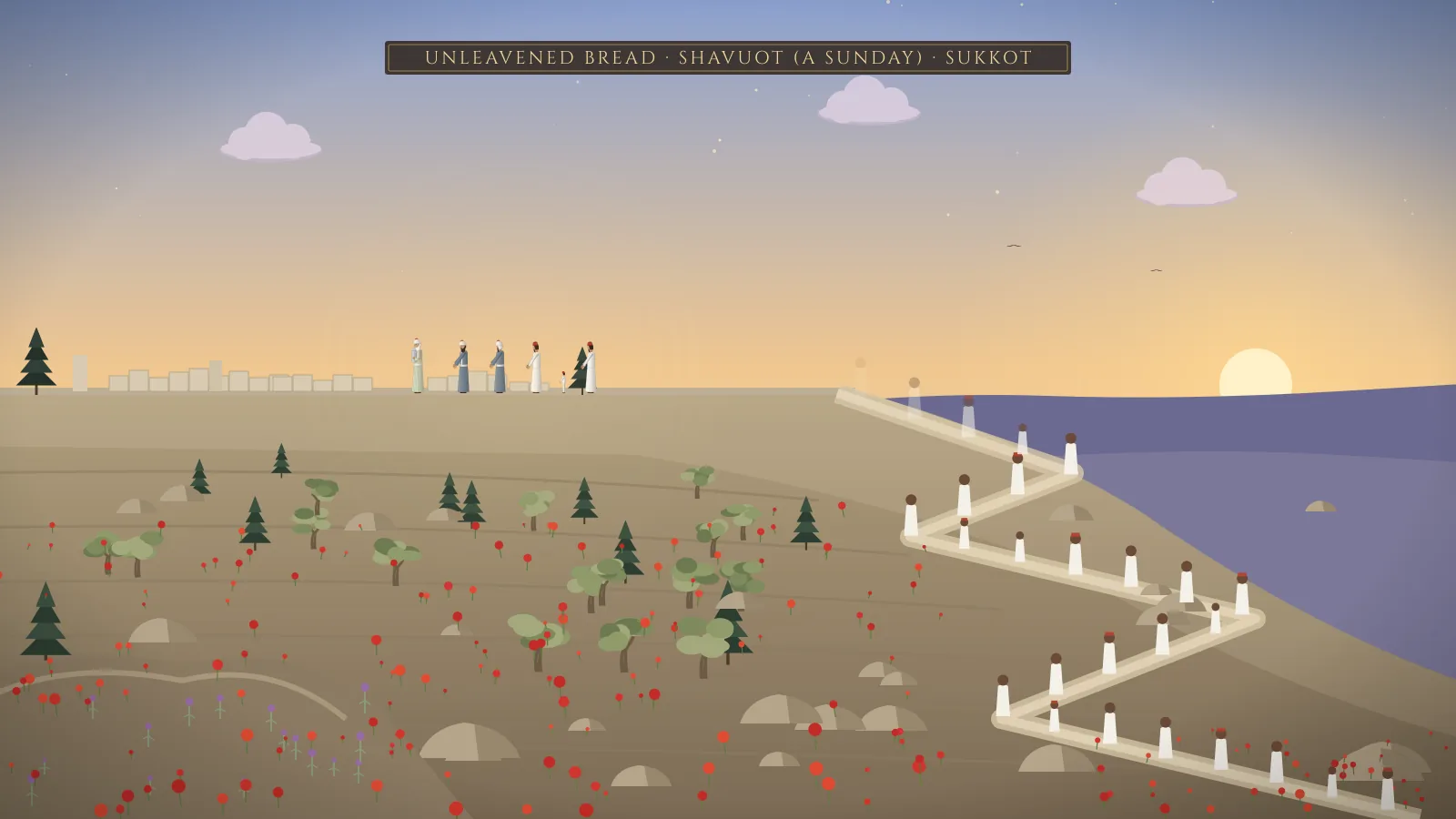
Three times a year they climb to the summit in procession at dawn: at the Feast of Unleavened Bread, at Shavuot, which by their count always falls on a Sunday, and at Sukkot. At the holy places, they read from the Torah.
So small a people faces real challenges. Marriage within the community has raised concerns about inherited illness, and in recent decades some Samaritan men have married women from Ukraine, Russia, Azerbaijan and elsewhere, who embraced the faith. Biblical purity laws are still kept closely. And the community is growing again, proud to be among the smallest and oldest peoples in the world.
And every spring comes the night of Passover. On the mountain the lambs roast whole for hours in the pits, and after dark they are eaten in haste, with unleavened bread and bitter herbs, as Exodus describes, while the people sing and pray. Seven days of unleavened bread follow. Visitors come from across Israel and the West Bank to watch from the edge. But for the Samaritans it is above all a family night, when the whole people stands together on the holy mountain.
Chapter VIIIwatch from 9:39
What the Records Show
It is often said that the Samaritans are a Jewish sect, descended from foreign settlers, and keeping a corrupted copy of the Torah.
The records show an Israelite people of its own, descended largely from the north; a Torah whose readings are often very old; and a community that fell to fewer than one hundred and fifty, and grew back.
Before sunrise, the fires on Gerizim burn low. The meal is over, and whatever remains is burned before morning, as the law commands. Below, Nablus wakes. On the slope, the white houses of Kiryat Luza catch the first light, and the keepers of the Law walk home.