The story of the film
Devon, Exeter, London and Bedford · 1750–1927
Somewhere in or near the English town of Bedford, in a place its keepers will not name, there is a sealed wooden box. It is said to hold the prophecies of a servant woman from Devon, who died more than 200 years ago.
By her instructions, her followers say, it may be opened only in a time of national danger, and only before 24 bishops of the Church of England. The bishops have never come.
Chapter Iwatch from 0:35
The Servant and the Seal
Joanna Southcott was born in April 1750, near Ottery St Mary in Devon, the daughter of a small farmer. She grew up doing dairy work on the farm, in a devout home, and she read the Bible closely all her life.
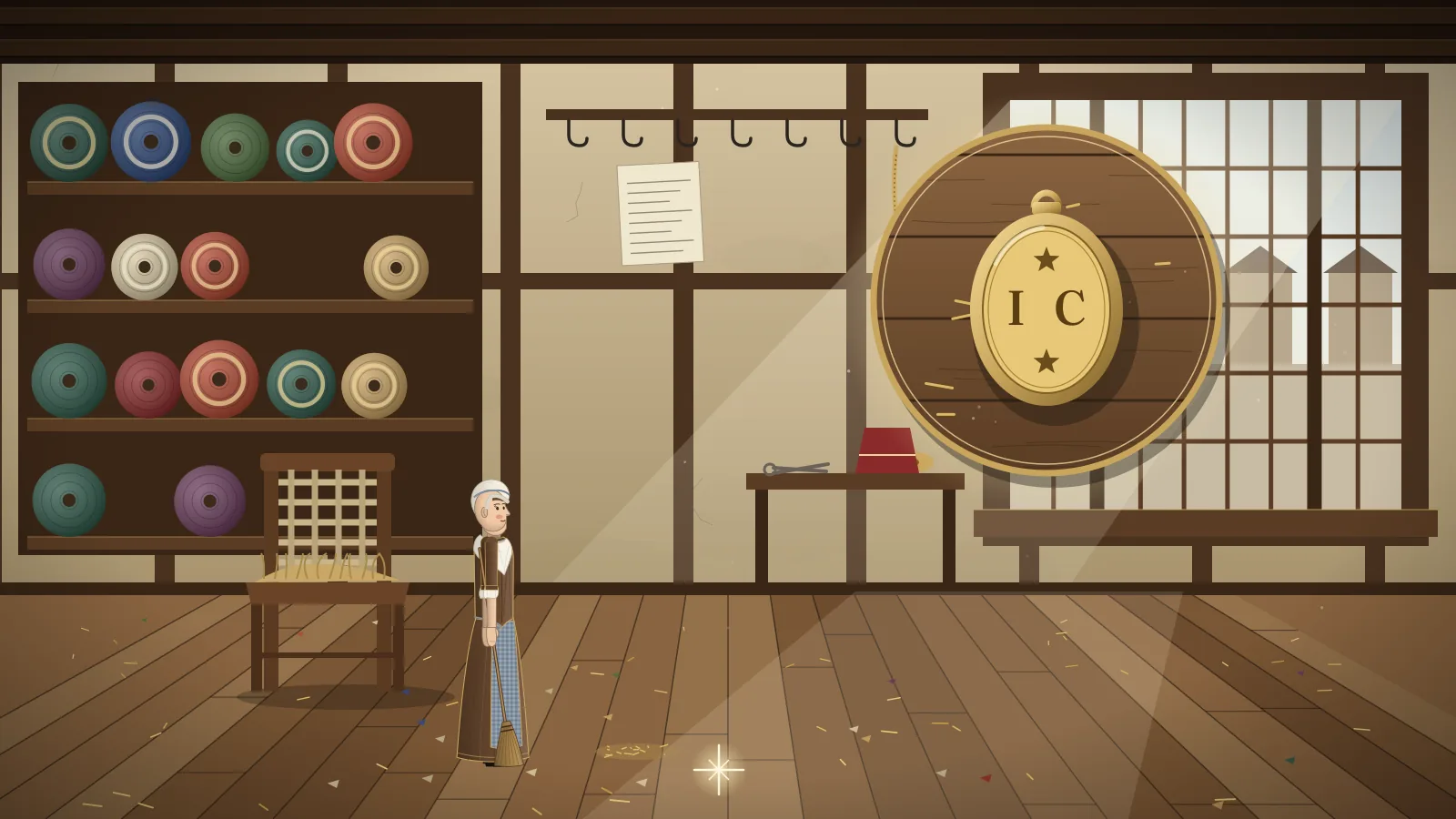
As a young woman she went into service. For many years she worked in Exeter, the cathedral city of the West Country, as a servant, and as an assistant in an upholsterer’s shop, where furniture was stuffed and covered.
In 1790, by later accounts, she was sweeping that shop after a sale when her broom turned up something small on the floor. It was an oval seal. It bore the letters I and C, with a star above and below.
It bore the letters I and C, with a star above and below.
She kept it. In time she came to read the letters as the initials of Jesus Christ.
Chapter IIwatch from 1:27
The Voice in Exeter
In 1792, in her early forties, she began to hear a voice that she believed was the Spirit of God. It spoke of small things and great ones: the weather, the harvest, deaths among her neighbours, and war with revolutionary France.
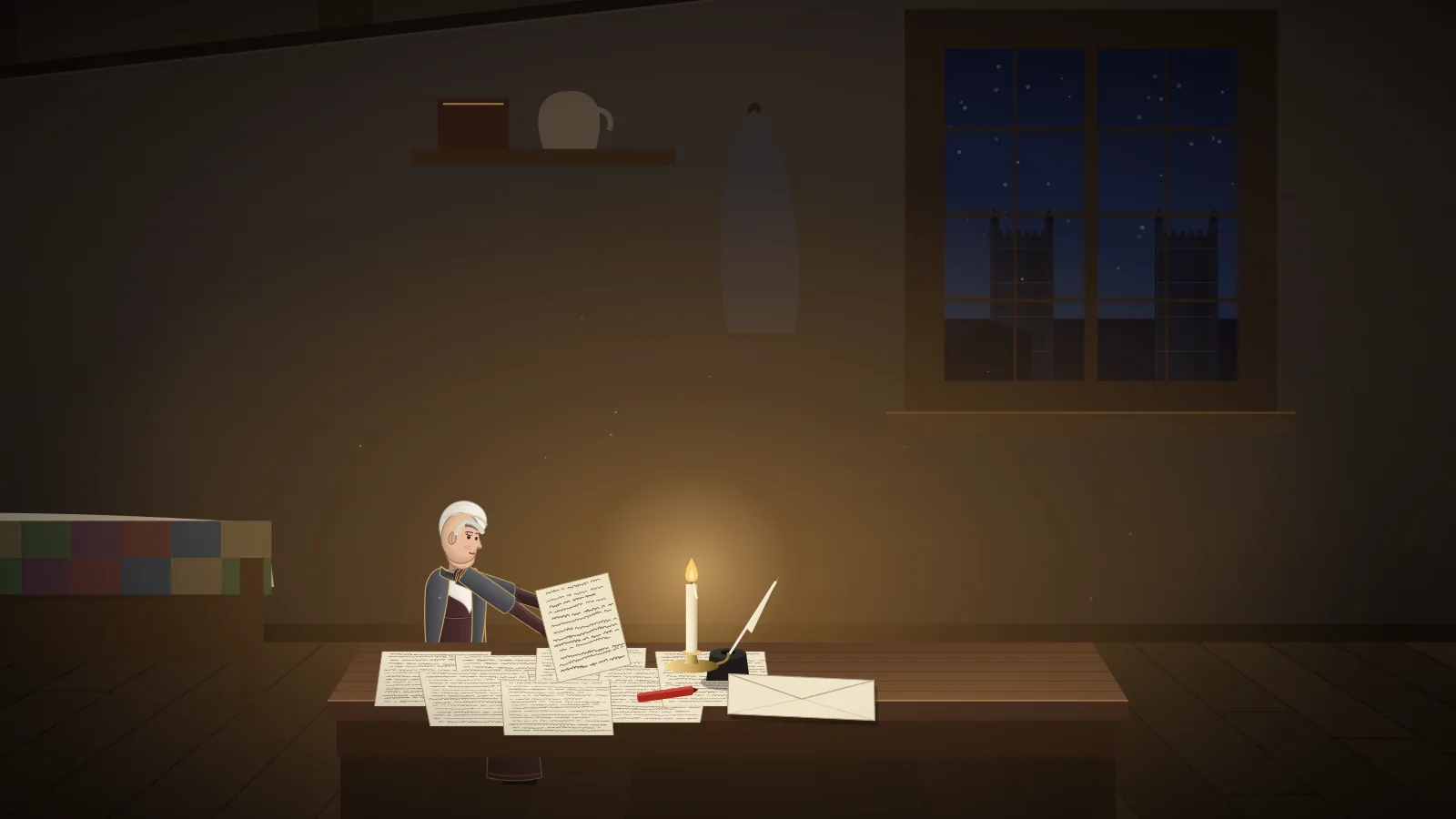
She wrote down what she heard, in rhyming verse and in prose. Her handwriting was so hard to read that others had to copy it out. Some prophecies she had sealed and dated, so that they could be opened later, and checked against what had happened.
It spoke of small things and great ones.
In 1801 she paid to print her first book, The Strange Effects of Faith. Copies reached London. There, a group of educated readers took notice. Among them were several clergymen, and William Sharp, one of the finest engravers in England.
They travelled to Exeter to meet the woman who had written it. In 1802, at their invitation, she left Devon and moved to London.
Chapter IIIwatch from 2:35
The Sealed Believers
England was at war with France for most of the years that followed. Bread was dear, and many people feared invasion. Her message spoke to those fears. The millennium, Christ’s 1,000-year reign on earth, was close, she taught, and Satan’s power was about to be broken.
She identified herself with the Woman Clothed with the Sun, in the 12th chapter of the Book of Revelation, who gives birth to a child destined to rule the nations. As a woman, she believed, she was called to undo the fall that had begun with Eve.
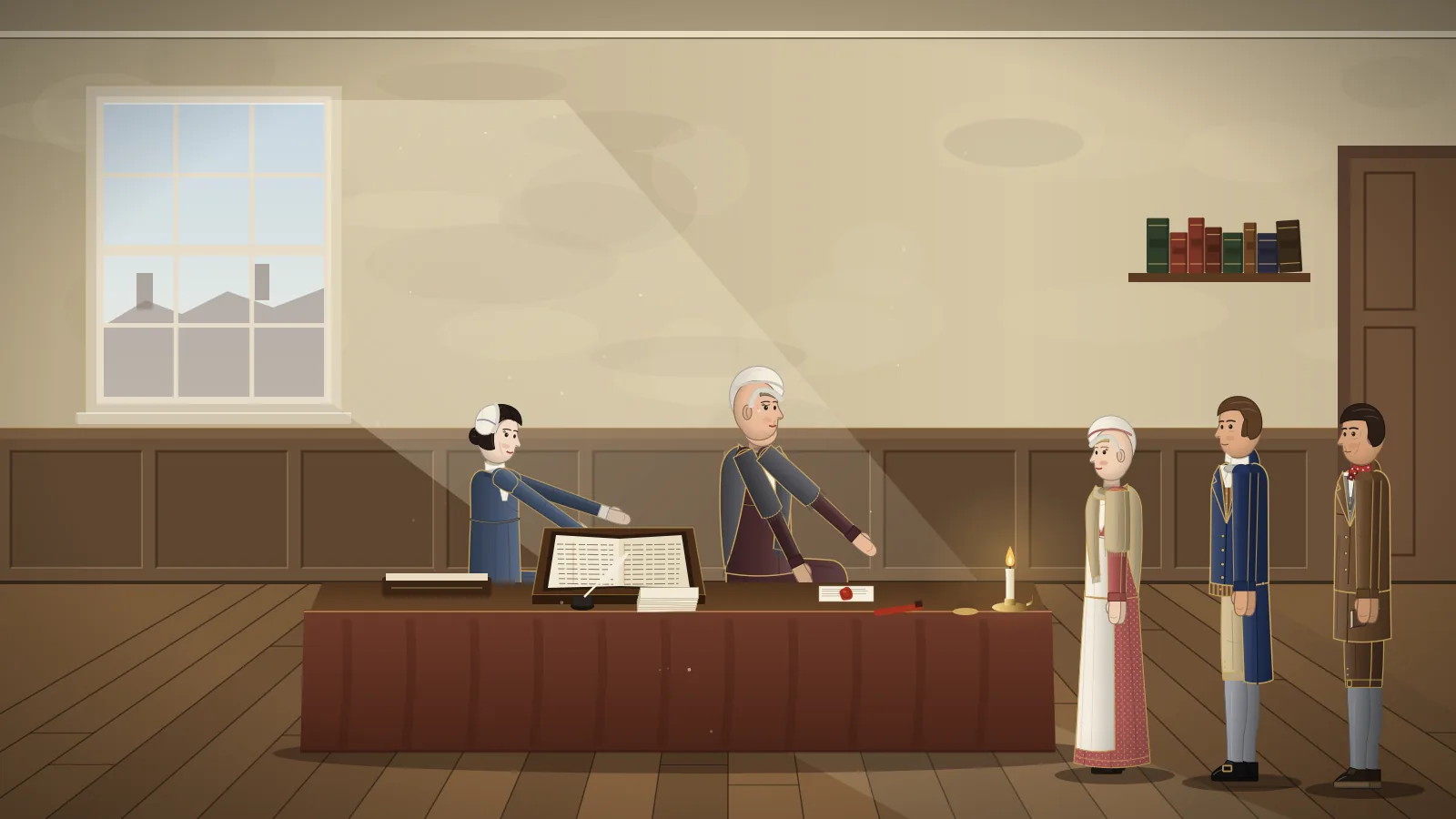
Her most distinctive practice was the sealing. Believers signed their names on a list, and received a folded paper, signed by Joanna and marked with her seal in red. It promised them a place among the elect, the 144,000 of the Book of Revelation, who would inherit the Tree of Life. Critics said she sold the seals. Most historians think she gave them freely, although believers often made gifts in return.
Her most distinctive practice was the sealing.
She gave out many thousands of seals. Most of those who received them were ordinary working people, and, by surviving lists, about two thirds were women. They met in chapels and in homes, from London and the West Country to the mill towns of Lancashire and Yorkshire, to read her words aloud and sing hymns.
To answer the scoffers, her supporters held formal trials of her writings, the first at Exeter in 1802 and others in London in the years that followed. Chosen men sat like a jury, and weighed the prophecies against the evidence. She wrote to bishops, too, and challenged them to examine her claims. Most ignored her. Cartoonists mocked her as a foolish old woman.
In 1804, according to her followers, a set of her prophecies was sealed inside a box, to stay shut until a time of national danger. Then it was to be opened before 24 bishops. The box was entrusted to William Sharp, the first of many keepers.
Chapter IVwatch from 4:42
The Promise of Shiloh
Then, in 1814, came her boldest announcement. At 64 years old, she declared that she was pregnant, and would give birth to Shiloh. The name comes from Genesis: “The sceptre shall not depart from Judah … until Shiloh come.” Many Christians read it as a name for the Messiah.
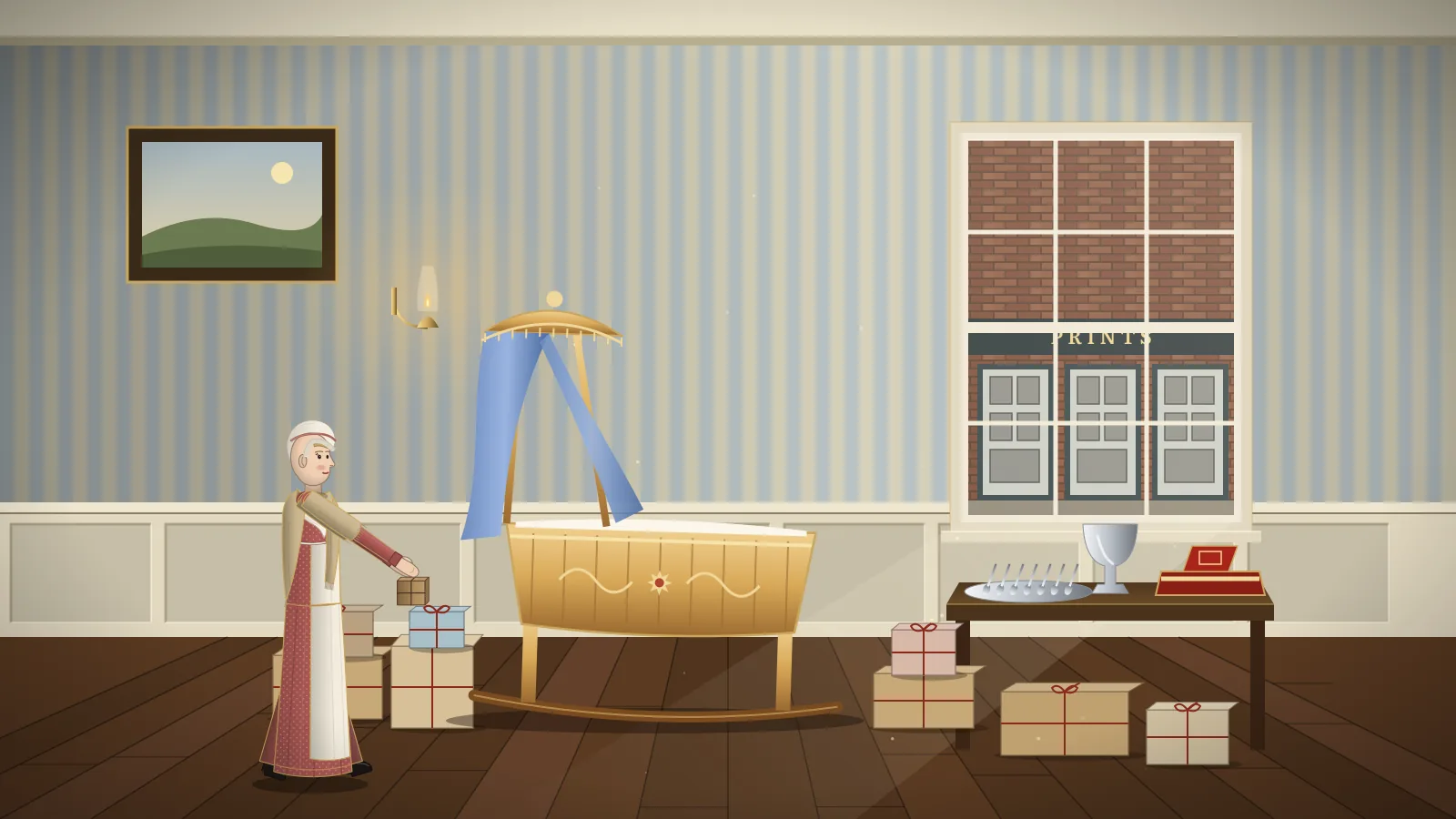
Doctors came to see her at her house in Manchester Street, in London. Some, among them the physician Richard Reece, said she showed signs of pregnancy.
Believers sent gifts from far and wide. An ornate cradle was ordered from a London cabinetmaker, Seddons of Aldersgate Street, at a cost of £200. There were feeding spoons, and a Bible bound for the child. Newspapers and caricaturists followed every rumour, and followers travelled to London to wait for the birth.
The day came, and passed.
The child was expected on 19 October. The day came, and passed.
Through the autumn her health declined. In November, she told Dr Reece that she was slowly dying. She asked that, if she died, her body should be kept warm for 4 days, in case she revived, and only then examined. By the accounts of those around her, in her last weeks she wondered aloud whether she had been deceived. Many of her followers still believed.
Chapter Vwatch from 6:15
The Last Days of December
She died in the last days of December 1814, just after Christmas. The official date is the 27th.
Her friends kept her body wrapped and warm, as she had asked, behind a closed door in Manchester Street. On the last day of the year, the doctors examined her. They found no child.
They found no child.
Early in January, she was buried quietly, in the burial ground at St John’s Wood.
Many believers concluded that the child had been born in spirit, and taken up to heaven, as in Revelation. Others drifted away, or followed new prophets who claimed to be her heirs. But the box remained, sealed and waiting.
Chapter VIwatch from 6:58
Octavia and the Petitions
A century later, in 1919, a clergyman’s widow in Bedford, Mabel Barltrop, gathered a small community around Joanna’s writings. Her followers called her Octavia. They became the Panacea Society.
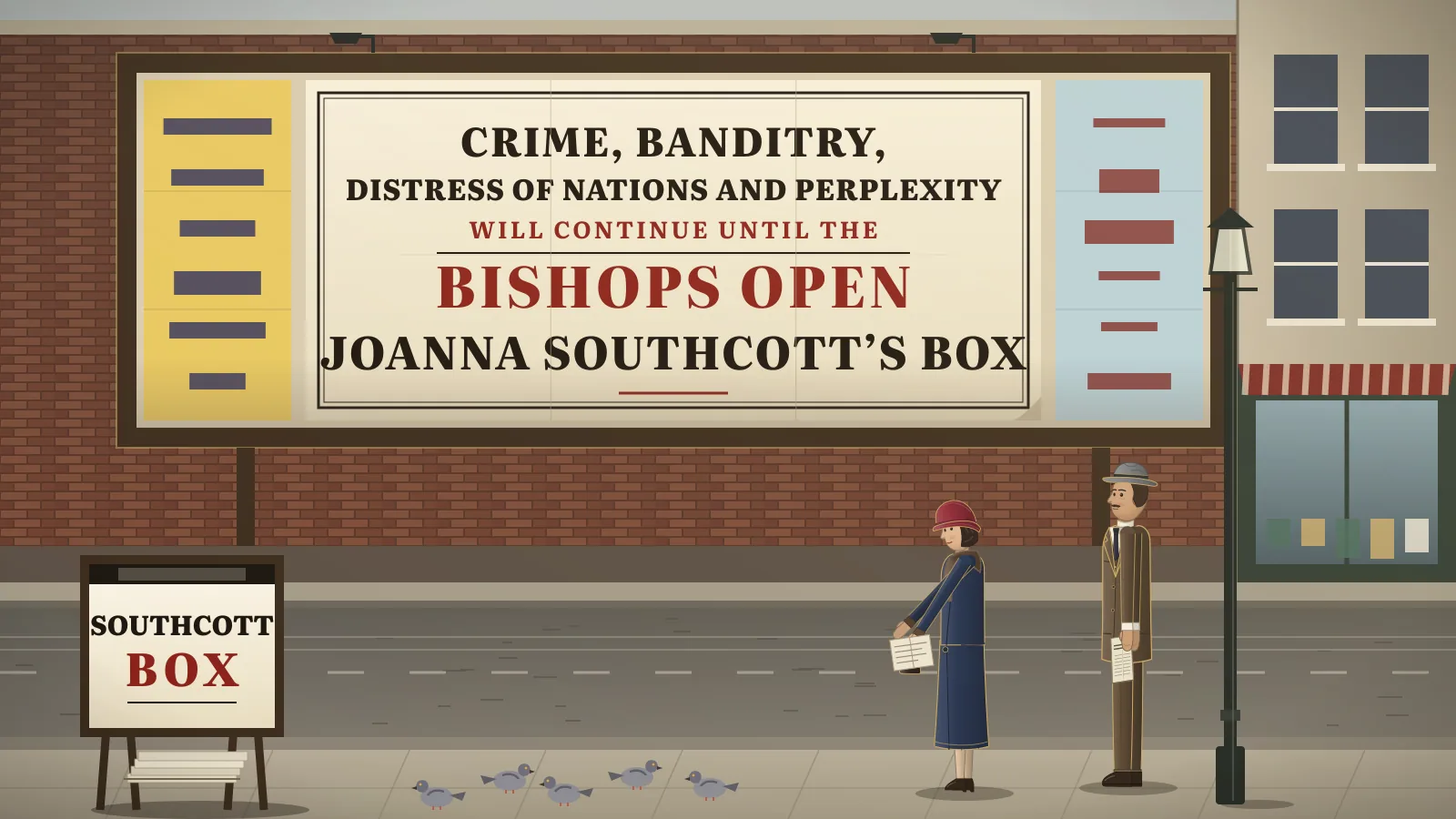
The great crisis had come, they believed, with the First World War, and now the box must be opened. They placed advertisements in the national newspapers, and later on billboards in London, among them one at Piccadilly Circus in 1932. One warned that crime, banditry, distress of nations and perplexity would go on, until the bishops opened Joanna Southcott’s box.
Now the box must be opened.
In the late 1920s and early 1930s, more than 100,000 people signed their petitions. The Society even bought a house in Bedford in 1930 and furnished it with bedrooms, bathrooms and a dining room, ready for the bishops’ stay. No bishop ever slept there.
Chapter VIIwatch from 7:57
The Two Boxes
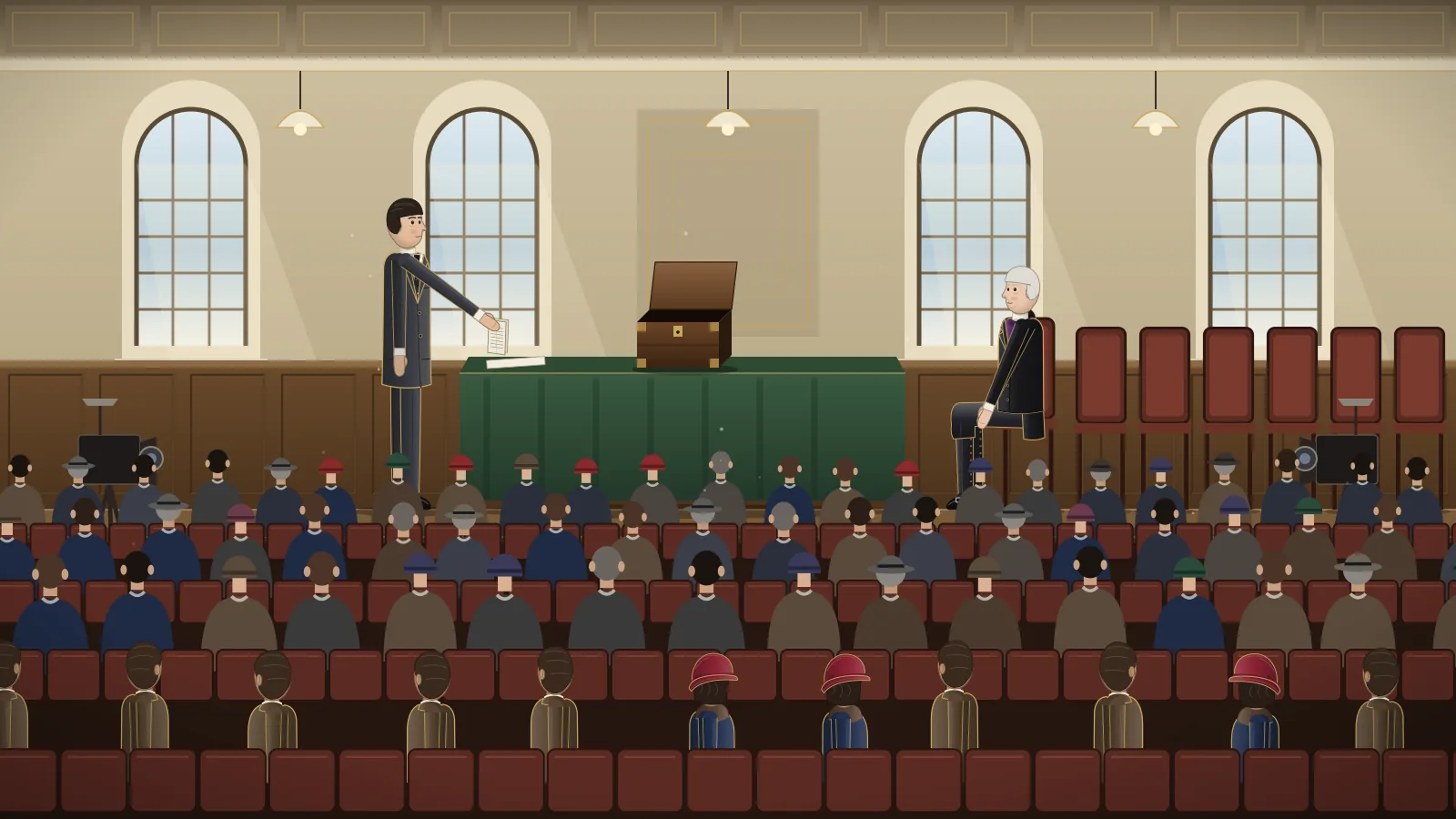
In 1927, the psychical researcher Harry Price announced that he had a box said to be Joanna’s. He had it X-rayed. On 11 July, he opened it at the Hoare Memorial Hall in Westminster, before a crowd. Only one bishop came: John Hine, the suffragan Bishop of Grantham.
Inside were a few oddments: some books and papers, a dice box, a nightcap, a lottery ticket, and an old horse pistol.
The newspapers laughed. But the Panacea Society said this was not the true box, and no one ever showed that it had been Joanna’s. One later writer even suspected Price of staging the whole affair.
Only one bishop came.
Historians have come to take her seriously: not as a fraud, but as a sincere religious leader who gave voice to the hopes of poor people in a time of war.
In 1957, the Society said, the true box came into its keeping, from a family that had guarded it since 1861, the Jowetts. The last member of the Society died in 2012. Its houses are now a museum, with a copy of the box on show, and the bishops’ bedrooms, never slept in.
The real box, its keepers say, is still sealed, in a secret place somewhere around Bedford. More than 200 years after a servant from Devon picked up a little seal from a shop floor, her words lie behind seals of their own. Like Joanna’s followers in 1814, the box is still waiting.