The story of the film
Athens and Sais, then Europe, America and Thera in the Aegean · c. 360 BCE – 1967
Around 360 BCE, in Athens, an old philosopher sat writing the story of an island that had vanished beneath the sea. He described its harbours and its temples, its kings and its laws, the rings of water around its city and the red gleam of its walls. Then, in the middle of a sentence, the story simply stopped.
As far as we know, he never finished it. But for more than 2,000 years, people have tried to finish it for him.
Chapter Iwatch from 0:37
The Philosopher's Tale
The philosopher was Plato, a student of Socrates, and the founder of a school in a grove outside Athens, called the Academy. There, among the trees, young men came to argue about justice, the soul and the best way to live.
Plato wrote dialogues, conversations between speakers. Two of them, the Timaeus and the Critias, tell the tale of Atlantis. No earlier text that survives, Greek or Egyptian, mentions it. Everything we know of the island begins with these pages.
In the Timaeus, Socrates has just described an ideal city. Now he wants to see such a city in action, the way one longs to see beautiful animals, seen only at rest, finally move. An Athenian named Critias offers a story. It is strange, he says, but entirely true.
It is strange, he says, but entirely true.
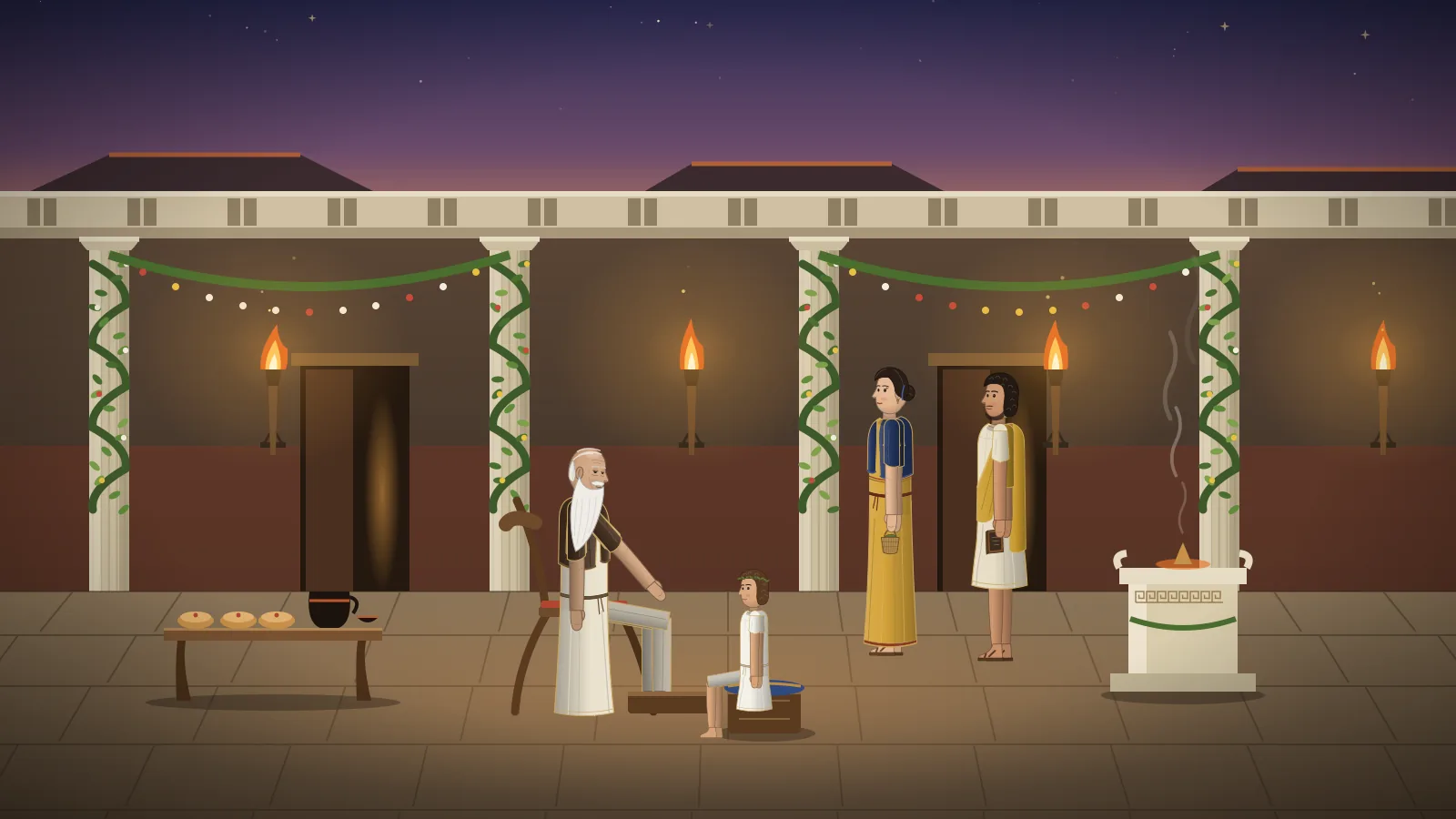
He heard it as a boy of about 10, at the Apaturia, the family festival at which boys were registered, from his grandfather, who was then nearly 90. The family had it from Solon, the great lawmaker of Athens and a friend of Critias’s great-grandfather. Solon lived some two centuries before Plato.
Chapter IIwatch from 1:43
The Priest of Sais
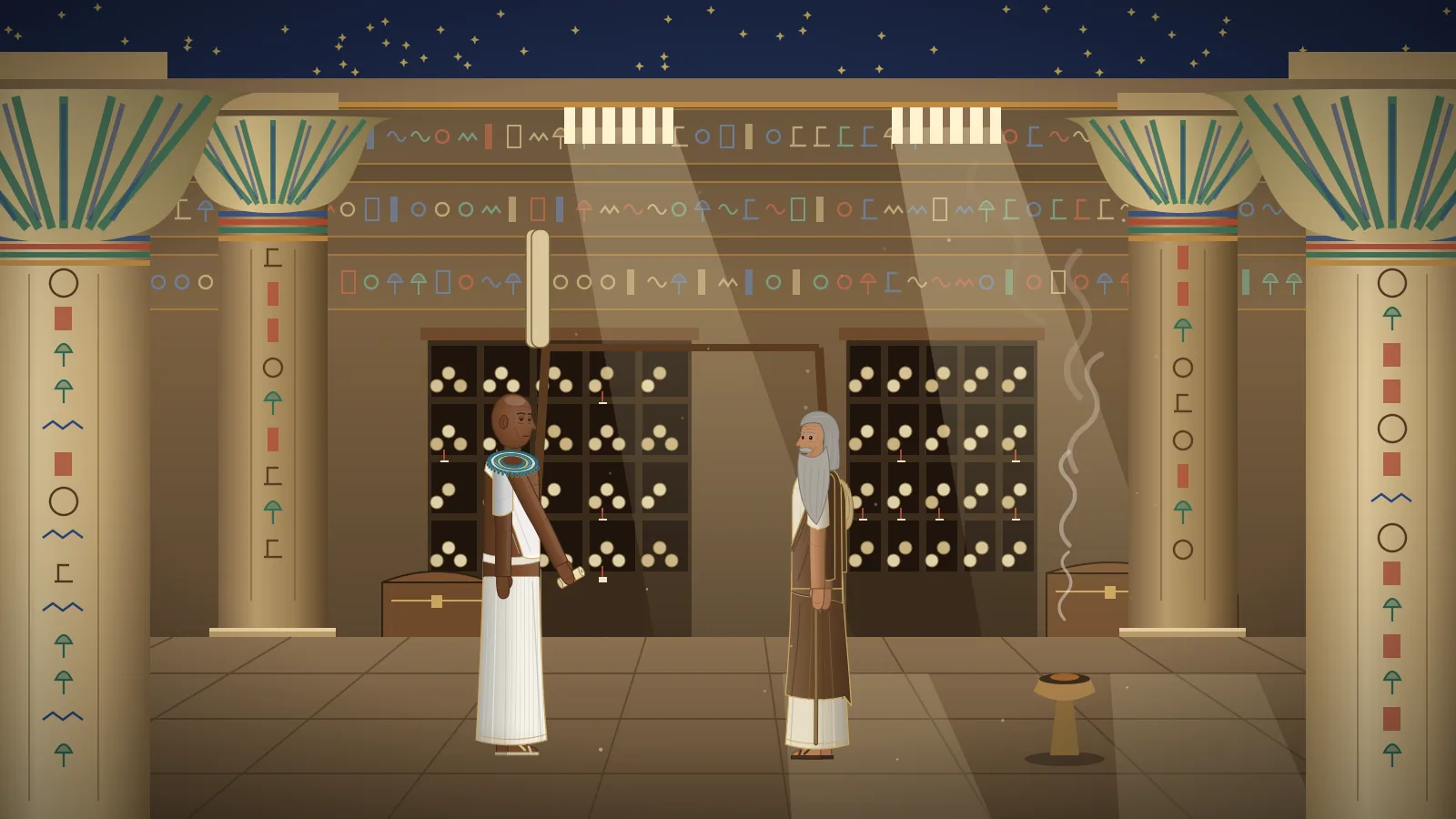
Solon really did travel to Egypt; the historian Herodotus says so, and the later writer Plutarch tells of his studies with a priest of Sais. In Plato’s tale, he came to Sais, in the Nile Delta, whose goddess, Neith, the Greeks linked with their own Athena.
There, among the temple’s columns, an aged priest told him: “O Solon, Solon, you Greeks are always children.” Floods and fires, he said, had wiped out Greek memory again and again, so that each new generation began from nothing and knew nothing of the past.
“O Solon, Solon, you Greeks are always children.”
But in Egypt the old records survived, kept in the temples. And they told of events 9,000 years earlier.
Out in the ocean, beyond the Pillars of Heracles, which we call the Strait of Gibraltar, lay an island larger than Libya and Asia put together. Its kings ruled other islands and parts of the mainland, as far as Egypt and Italy. Then they set out to conquer the rest.
Ancient Athens, the priest said, led the Greeks against them. When its allies fell away, it stood alone, defeated the invaders, and set the enslaved peoples free.
Then came violent earthquakes and floods. In a single dreadful day and night, the Athenian warriors sank into the earth, and Atlantis vanished into the sea. All that remained was a shoal of mud, so that the ocean there could no longer be sailed.
Chapter IIIwatch from 3:13
The Island of Poseidon
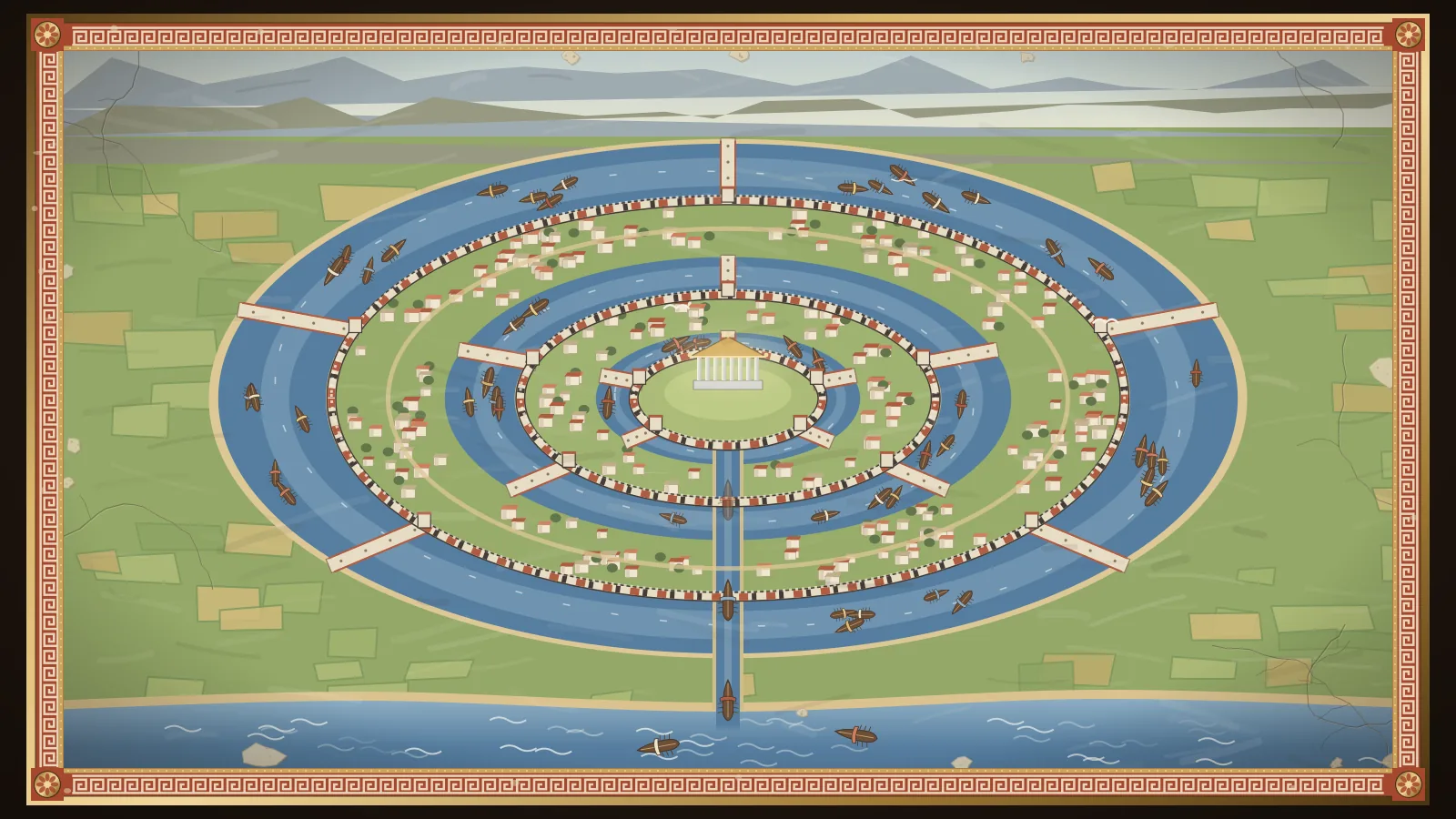
The Critias was meant to tell the rest. In the beginning, it says, the island fell to Poseidon, god of the sea, who loved a mortal woman named Cleito. Around her hill he made rings of land and water, 2 of land and 3 of sea, so that no one could reach it, and he brought up 2 springs from the ground, one warm and one cold.
Cleito bore him 10 sons, 5 pairs of twins. The eldest was Atlas, and from him, Plato says, the island and the ocean took their names.
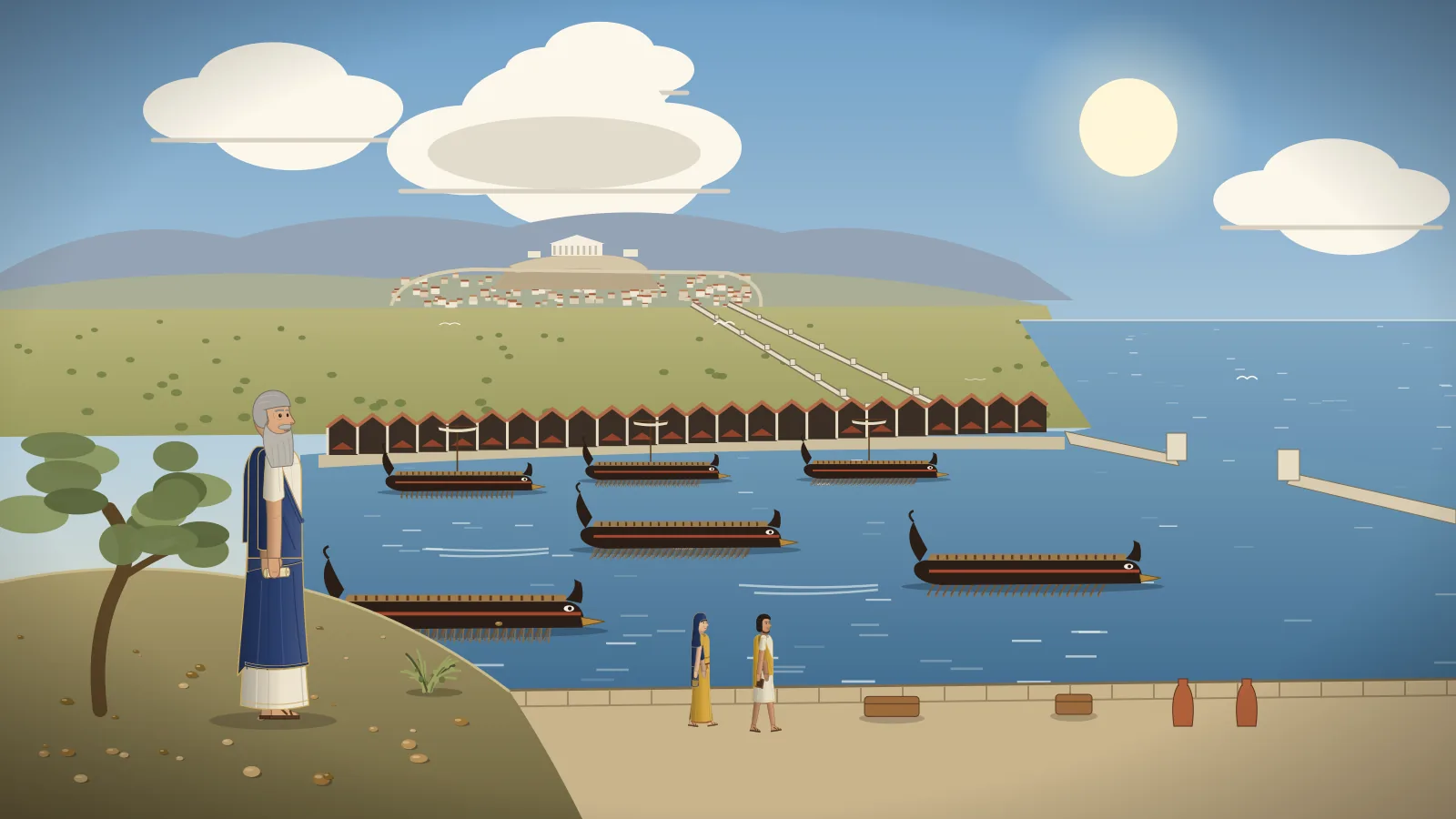
Plato describes the city like a painter. Bridges crossed the rings. A canal ran in from the sea, and the harbours were crowded with ships. The walls were coated in bronze and tin, and the innermost one flashed with the red light of orichalcum, a metal that, Plato says, was known in his own day only by name.
The innermost wall flashed with the red light of orichalcum.
At the centre stood the temple of Poseidon, a stadium in length: its outside covered in silver, its pinnacles in gold, its inner roof of ivory. Inside, a golden statue of the god stood in a chariot drawn by 6 winged horses, its head touching the roof. Around it rode 100 sea nymphs on dolphins.
Every fifth and sixth year, the 10 kings met at the temple. They hunted a bull with only staves and nooses, and swore oaths before a pillar of orichalcum carved with their laws.
For generations, Plato writes, they were wise and gentle. But as the divine part in them faded, they grew greedy for wealth and power. So Zeus, the god of gods, gathered all the gods to decide their punishment. “And when he had called them together,” the text says, “he spoke as follows.”
And there, the Critias ends. Most scholars think Plato simply never finished it; a few have thought the ending was lost.
Chapter IVwatch from 5:17
A Story with a Point
Why did he tell this story? Socrates had asked to see the ideal city at war, and Atlantis gave him that war: ancient Athens, well ordered and brave, against a vast empire from the ocean.
Many readers also see a mirror of Plato’s own Athens, a proud sea power with a great fleet. In his youth, between 415 and 413 BCE, a vast Athenian expedition to Sicily ended in disaster. Plato never says so, but the parallel is hard to miss.
Plato invented other stories to make a point, about prisoners in a cave, or about the afterlife. For most classicists, Atlantis belongs with them: a story about pride, power, and how they fall.
A story about pride, power, and how they fall.
Ancient readers were already divided. Crantor, one of the first to comment on the Timaeus, is said to have taken it as history; we know his view only through a writer who lived centuries later, and what he meant is still debated. Others doubted. The geographer Strabo preserved a remark, often credited to Aristotle: the man who invented the island made it vanish too.
Chapter Vwatch from 6:12
New Atlantises
Nearly 2,000 years later, European ships crossed the ocean that bore Atlas’s name. Some writers wondered whether the Americas were Plato’s lost lands.
In 1626, just after the death of the English thinker Francis Bacon, his unfinished tale New Atlantis appeared in print. Its sailors, lost in the Pacific, reach an island called Bensalem, where wise men run a great house of research, Salomon’s House, devoted to the study of nature. Bacon’s New Atlantis was a dream of science.
Bacon’s New Atlantis was a dream of science.
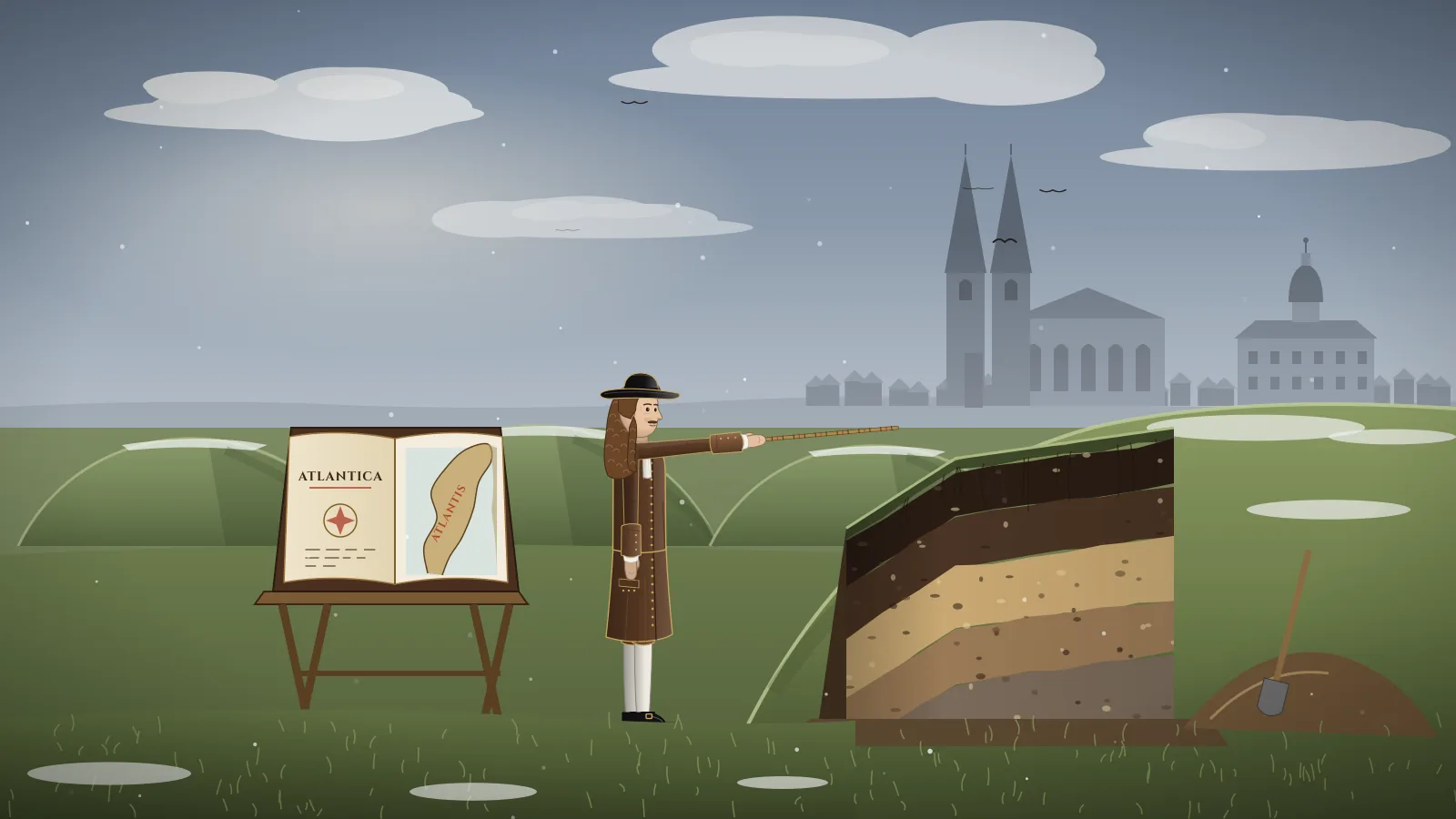
In Sweden, the Uppsala professor Olof Rudbeck, a gifted anatomist who had studied the body’s lymphatic vessels, went further. In a huge work called Atlantica, begun in 1679, he argued that Atlantis had been Sweden, and old Uppsala Plato’s city. Its volumes ran to thousands of pages, and much of the last one was lost when fire swept Uppsala in 1702.
He measured the layers of soil over ancient graves, trying to date them. His conclusions were wrong, but his method, one historian has judged, was ahead of its time.
Chapter VIwatch from 7:16
The Lost Continent
Then, in 1882, came the book that launched the modern Atlantis craze. Its title was Atlantis: The Antediluvian World, and its author was Ignatius Donnelly, a former congressman from Minnesota.
He claimed that Plato’s island was real, the mother of civilisations from Egypt to the Maya, and the source of the world’s flood stories. Egypt, he wrote, was its oldest colony, and the survivors’ memory lived on in legends of a great deluge.
The book was hugely popular. Critics showed that many of his facts were wrong, but the idea of a lost super-civilisation took hold.
The idea of a lost super-civilisation took hold.
In 1888, in The Secret Doctrine, Helena Blavatsky, a founder of Theosophy, described the Atlanteans as an earlier race of humanity, the fourth of the root races through which, she taught, humankind passes. Psychics and novelists added their own visions.
Later, racial theorists, some in Nazi Germany, turned Atlantis into a myth of a master race. Historians reject such claims, which deny the real achievements of ancient peoples.
Chapter VIIwatch from 8:18
The Volcano and the Verdict
But was there a real disaster behind the story? Many have pointed to Thera, today’s Santorini, in the Aegean Sea.
In the Bronze Age, perhaps around 1600 BCE, its volcano exploded in one of the greatest eruptions in human history, and the heart of the island collapsed into the sea. Radiocarbon points to that date; some archaeologists still argue for about 1500 BCE.
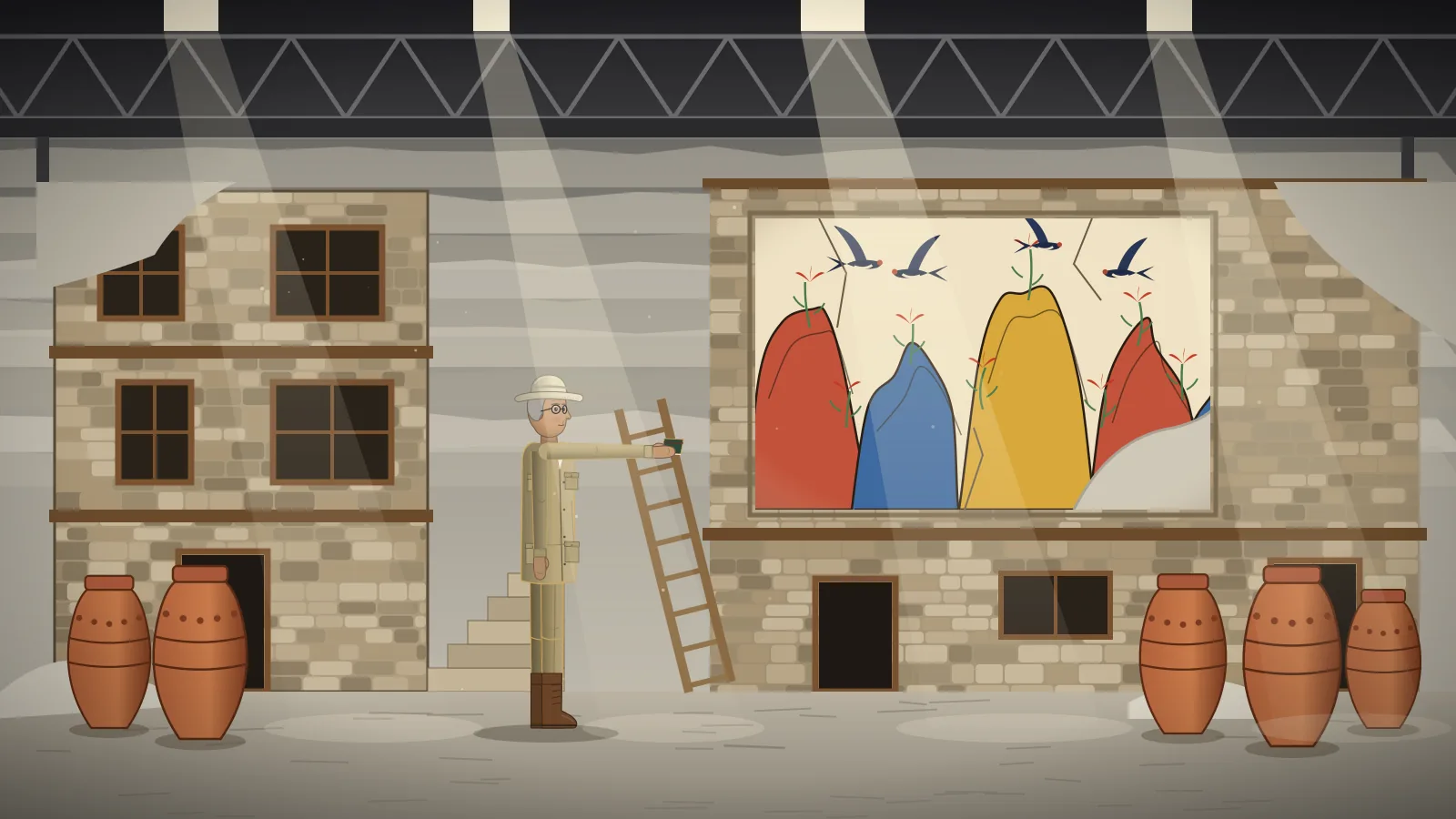
In 1909, the scholar K. T. Frost, in an unsigned article in The Times, linked the legend to the Minoans of nearby Crete. From 1967, the archaeologist Spyridon Marinatos uncovered a whole town on Thera, at Akrotiri, buried under metres of ash. Its houses and painted walls survived, but no human remains have been found there. The people, it seems, had time to flee.
The people, it seems, had time to flee.
Yet Thera lay inside the Mediterranean, not beyond Gibraltar, and it was destroyed about 1,000 years before Solon, not 9,000. Maps of the ocean floor show no sunken continent in the Atlantic.
Most scholars see in Atlantis at most a distant echo of real disasters, shaped by Plato into a philosophical myth.
Plato left his island at the moment of judgement, in the middle of a sentence, with Zeus about to speak. Ever since, dreamers, explorers and storytellers have tried to write the ending, in Sweden and in Minnesota, on Thera and under the Atlantic. But the island itself was only ever made of words, written by an old man in Athens about a city that rose too high, and fell.