The story of the film
Lirey and Chambéry in France, then Turin · c. 1353–1997
Late on the night of 11 April 1997, fire broke out in Turin, in the black marble chapel that stands beside the cathedral. Inside the cathedral itself stood a bulletproof glass case. A firefighter, Mario Trematore, struck it with a sledgehammer, again and again, until at last it gave way.
The firefighters carried a long casket out into the night. Inside, folded, lay a strip of old linen more than 4 metres long. It was not the first time that this cloth had been pulled from the flames.
Chapter Iwatch from 0:37
The Knight of Lirey
It is called the Shroud of Turin. It is a length of linen, woven in a herringbone pattern, about 4.4 metres long and a little over 1 metre wide. On its pale weave lies a faint image of a man, front and back, with wounds like those the Gospels describe at the crucifixion.
Many Christians venerate it as the burial cloth of Jesus. Many scientists think it is medieval. Its written history spans almost 700 years, and it is a history of fire, faith and argument.
That history begins in the village of Lirey, in Champagne, in north-eastern France. In 1353 a knight named Geoffroi de Charny founded a small church there, served by 6 canons. Three years later, at the Battle of Poitiers, he was killed while carrying the Oriflamme, the sacred battle banner of the kings of France.
His son and his granddaughter later said that Geoffroi had acquired the cloth. No document says how. Even the founding charter of his church does not mention it. That silence has fed theories ever since.
That silence has fed theories ever since.
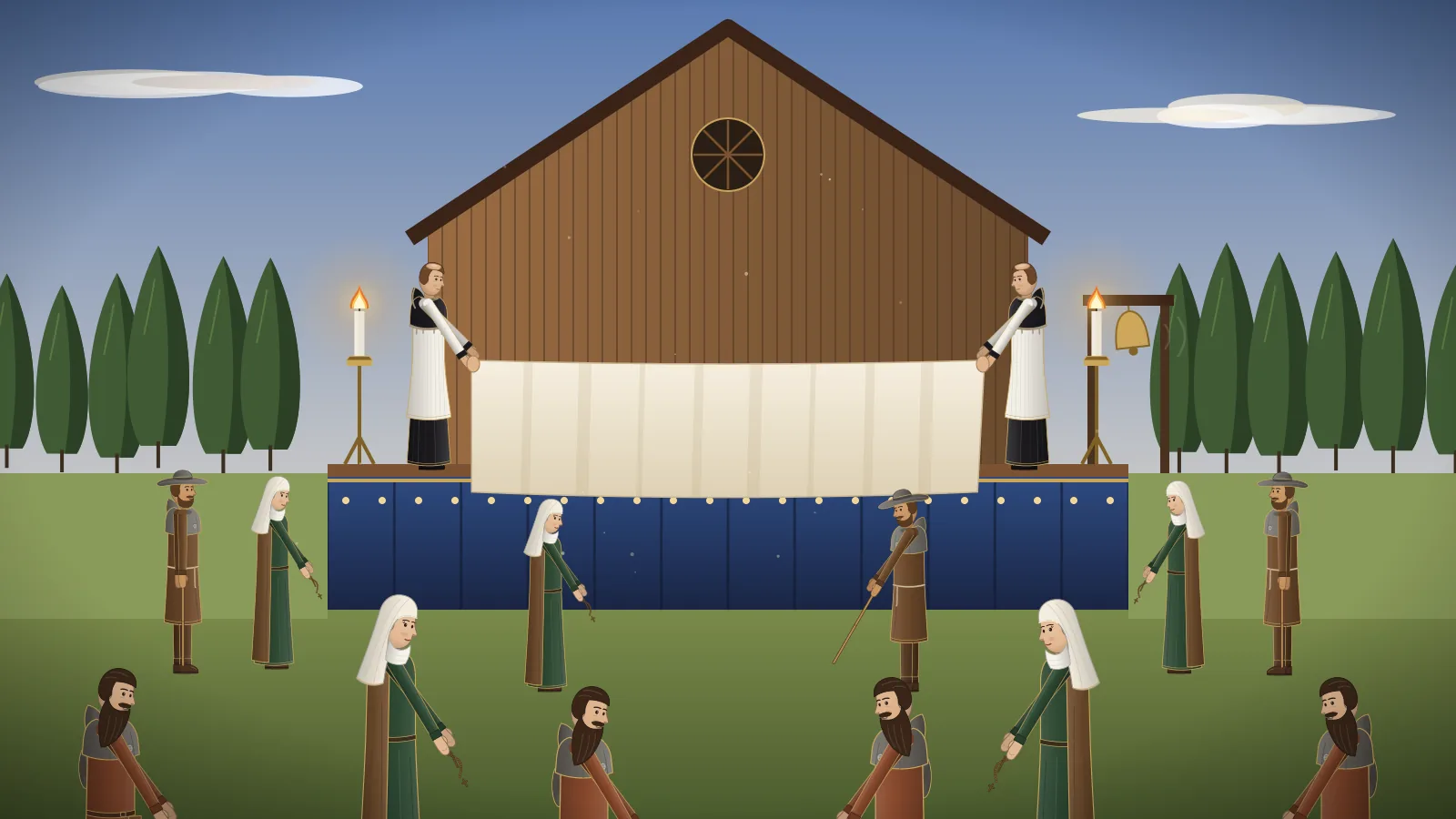
What is known is that the cloth was shown to pilgrims at Lirey, held up by two clerics. In 1855 a small lead pilgrim badge was found in the Seine in Paris, near the Pont au Change. It shows the cloth, with the coats of arms of Geoffroi and of his wife, Jeanne de Vergy. In 2009 a mould for a similar badge turned up at Machy, near Lirey. Historians still debate whether the first showings came in Geoffroi’s lifetime, or soon after, under his widow.
Chapter IIwatch from 2:14
The Bishop's Memorandum
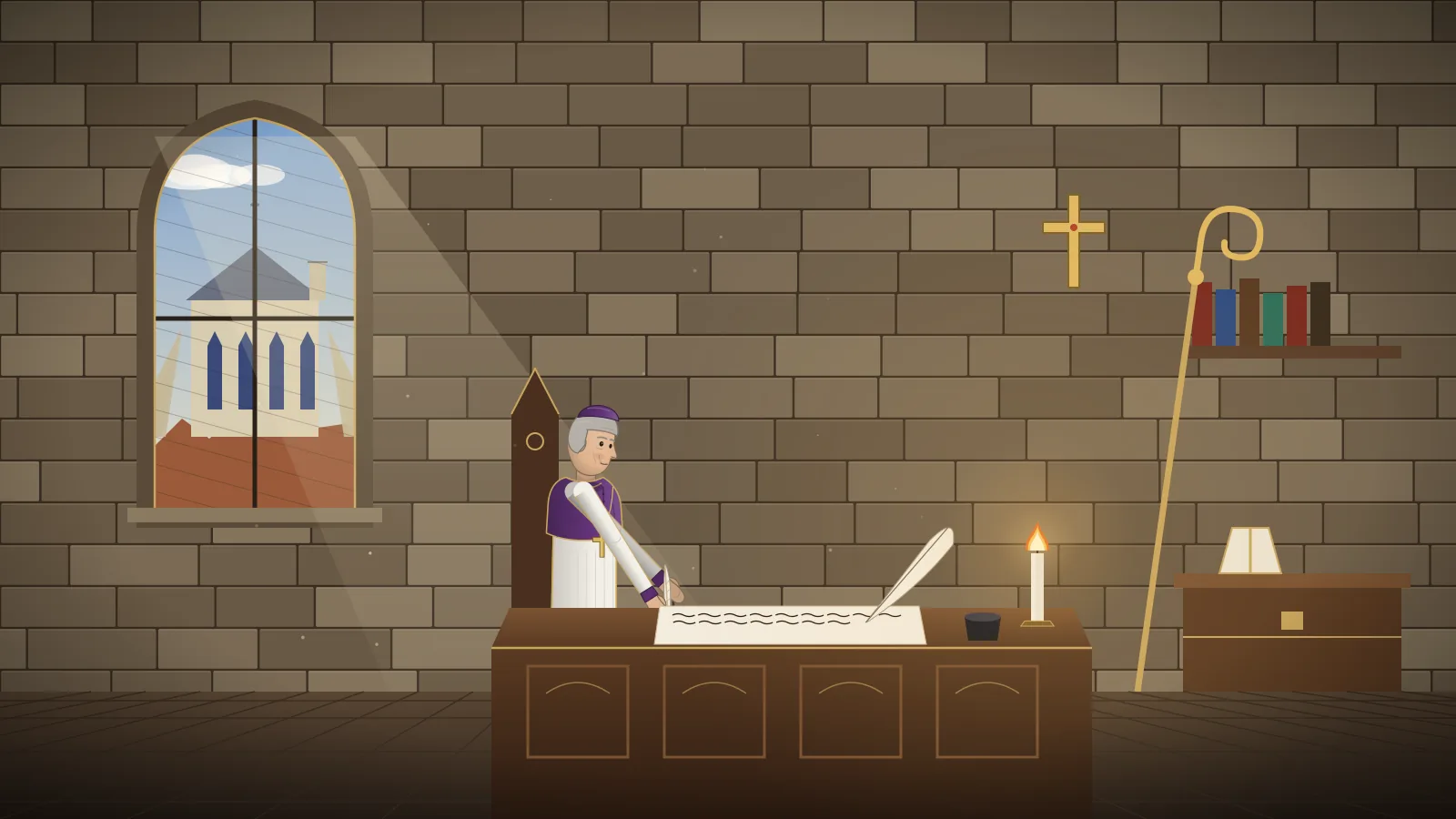
In 1389, when Geoffroi’s son was showing the cloth again, the Bishop of Troyes, Pierre d’Arcis, drafted a memorandum to the pope. It survives as an undated, unsigned draft. One of his predecessors, he wrote, had investigated the cloth about 34 years earlier, and found it cunningly painted. The bishop claimed that the artist himself had admitted it.
His letter went to Clement VII in Avignon, one of two rival popes in the great split of the Western Church. In January 1390, Clement let the showings go on, on one condition. It had to be announced aloud that this was not the true shroud of Christ, but a figure, or representation, of it.
It had to be announced aloud that this was not the true shroud of Christ, but a figure, or representation, of it.
In 1418, with armed bands roaming the land, the canons handed the cloth for safekeeping to Geoffroi’s granddaughter Marguerite and her husband, Humbert de Villersexel, who kept it at his castle of Montfort. The canons later asked for it back, and took the matter to the courts. Marguerite never returned it.
In 1453, at Geneva, she gave it to Duke Louis of Savoy, and received a castle and the revenues of an estate in return. A few years later, she was excommunicated for keeping it from the canons.
For half a century the cloth travelled with the court of Savoy from castle to castle. From 1502 the dukes kept it in a silver casket in their Holy Chapel at Chambéry. It became the treasure of the dynasty. In 1506 Pope Julius II approved a feast in its honour, kept on 4 May.
Chapter IIIwatch from 3:54
Fire at Chambéry
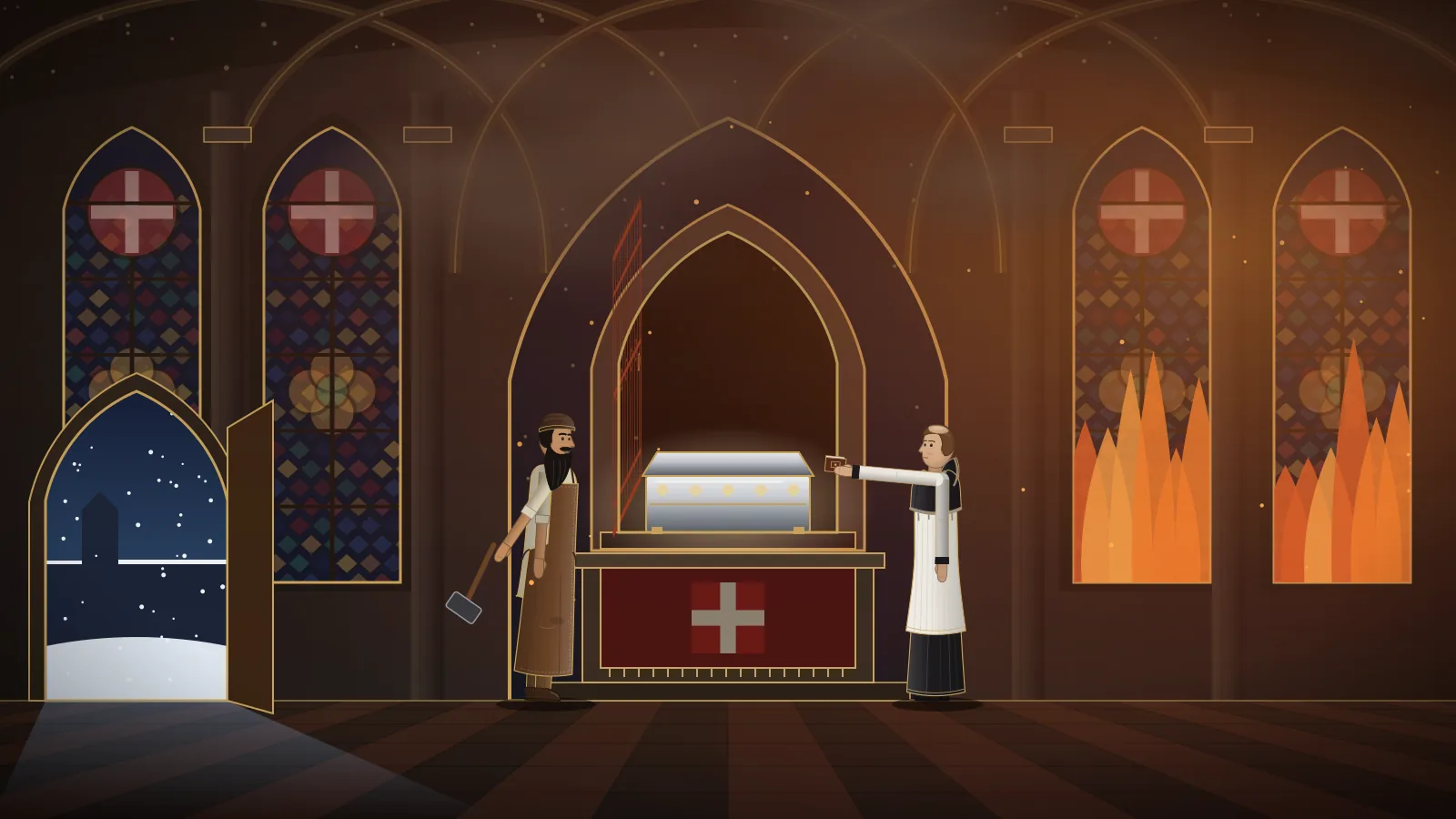
Then, on the night of 3 December 1532, fire swept through the chapel. According to the accounts, a canon, a blacksmith and two friars forced open the iron grille and pulled the casket out.
Inside, a drop of molten silver had fallen on the folded linen and burned through the layers. The water used to cool it left pale stains. Yet the burns had mostly missed the image itself.
Yet the burns had mostly missed the image itself.
In 1534 the Poor Clare nuns of Chambéry spent about 2 weeks mending it. With needle and thread they sewed patches over the holes, and stitched the whole cloth onto a linen backing. Their patches stayed in place for more than four and a half centuries, until restorers removed them in 2002.
In 1578 the dukes, who had moved their capital to Turin, brought the cloth across the Alps. The reason given was a pilgrim. Charles Borromeo, Archbishop of Milan, had vowed to walk to the shroud after a terrible plague. That October he entered Turin, it is said, barefoot. Many historians think the dukes also wanted the relic close to them, in their new capital.
Turin kept it. In 1694 the cloth was placed in a new chapel by the architect Guarino Guarini, under a dome of stone that rises like a lattice of stars.
Chapter IVwatch from 5:27
The Photographer's Plate
For 2 centuries the cloth was shown only on rare occasions. Then, in 1898, a lawyer and amateur photographer, Secondo Pia, was allowed to photograph it. The cathedral had no electricity. Pia brought a generator and two electric lamps, and on the evening of 28 May he made his exposures.
Around midnight, in his darkroom, the image appeared on the glass plate. In a negative, light and dark are reversed. Yet here the figure looked clearer than on the cloth itself. He later recalled that he almost dropped the plate. The cloth seemed to behave like a photographic negative, and new photographs taken in 1931 confirmed the effect.
The shroud had become a question for science.
The shroud had become a question for science. In 1978 a team of mostly American scientists, known as STURP, examined the cloth for 120 hours, day and night. They reported that the colour lay only on the topmost fibres, and that they had found no paint, dye or pigment forming the image. What produced it, they wrote, remained a mystery.
But the microscopist Walter McCrone, studying sticky-tape samples from the same examination, concluded that it had been painted, with iron oxide and vermilion. The argument goes on.
In 1983 Umberto II, the last king of Italy, died in exile. His family, the House of Savoy, had owned the cloth for more than 500 years. In his will, he left it to the pope.

Chapter Vwatch from 7:09
1260 to 1390
On 21 April 1988, in the sacristy of Turin Cathedral, a strip about 7 centimetres long was cut from one corner of the cloth. Pieces went to laboratories in Oxford, Zurich and Tucson, Arizona.
Radiocarbon dating measures how much carbon-14 is left in something that once lived, like the flax from which linen is made. Each laboratory also received control samples of known age, so the results could be checked.
On 13 October 1988 the Archbishop of Turin, Cardinal Anastasio Ballestrero, told reporters the result. The linen dated from between 1260 and 1390. That afternoon, at the British Museum in London, the scientists faced the cameras beside a blackboard bearing those dates and an exclamation mark. The full results were published in the journal Nature the following February, at 95 per cent confidence.
The linen dated from between 1260 and 1390.
The cardinal added that the Church still regarded the cloth with respect and veneration, as an icon of Christ.
For most scientists and historians, the case is strong. The dates match the moment the cloth first appears in the written record, at Lirey in the 1350s.
Defenders of authenticity disagree. Some argue that the corner sampled was a later repair, or that the fire of 1532 altered the carbon. In 2019 a reanalysis of the raw data argued that the samples were not uniform. The laboratories and many specialists reply that textile experts examined the corner before it was cut, and that no proposed effect is large enough to shift the date by some 13 centuries.

Chapter VIwatch from 8:55
An Icon in the Dark
The Catholic Church has never declared the cloth authentic. In 1998 Pope John Paul II said that the Church had no specific competence on such questions, and left them to scientists.
Popes since have called it an icon, inviting prayer on the suffering of Christ, whatever its age. In 2013 Pope Francis spoke of it as “this Icon”.
Popes since have called it an icon, inviting prayer on the suffering of Christ, whatever its age.
And the pilgrims still come. In 2010 more than 2 million people filed past the cloth in Turin Cathedral, and in 2015 they came in their millions again. In 2020, during the pandemic, it was shown on screens, as a prayer service on Holy Saturday reached people in their homes.
In 1997 it survived fire once more. The chapel of Guarini took over 20 years to restore, and opened again in 2018. Today the cloth lies flat in a sealed case filled with argon, in a side chapel of Turin Cathedral, hidden from view most of the time.
A medieval work of astonishing skill, or something more? From the two clerics who held it up at Lirey to the firefighter who broke open its case in Turin, people have guarded it, tested it, argued over it and prayed before it for almost 700 years. They are still asking, as the linen waits in the dark.