The story of the film
Strasbourg, Haarlem and Friesland, then Münster in Westphalia · c. 1525–1536
In the heart of the German city of Münster, high on the tower of St Lambert’s Church, hang three iron cages. They are empty. Each one is about the height of a man, and far below them shoppers cross the market square, going about their day.
For almost 500 years, people have stopped on those cobbles, looked up and asked the same question: who was put in those cages, and why?
Chapter Iwatch from 0:31
The Rebaptisers
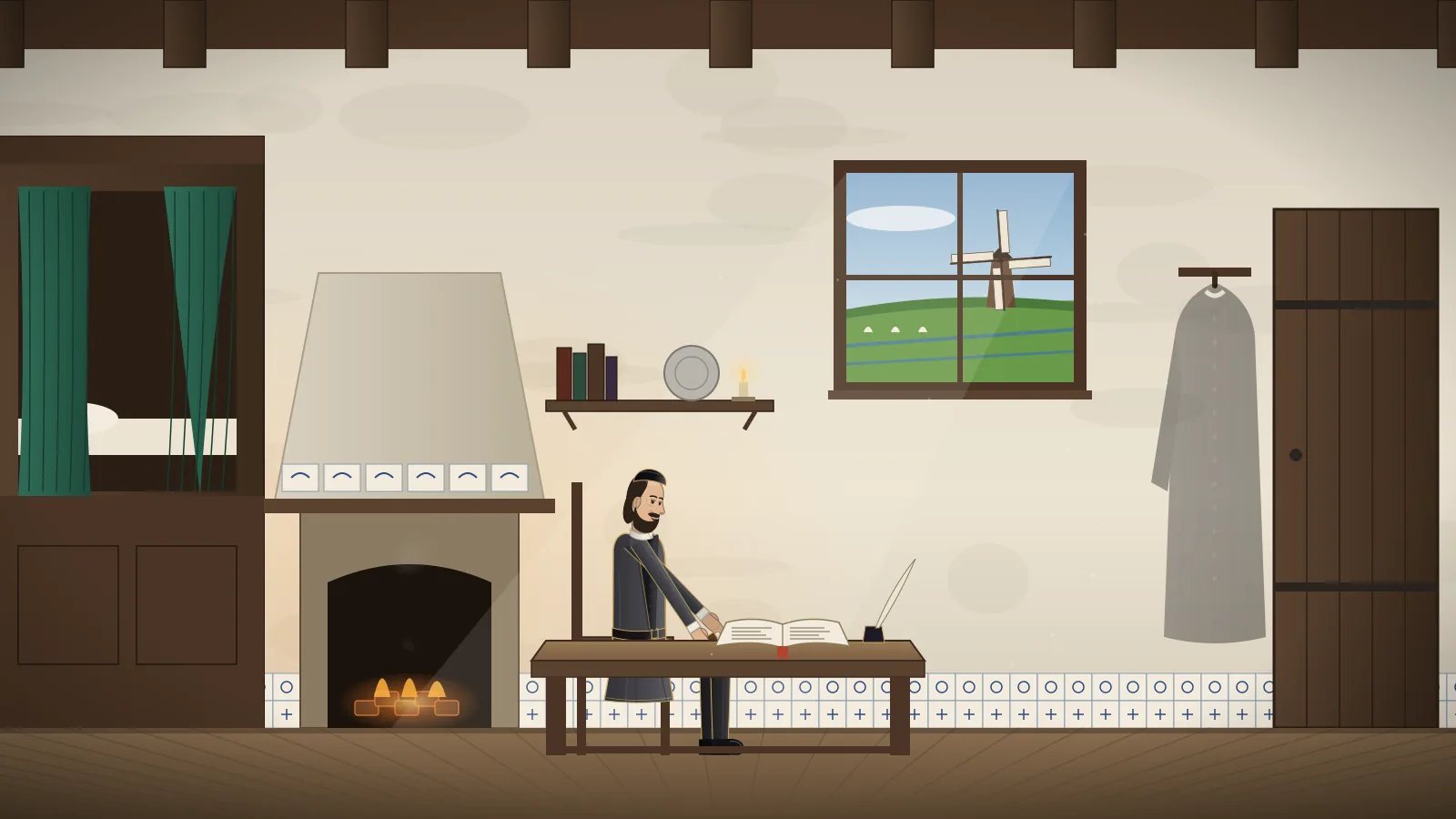
The answer began in the 1520s, when the Reformation split Western Christianity. Alongside Luther and Zwingli, who had broken with Rome, small groups of believers reached a more radical conclusion. Baptism, they said, was not for babies. It was for adults who freely confessed their faith, and so they baptised one another again, as grown men and women. Their enemies called them Anabaptists, which means rebaptisers.
Catholic and Protestant rulers alike saw them as a danger to order. A church that people chose to join, rather than one they were born into, seemed to shake the ground on which princes and cities stood. From 1529, imperial law made rebaptism a crime punishable by death.
Most Anabaptists answered by withdrawing. They met in secret, in houses and out-of-the-way places. They refused oaths and weapons, and left judgement to God.
Most Anabaptists answered by withdrawing.
But a few expected that judgement very soon. A wandering preacher, Melchior Hoffman, taught that the end of the world was near, and that Strasbourg would be the New Jerusalem. In 1533, Strasbourg locked him in prison.
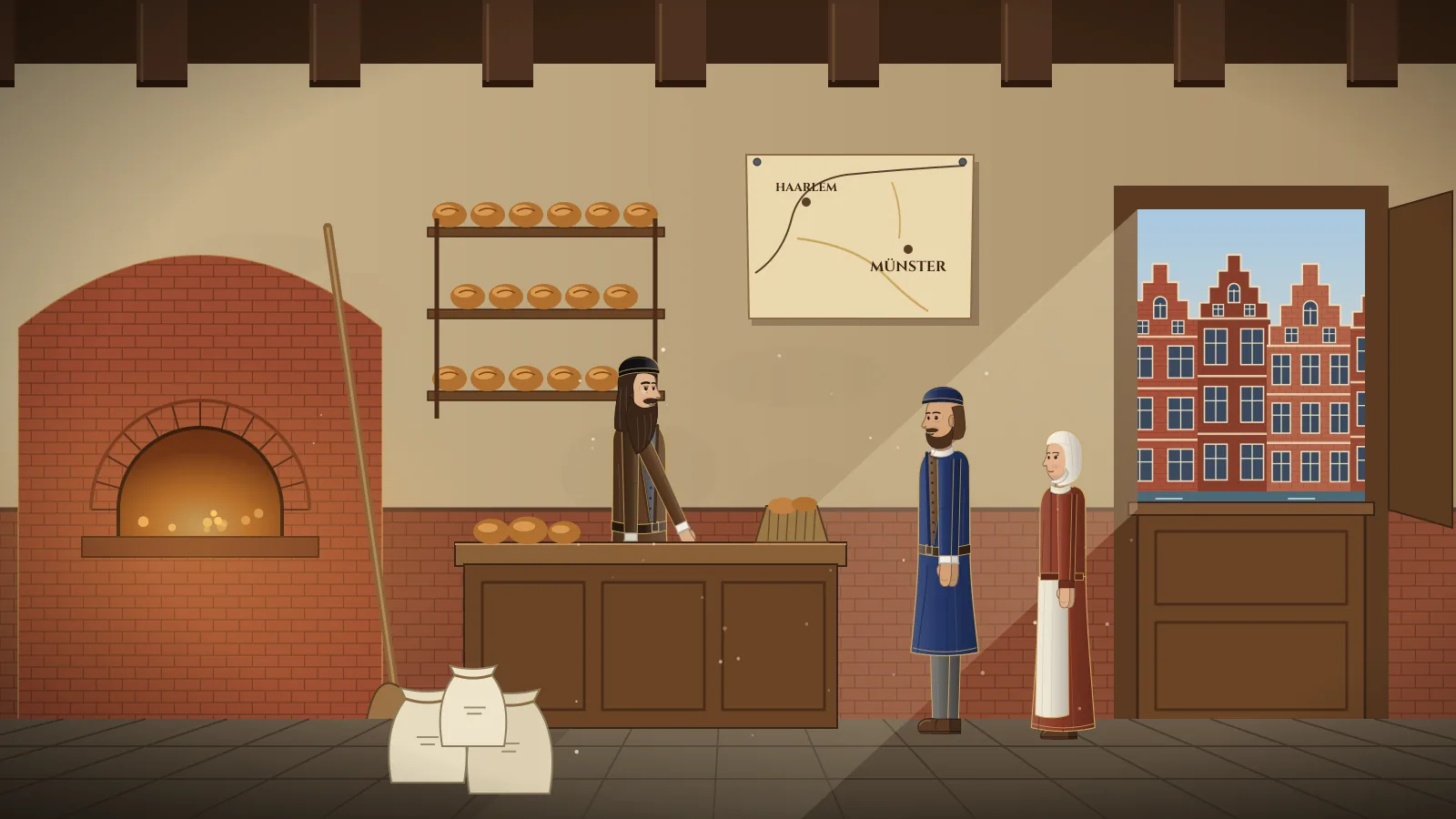
Among his followers was a baker from Haarlem, in Holland, named Jan Matthys. He claimed to be a prophet, and his message was sharper than his master’s. The faithful, he taught, should not merely wait for the end. They should prepare the way. And the chosen city was not Strasbourg. It was Münster.
Chapter IIwatch from 1:56
The Saints Arrive
Münster, in Westphalia, was a walled city of churches, guildhalls and steep-gabled houses, ruled by a prince-bishop. Its guilds wanted reform, and its most popular preacher, Bernhard Rothmann, had come to reject infant baptism.
On 5 January 1534, two messengers from Matthys arrived and began to baptise adults. The news spread from house to house, and within weeks well over a thousand people had been rebaptised. Among the newcomers was a young tailor from Leiden, Jan Beukelszoon, remembered as Jan van Leiden. He had once acted in an amateur theatre society, and he knew how to hold a crowd.
In early February, after a tense armed stand-off in the market square, the council granted freedom of faith. Anabaptists from the Netherlands began to stream in through the gates. On 23 February they won the council election, and a cloth merchant, Bernhard Knipperdolling, became mayor. Jan Matthys himself had now arrived, to lead the saints.
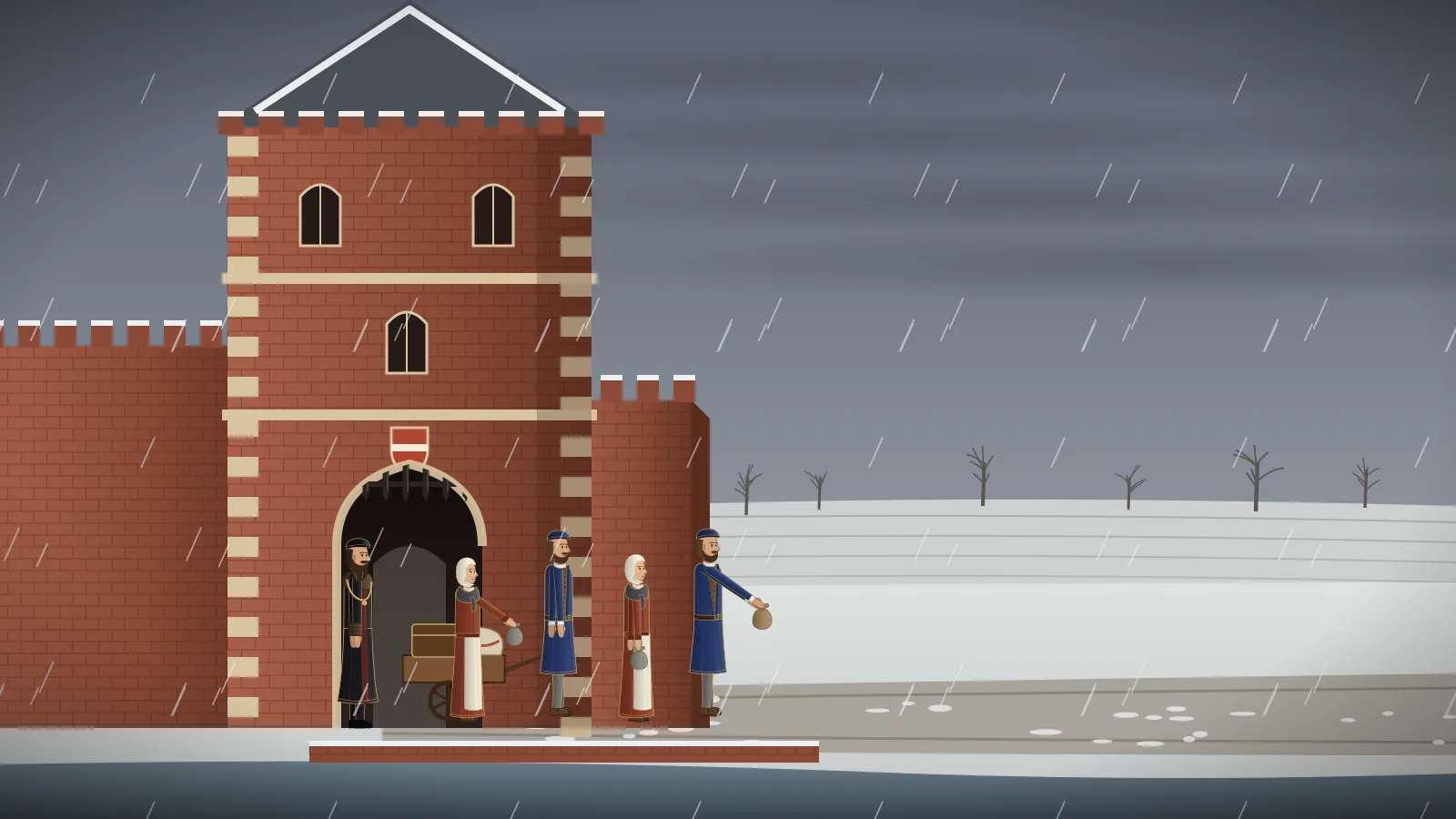
Four days later, everyone who refused rebaptism was ordered out of the city. By one account, a cutting wind was blowing, with sleet. Families carried what they could through the gates and onto the frozen roads.
About 2,000 people left their homes behind.
About 2,000 people left their homes behind. Their houses and their food went to the believers who stayed.
Chapter IIIwatch from 3:22
A City Under Siege
The prince-bishop, Franz von Waldeck, gathered hired soldiers and laid siege to his own city. Camps and earthworks began to ring the walls, and the roads to Münster filled with tents and wagons.
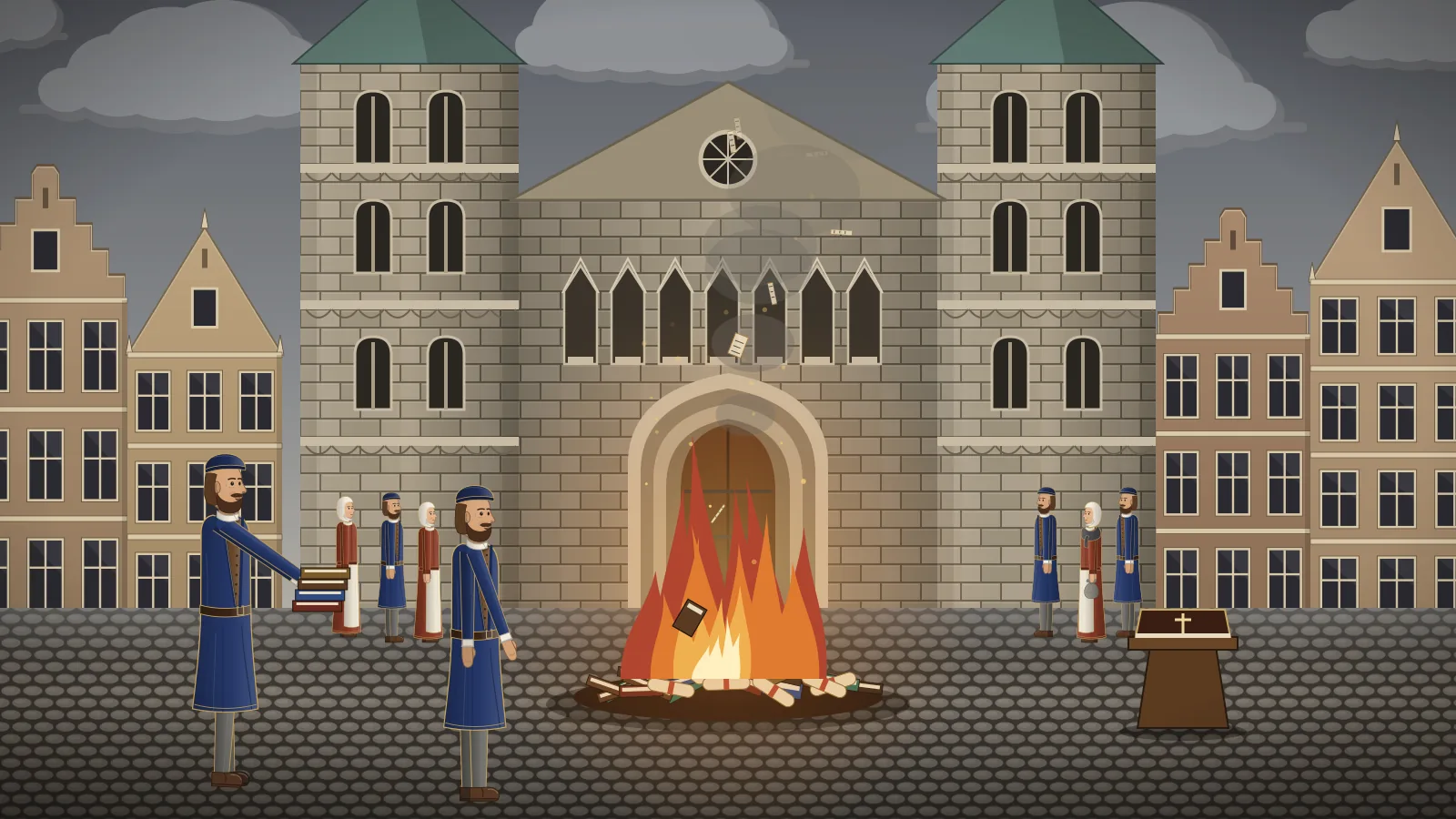
Inside, a new order took shape. Private property was largely abolished, and so was money. Food was handed out from common stores. In March, on the cathedral square, the books were burned. Only the Bible was spared. Deeds and records of debt went into the flames as well, as though the old world’s accounts could be closed for ever.
Matthys had foretold that the end would come at Easter 1534. On Easter Sunday he rode out of a gate, with a handful of men, against the besiegers. He seems to have believed that God would protect him.
He never came back.
He never came back. Leadership passed to Jan van Leiden, only 25 years old. He replaced the council with 12 elders, like the 12 tribes of Israel.
The besieged city now held about two women for every man, and women helped to repair and guard the walls. In June, a young woman named Hille Feicken slipped out of the city, hoping, like Judith in the Bible, to kill the bishop. She was caught, and put to death.
In July, Jan van Leiden proclaimed that men could take more than one wife, as the patriarchs of the Old Testament had done. Many inside the walls resisted. At the end of July, a group of townsmen rose up against the new law. The rising was crushed, and dozens of them were executed. Outside, the bishop’s army tried twice to storm the walls, in May and again at the end of August. Both times, the defenders drove them back.
Chapter IVwatch from 5:13
The Tailor on the Throne
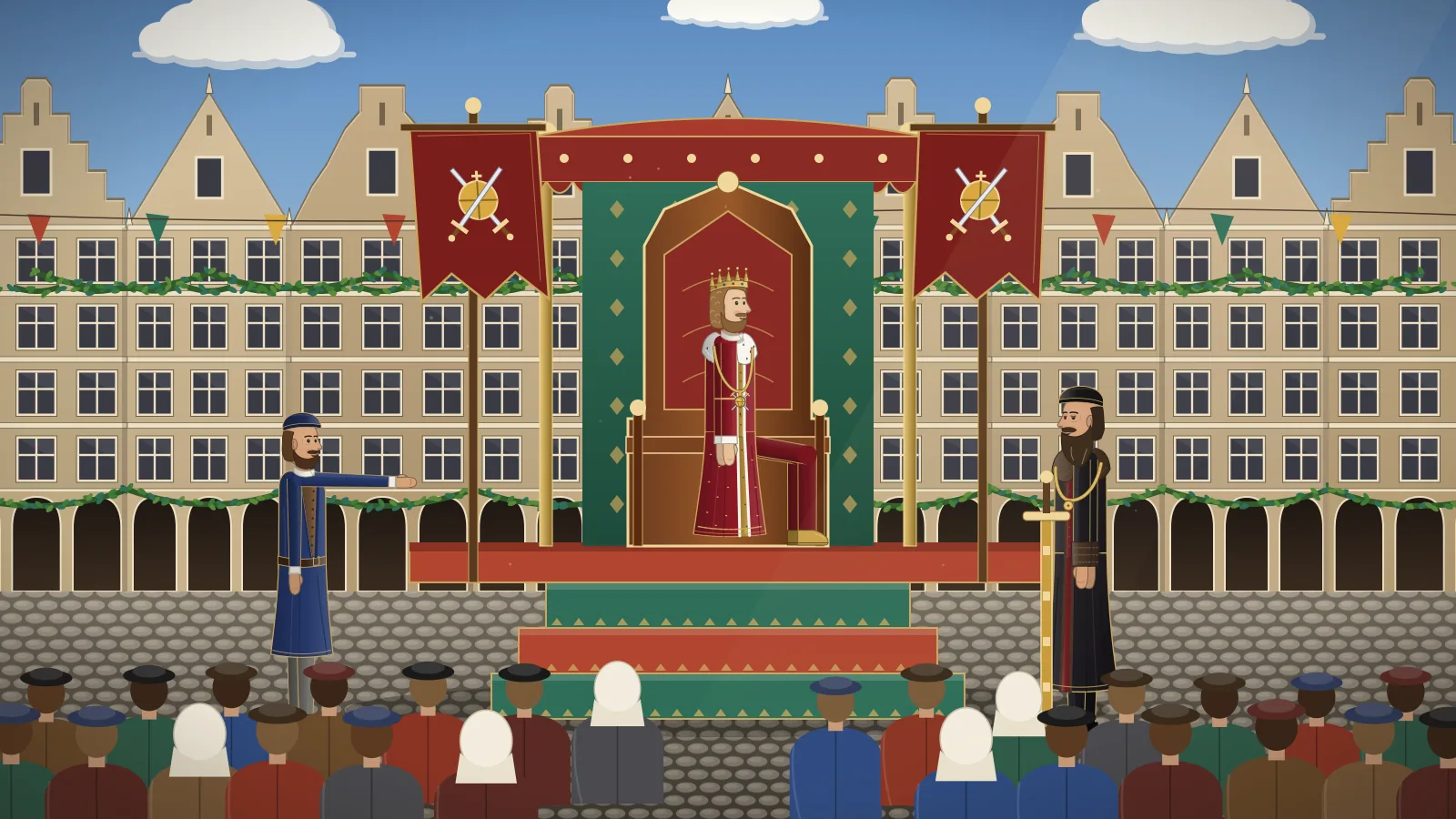
A few days after the second victory, a goldsmith from the nearby town of Warendorf, who claimed to be a prophet, proclaimed Jan van Leiden king. The tailor became king of the New Zion. He wore a crown, and a golden chain that held a globe pierced by two swords.
The tailor became king of the New Zion.
According to later accounts, three times a week he sat on a throne in the market square, and gave judgement. He married Divara, the widow of Jan Matthys, and made her his queen. In all, he took 15 more wives.
The city struck its own coins, not to spend, since money had been done away with, but to carry a message. They bore words, not pictures: “The Word was made flesh.” Even streets and gates were given new names, as if the city itself were being born again.
In October, the king sent out 27 apostles to raise other towns for the kingdom. They walked out along the roads of Westphalia with the message of the New Zion. Most of them were captured, and put to death.
Chapter Vwatch from 6:14
Hunger and the Night Gate
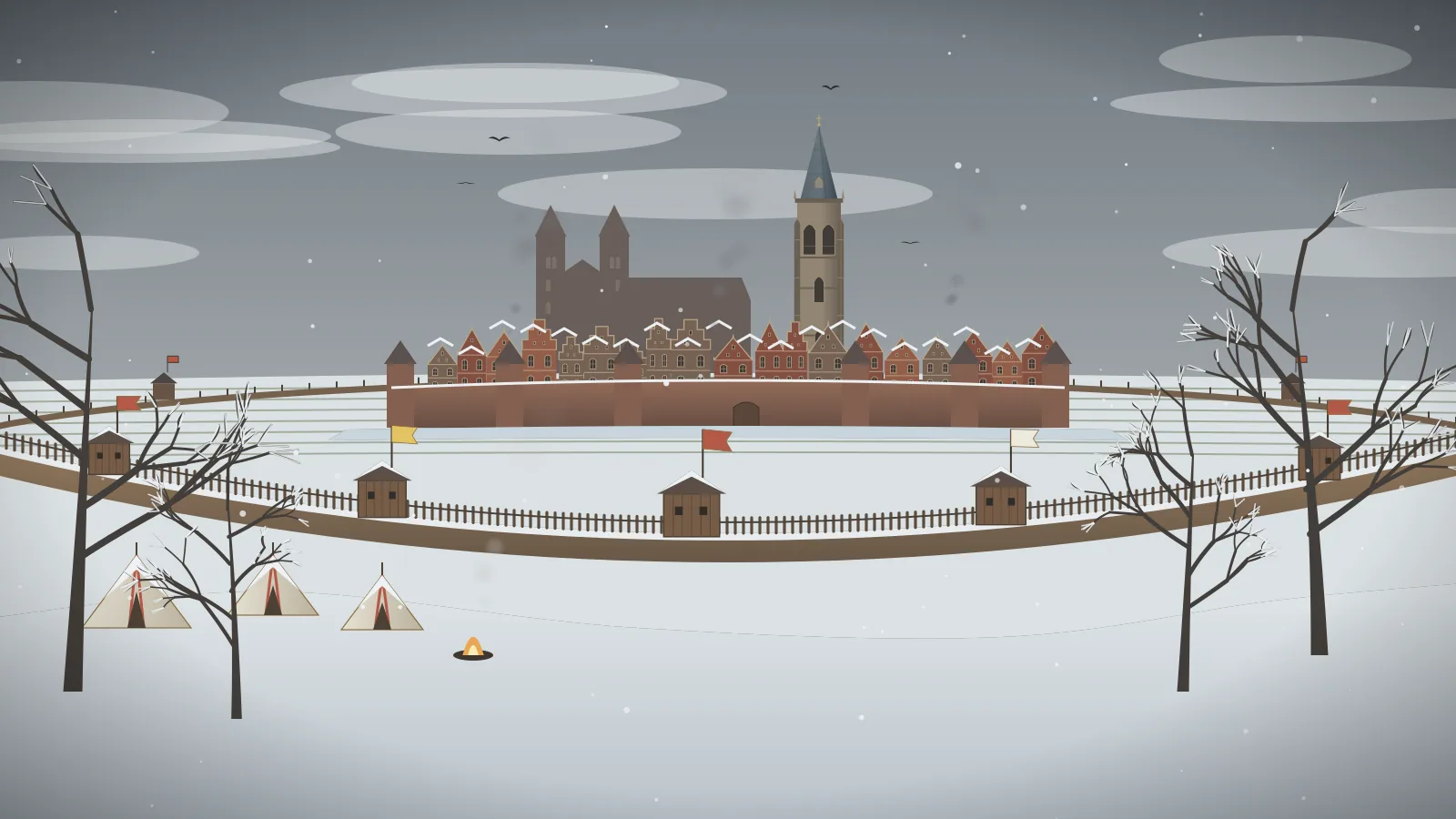
Neighbouring princes, Catholic and Lutheran alike, now sent help to the bishop. Through the winter, the blockade tightened, until almost nothing could pass in or out.
By the spring of 1535, the city was starving. According to one eyewitness, people ate the horses, and then dogs, cats and rats. Some were allowed to leave. Many found themselves trapped in the open ground between the walls and the siege lines, with nowhere to go.
That eyewitness was a carpenter, Heinrich Gresbeck. He escaped by night, was captured, and helped the besiegers plan their way in. On the night of 24 June 1535, guided by Gresbeck and another deserter, a small force slipped into the city in the dark.
Within hours, the kingdom was over.
Within hours, the kingdom was over. Hundreds of defenders were killed, many after they had surrendered. Rothmann, the preacher who had first turned the city towards the rebaptisers, was never found.
Chapter VIwatch from 7:21
Three Iron Cages
Jan van Leiden, Knipperdolling and another leader, Bernd Krechting, were taken prisoner. For months, they were questioned.
On 22 January 1536, the three men were publicly put to death in the market square. Their deaths were meant as a warning. A blacksmith had forged three iron cages. The bodies were placed inside, and hoisted up the tower of St Lambert’s, where the whole city could see them.
There they stayed, by most accounts for around 50 years. In time, the bones were taken away. The cages remained.
The cages remained.
Almost everything we know about the kingdom comes from its enemies. Gresbeck had helped to betray the city. Catholic and Lutheran writers had every reason to paint it as a den of tyranny. One famous story says that the king beheaded one of his own wives in the market square. It comes from hostile sources, and cannot be fully proven.
Chapter VIIwatch from 8:22
The Peaceful Heirs
For centuries, rulers used Münster to brand every Anabaptist a rebel. Yet most had never shared its dream. In 1527, the Swiss Brethren had already vowed never to take up the sword.
Yet most had never shared its dream.
In that same January of 1536, a Frisian priest named Menno Simons left the Catholic Church. Many historians think his own brother had died the year before, in a failed Anabaptist rising. Menno helped gather the scattered Dutch Anabaptists into a firmly peaceful movement, and condemned the violence of Münster. His followers became known as Mennonites.
From the peaceful strands of the movement came the Mennonites, the Amish and the Hutterites. Today the wider Anabaptist family counts about 2 million baptised believers. They are known for pacifism and service, not for revolution.
In Münster, the old tower of St Lambert’s was pulled down in 1881. When the new tower was finished, in 1898, the original cages were hung up again. In 1987, the artist Lothar Baumgarten placed a small light in each cage. He called the work Three Will-o’-the-Wisps.
So the cages still hang above the market, empty and faintly glowing: a reminder of the months when waiting for the end of the world became a besieged kingdom.