
The story of the film
Scandinavia, Iceland and the Viking world · c. 750–1100, and its afterlife to today
On 21 April 1971, a chilly but sunny Wednesday, a Danish navy ship sailed into the harbour of Reykjavík, the capital of Iceland. A great crowd was waiting on the quay, with a brass band and scouts carrying flags. Sailors carried three wrapped packages ashore, and a police van drove them away.
Inside one of them was a small, worn book of dark vellum, full of poems about the gods of the Vikings. Yet no Viking wrote it. A Christian copied it out around 1270, long after Iceland gave up the old gods. To understand what the Vikings really believed, we have to understand why.
Chapter Iwatch from 0:43
A Faith Without a Book
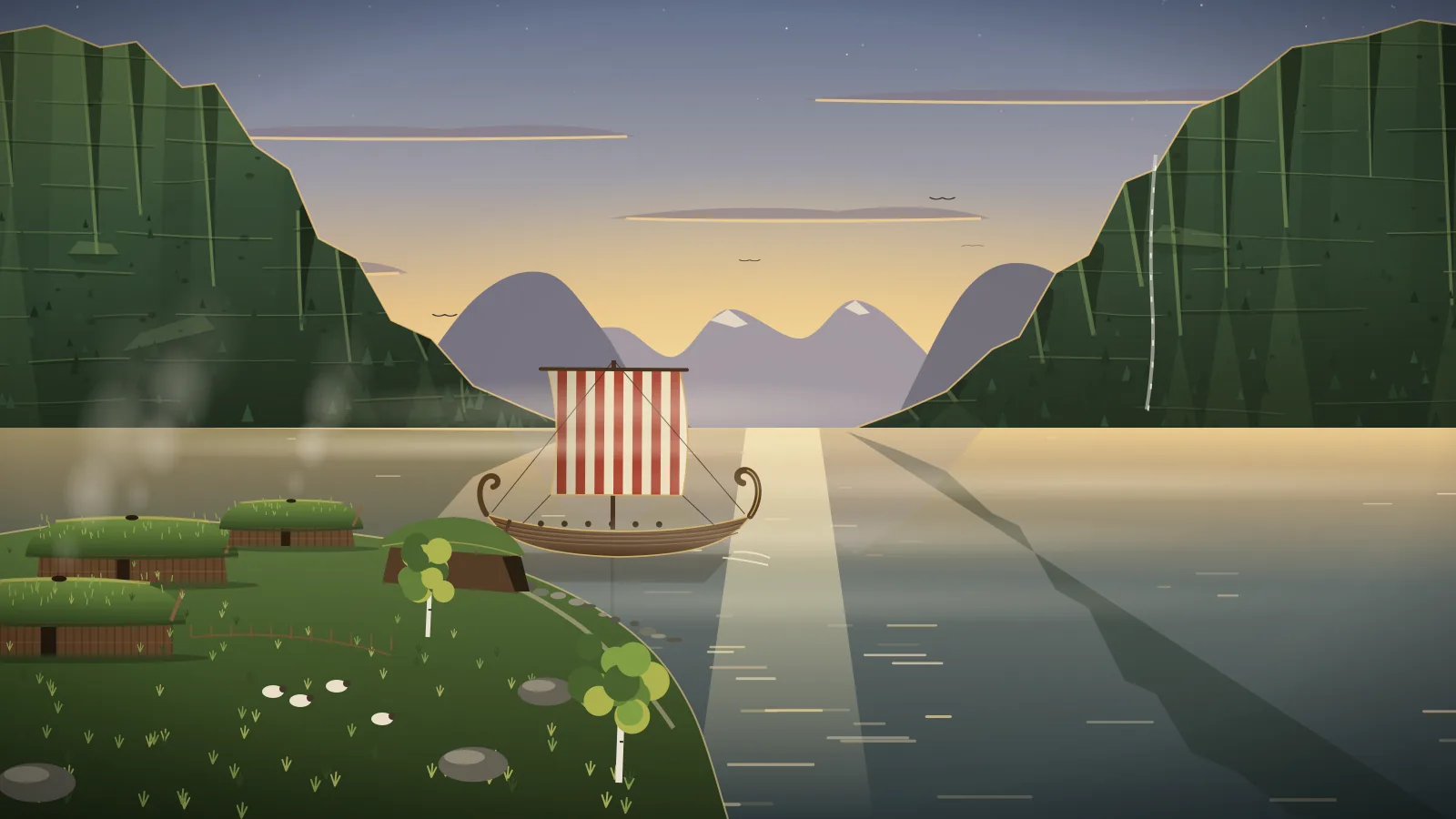
Between about 750 and 1100, Scandinavians sailed out from the fjords as traders, raiders and settlers. They reached Dublin in the west and Russia in the east, and crossed the open ocean to Iceland and Greenland.
They had no church, no creed and no holy book. There were no bishops to settle what was true and no councils to write it down. Religion lived in the farm and the hall, in the turning of the seasons and the care of the family, and it differed from valley to valley.
They had no church, no creed and no holy book.
They wrote little: short messages in runes. About 3,000 Viking Age runestones are known, most of them in Sweden. Most simply remember the dead. Only a few mention the gods. For the rest of the story, we must turn to people who lived later.
Chapter IIwatch from 1:23
The Christian Who Kept the Gods
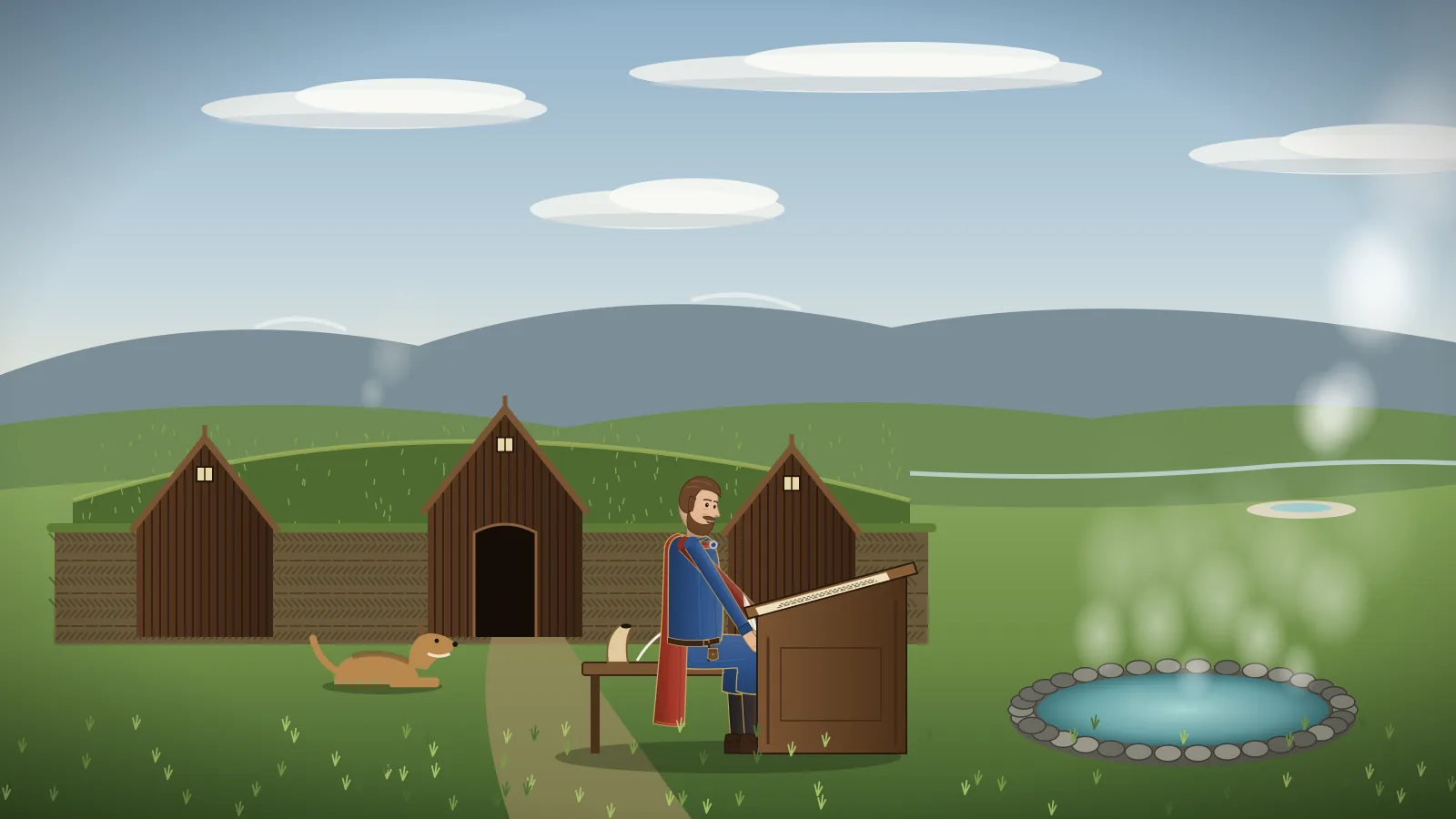
Around 1220, at Reykholt in western Iceland, a chieftain and poet named Snorri Sturluson wrote the book we call the Prose Edda. It was a handbook for poets. The old verse was thick with names and riddles drawn from the myths, and a young poet who did not know the stories could not understand it.
Snorri was a Christian. In his prologue, he explained the gods as ancient kings from Asia, whom people later mistook for gods. That was a learned way of keeping the old tales without honouring them as true, and scholars still debate how far Snorri ordered, or reshaped, what he had received.
About 50 years later, an unknown scribe copied some 30 older poems into the small book from the harbour: the Codex Regius, the King’s Book. How old those poems really are, no one can say. Some may go back to the Viking Age. Others may echo Christian ideas.
How old those poems really are, no one can say.
Where the book was for nearly four centuries is unknown. In 1643 it belonged to Brynjólfur Sveinsson, the Lutheran bishop of Skálholt. In 1662 he sent it as a gift to the king of Denmark, Frederick III, and it went into the Royal Library in Copenhagen. That is how it got its name, and why one day it had to sail home.
Chapter IIIwatch from 2:32
Nine Worlds and a Tree
The book opens with its greatest poem, the Völuspá, the prophecy of a seeress. “Hearing I ask from the holy races,” she begins, and she tells the history of the world from its first moment to its last.
In the beginning, the myths say, there was only a yawning gap between realms of ice and fire. From their meeting came the first giant, Ymir. The god Odin and his brothers killed him, and shaped the earth from his flesh and the sky from his skull.
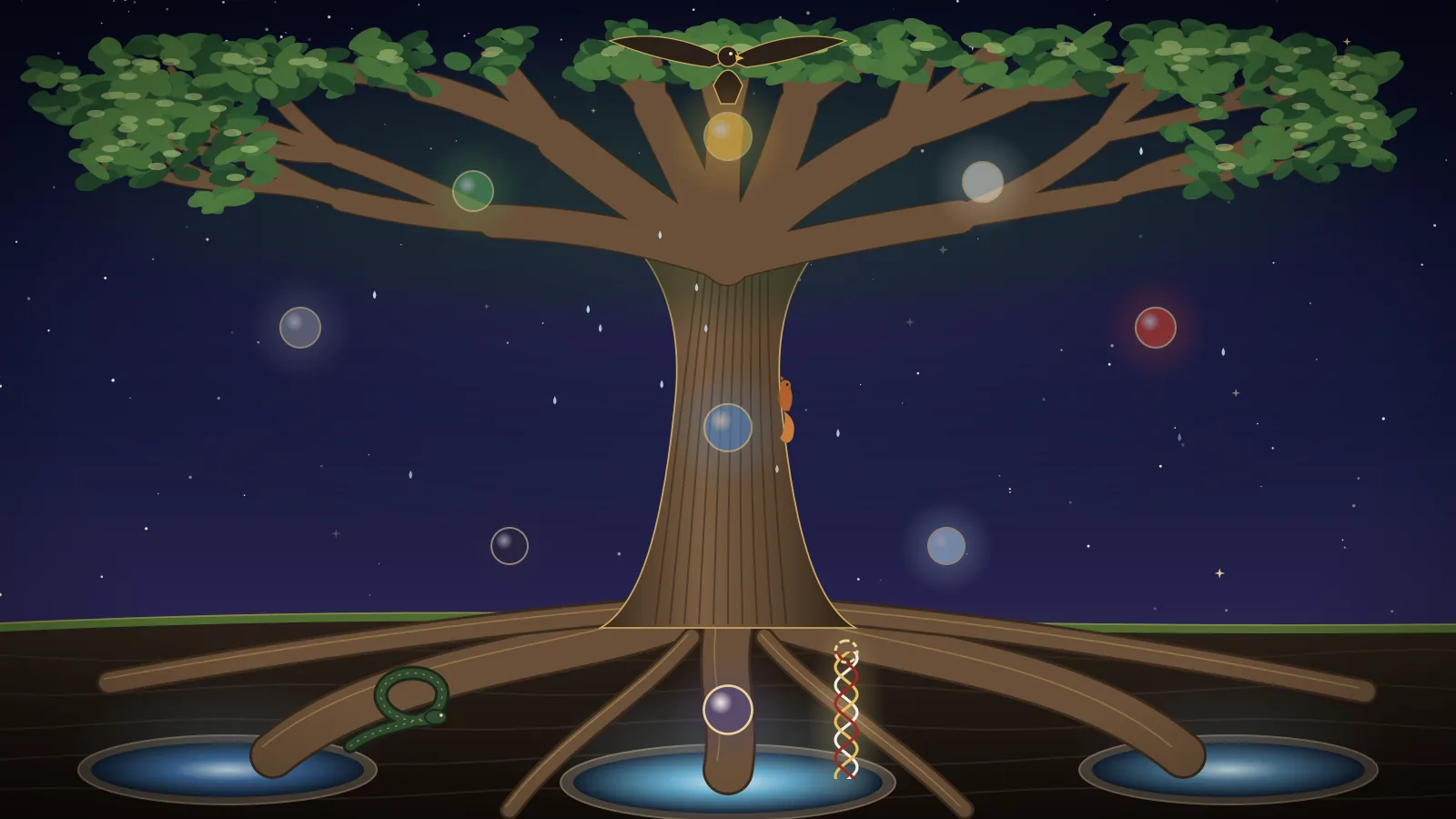
At the centre stood Yggdrasil, a vast ash tree, binding nine worlds: Asgard for the gods, Midgard for humans, and others for giants, elves and the dead. By its roots, three women called the Norns shaped fate. Even the gods could not escape it.
Even the gods could not escape it.
Odin was the chief of the gods, lord of wisdom, poetry, magic and the dead. The myths say he gave an eye for a drink from a well of wisdom. In the poem Hávamál, he says: “I ween that I hung on the windy tree, hung there for nights full nine.” So he won the runes.
Thor, red-bearded and hot-tempered, guarded gods and humans against the giants with his hammer, Mjölnir. Freyja, the great goddess of the Vanir, ruled over love, fertility and magic. One poem says she chooses half of the warriors who fall in battle, and Odin takes the other half to Valhalla. But most of the dead, Snorri wrote, went to Hel, a shadowy realm, unlike the Christian hell.
Chapter IVwatch from 4:24
Stones, Feasts and Offerings
Poems tell us what people imagined. Archaeology shows what they actually did. About 1,000 small hammer pendants have been found, worn at the neck like a charm. One, from Denmark, even spells it out in runes: “This is a hammer.”
On the Danish island of Funen, in the early 900s, a woman named Ragnhild raised a stone for her husband Alli, a priest. The carver added a blessing, “May Thor hallow these runes”, and a curse on anyone who dared to drag the stone away. It stood at the end of a great ship-shaped setting of stones.
May Thor hallow these runes.
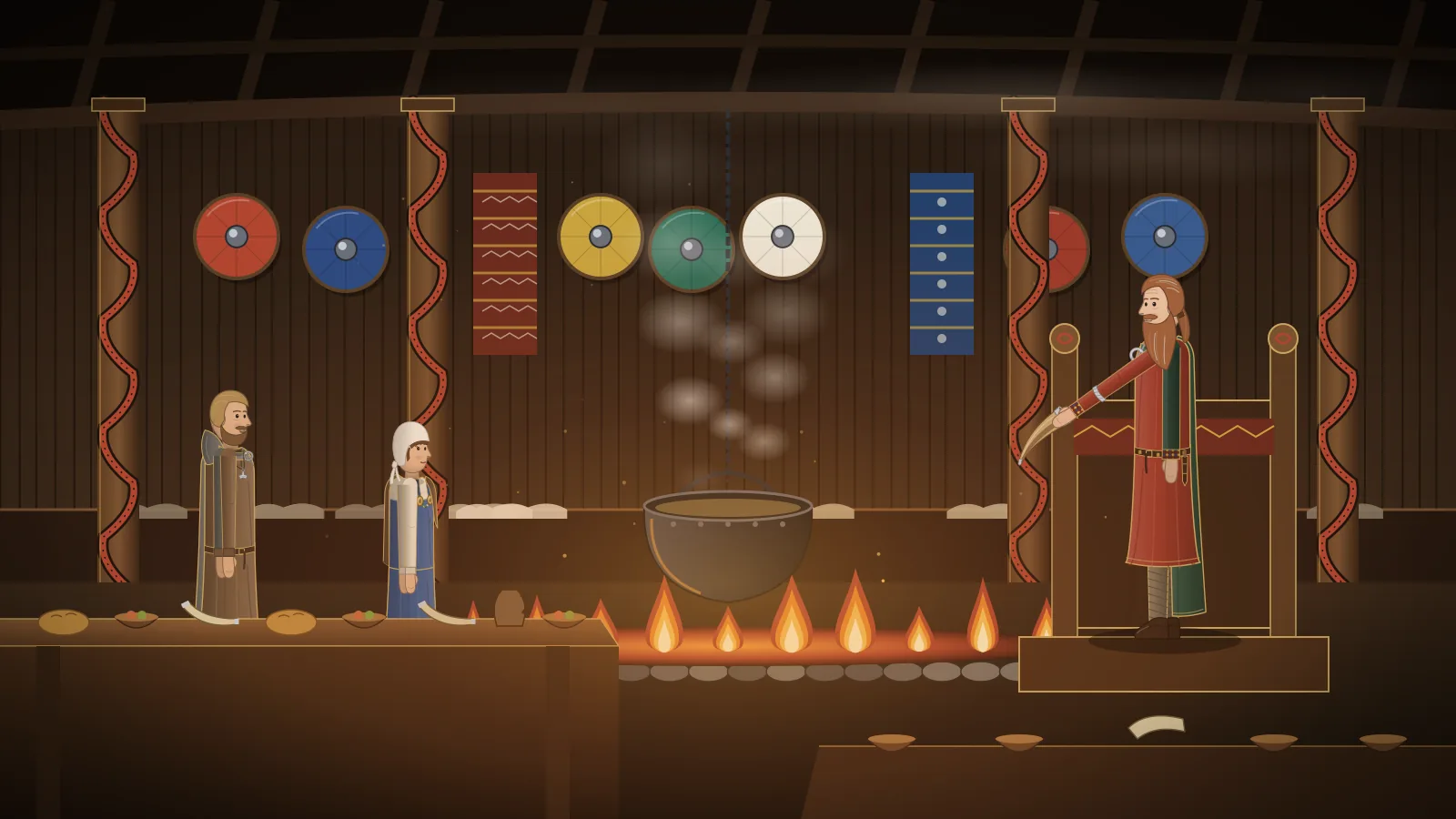
The heart of worship was the blót, a sacrificial feast. Animals were slaughtered, the meat was cooked and shared, and cups were raised to the gods for peace and good harvests. Often the chieftain led the rite in his own hall. In Iceland, the goði was both a local leader and a priest.
At Uppåkra, in southern Sweden, a small cult house was rebuilt on the same spot for centuries. In its walls lay about 200 tiny figures of gold foil. Elsewhere, weapons and jewellery were placed in lakes and bogs: gifts never meant to be taken back.
Chapter Vwatch from 5:34
Ships for the Dead
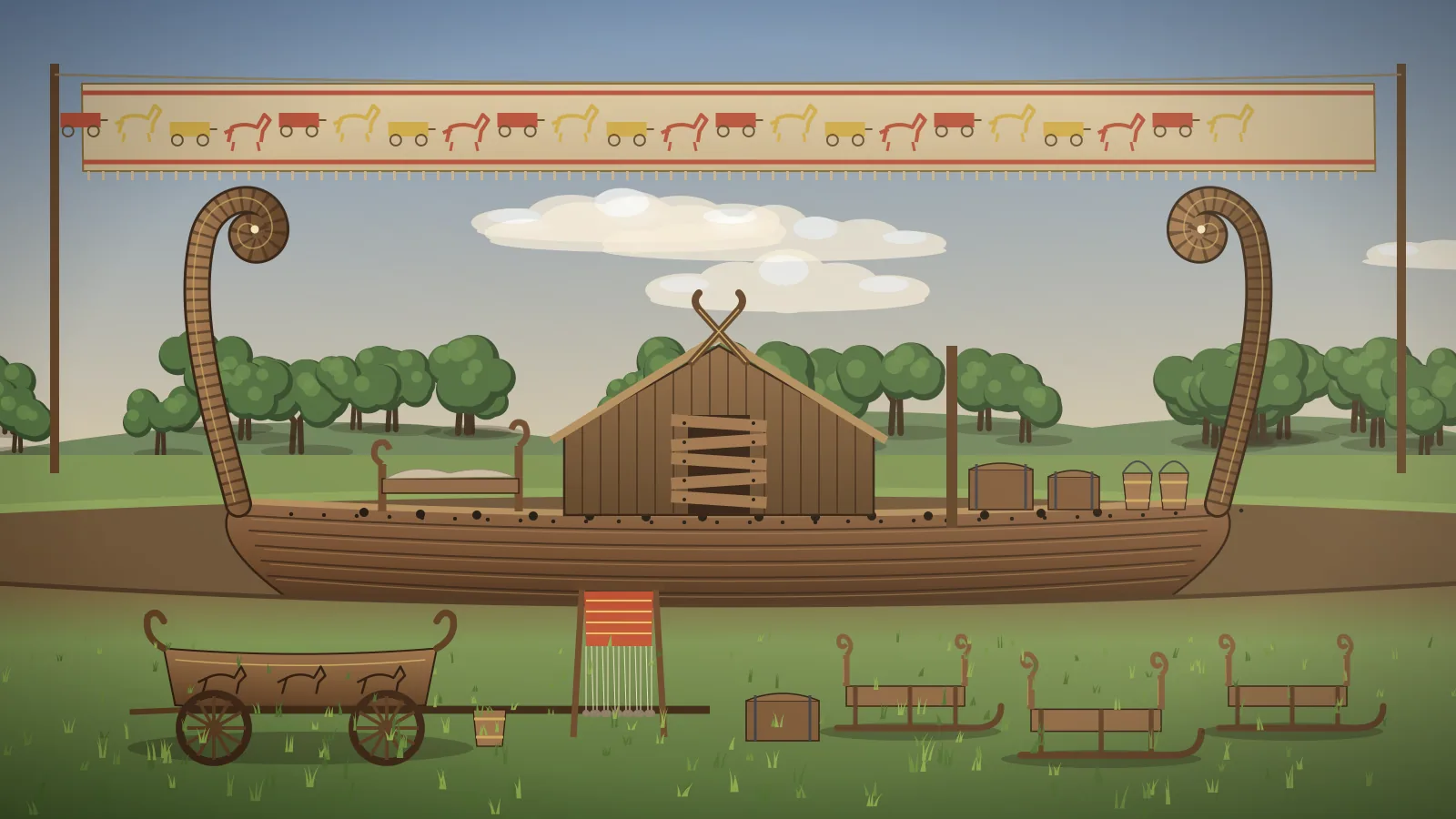
In 1904, archaeologists dug into a great mound at Oseberg, in southern Norway. Its blue clay had kept the timbers of a ship. The timber of its burial chamber was cut in 834. Two women were buried there, one of them elderly. No one knows who they were.
With them went beds, a carved wagon, sledges, a tapestry, and horses, dogs and cattle, as if for a long journey. Not far away, at Gokstad, around 900, a powerful man was laid in another ship, with hawks, and even 2 peacocks.
With them went beds, a carved wagon, sledges, a tapestry, and horses, dogs and cattle, as if for a long journey.
Outsiders wrote too. Around 1075, a German cleric, Adam of Bremen, described a temple at Uppsala, in Sweden, shining with gold. Inside, he said, stood images of Thor, Wodan and Fricco. Every 9 years came a festival of sacrifice, of animals and, he claimed, of men.
But Adam never went there. He relied on what others told him. Excavations at Uppsala have found great halls, but no certain trace of his golden temple.
Chapter VIwatch from 6:54
The End of the Old Gods
The seeress in the Völuspá also saw the end. Brothers would fight brothers, the sun would turn black, and the earth would sink into the sea. At Ragnarök, gods and giants would destroy one another. Scholars still debate how much this owes to Christian ideas of the Last Judgement.
In the real North, a different ending came. Around 965, King Harald Bluetooth raised a great runestone at Jelling, saying he had made the Danes Christian. The change was slow. In Denmark, a smith left a stone mould that cast crosses and a Thor’s hammer side by side, ready for customers of either faith.
The change was slow.
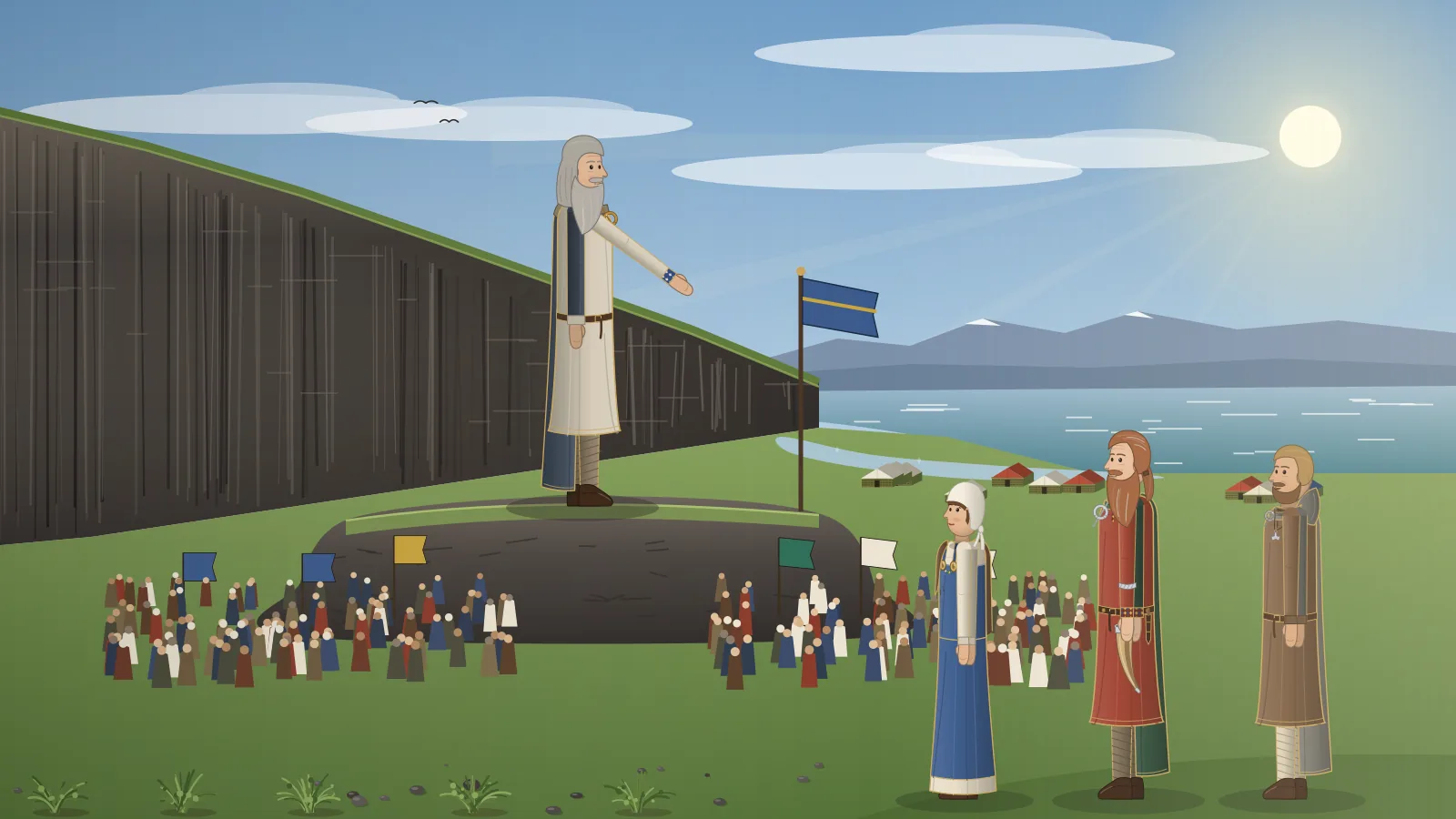
In Norway, King Olaf Tryggvason pressed the new faith hard, even on Iceland. In the year 1000, Iceland’s assembly, the Althing, was splitting in two. The lawspeaker, Thorgeir, was a pagan. According to Ari the Wise, writing over a century later, he lay under his cloak for a day and a night, without a word.
Then he called everyone to the Law Rock. If they tore apart the law, he warned, they would tear apart the peace. There would be one law, and it would be Christian. Everyone was to be baptised, though for a while private sacrifice was still allowed. A few years later, Ari wrote, that ended too.
Chapter VIIwatch from 8:25
What the North Remembers
And it was Christian Icelanders who saved the old myths, out of pride in their past and love of poetry. Without them, the gods of the North would be little more than names on stones.
In English, the week still remembers gods of the same family: Tiw on Tuesday, Woden on Wednesday, Thunor, the English Thor, on Thursday, and Frigg on Friday.
Some things people “know” are later inventions. Vikings did not wear horned helmets. That image owes much to 19th-century painters and to the costumes of Wagner’s operas. Nor did they drink from their enemies’ skulls. That came from a 17th-century mistranslation of a poetic phrase for drinking horns.
Some things people “know” are later inventions.
In 1972, a year after the book came home, a farmer and poet, Sveinbjörn Beinteinsson, helped found a fellowship in Reykjavík to honour the old gods. Iceland recognised it as a religion. Today it has more than 6,000 members. They hold their own blóts, without animal sacrifice, and believe in many ways.
The small book from the harbour is kept in Reykjavík today. And its first poem does not end at Ragnarök. After the fire and the flood, the seeress sees one thing more: “Now do I see the earth anew rise all green from the waves again.”




























































