The story of the film
Moscow, the Russian North and Siberia, Jurilovca and the Danube Delta in Romania, and Oregon and Alaska · 17th century–today
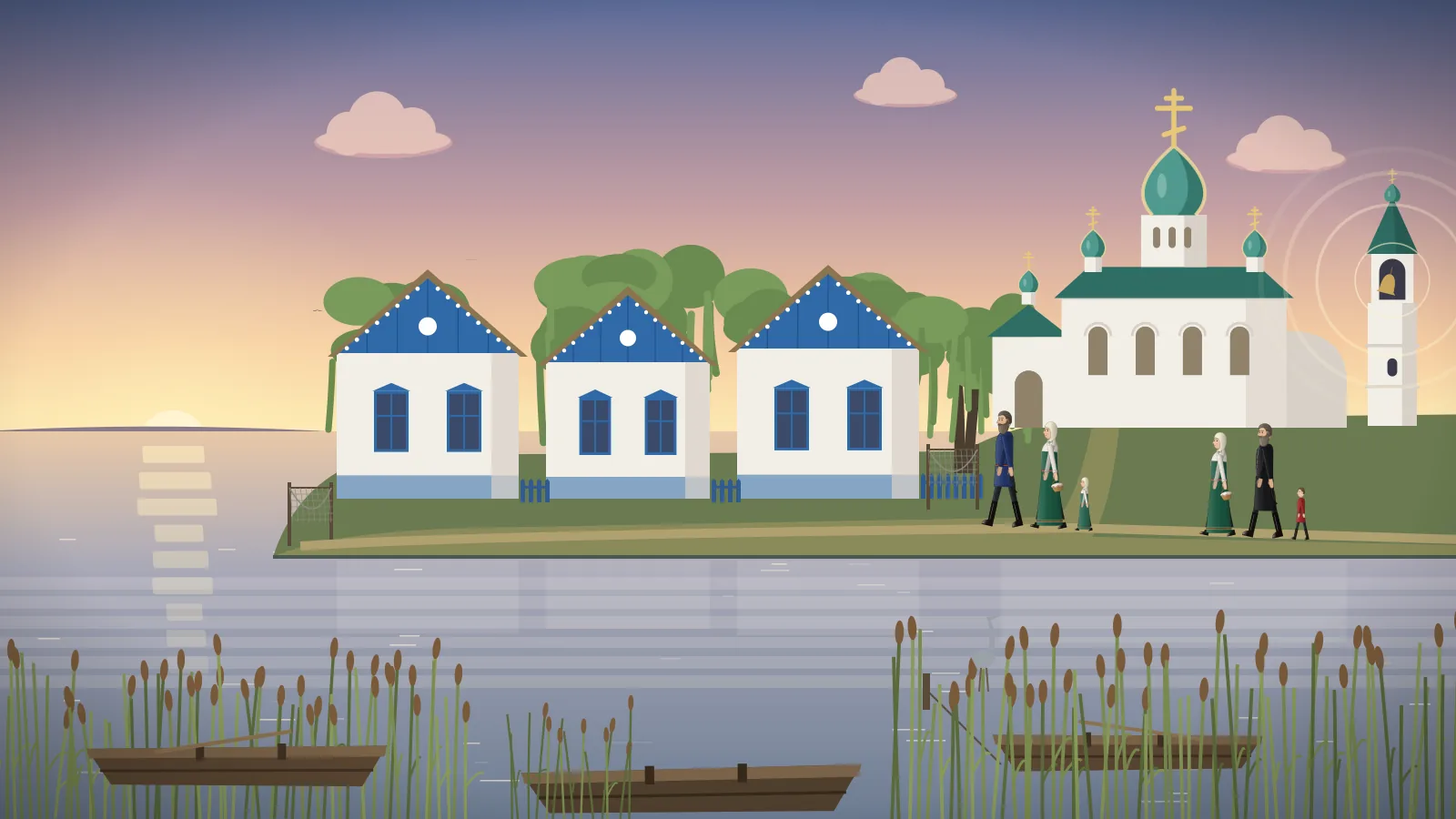
It is Easter eve in Jurilovca, a fishing village on the Razelm lagoons, at the edge of Romania’s Danube Delta. Blue and white houses stand dark along the shore, and flat wooden boats rest among the reeds. Families walk toward the lit church: the women with covered baskets, the men with small candles. They are Lipovans, Russian-speaking Old Believers, whose ancestors came to these waters long ago to keep their faith. Inside, as is the custom, men stand on the right and women on the left, their hair covered. There are no pews and no instruments, only candles and an old chant sung in one voice. Many hold a lestovka, a leather prayer rope shaped like a ladder. The service follows the books of Russia as they were before 1652.
Chapter Iwatch from 0:59
The Third Rome
The Rus received Christianity from Byzantium in 988. Over the next six centuries their church grew its own ways of praying, of singing, and of copying its books by hand. When Constantinople fell to the Ottomans in 1453, Moscow came to see itself as the last free guardian of true Orthodoxy: the Third Rome.
Yet Russian books differed from Greek ones. The name of Jesus was spelled differently, as Isus. Russians sang the Alleluia twice, not three times, and their processions turned the other way. Most visible of all, Russians made the sign of the cross with two fingers, for the two natures of Christ, divine and human. The Greeks used three.
Chapter IIwatch from 1:50
Nikon’s Reforms
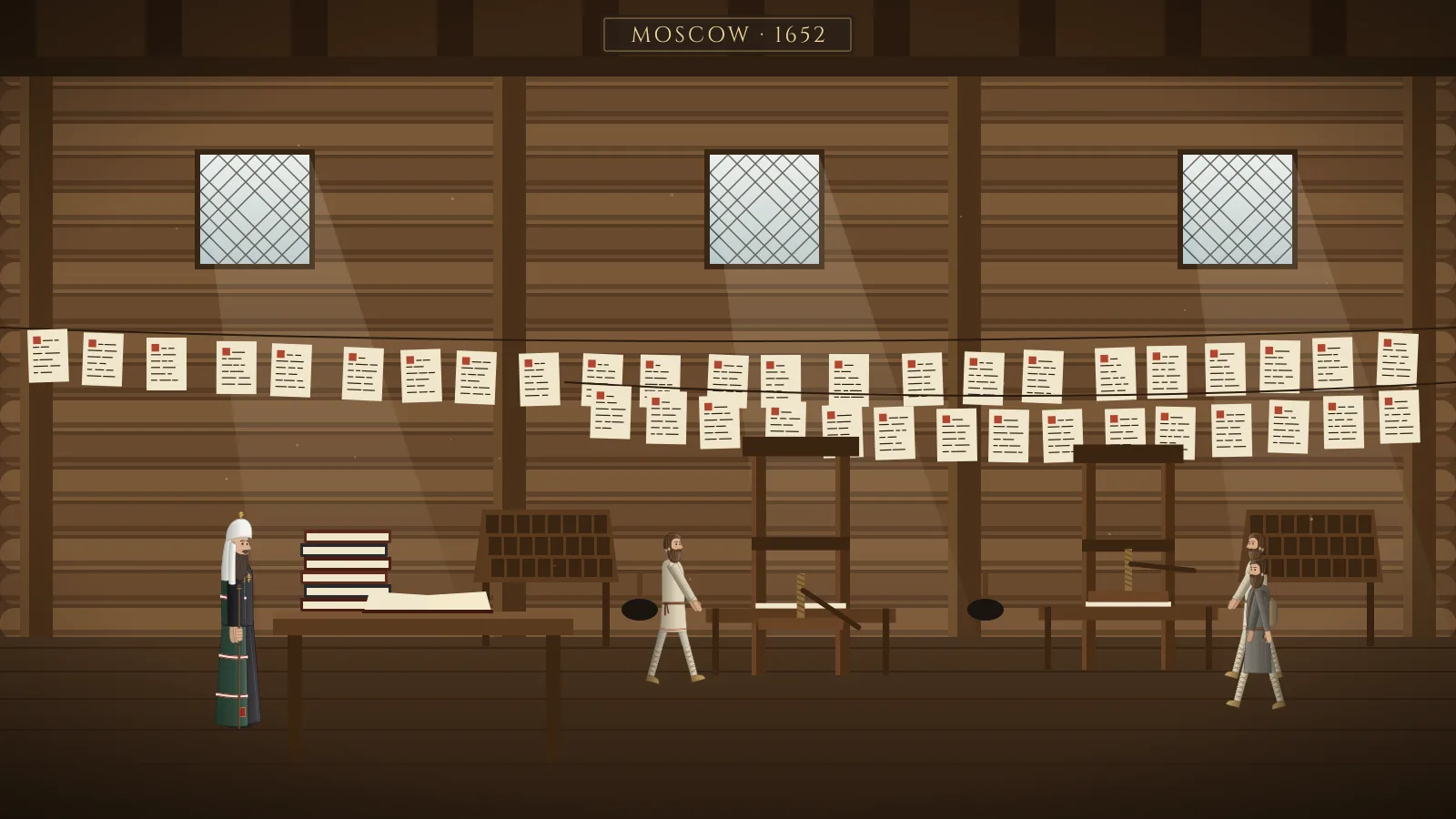
In 1652 Nikon, a monk of great energy, became Patriarch of Moscow. With Tsar Alexis behind him, he set out to bring Russian worship into line with Greek practice. From 1653 the Moscow Print Yard issued corrected books, and the faithful were told to cross themselves with three fingers.
The reformers had their reasons. Hand copying, they believed, had let errors creep into the books over the centuries. And the tsar hoped to unite the Orthodox, from Kyiv to the Greek lands, in one practice.
Many priests and monks were appalled. A Moscow council of 1551 had confirmed the two-finger sign, and the old forms, they said, came down from the saints of Rus. The Greeks had accepted union with Rome at the Council of Florence in 1439. Why should Holy Rus change for them? To change was to say that their ancestors had prayed wrongly.
Later scholars would find that many of the Russian forms were in fact older than the Greek ones that replaced them.
Nikon himself fell from favour in 1658, but the tsar kept his reforms. A great council in 1666 and 1667, attended by two Greek patriarchs, deposed Nikon yet confirmed his changes, and it anathematised all who refused them. This is the raskol, the schism. Those who kept the old rite were now treated as rebels against church and state.
Chapter IIIwatch from 3:27
Martyrs and Wanderers
Far to the north, on its island in the White Sea, the Solovetsky Monastery refused the new books. Government troops besieged its walls of great grey boulders from 1668 to 1676.
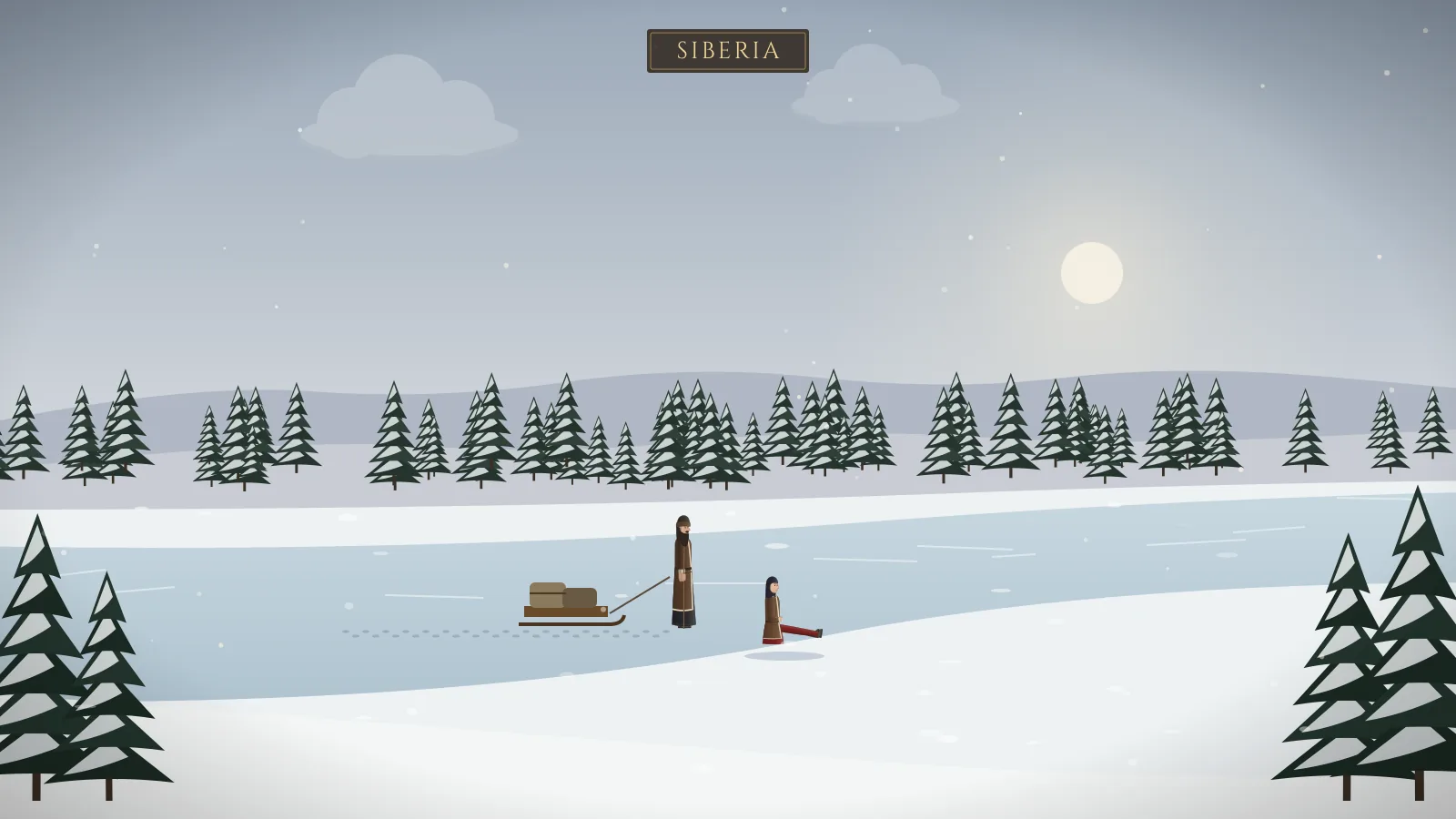
The strongest voice of the old faith was Archpriest Avvakum. He was sent into exile in Siberia with his family, and years later he wrote of a day on a frozen river there. His wife, Nastasya Markovna, slipped and fell on the ice, and asked him how long their sufferings would last.
Until death, he answered. Then let us walk on, she said.
And they walked on.
For his last fourteen years Avvakum was held at Pustozersk, by the Pechora in the far north, in an earthen cell. There he wrote his Life, one of the first great works of Russian prose. In 1682 Avvakum and his fellow prisoners were burned there, by order of the state. Old Believers honour them as martyrs.
The noblewoman Feodosia Morozova, a wealthy widow of the Moscow court, also refused the new rite. She died in prison at Borovsk in 1675, and she too is honoured as a martyr.
Many fled: to the forests of the north, to Siberia, and across the borders. Deep in the woods they built hermitages and villages of their own.
In those years some communities, sure that the end of the world had come, chose to die by fire in their chapels rather than surrender. How many died is uncertain. The self-burnings were real, but they were limited in time, and they were opposed by many Old Believer leaders, who urged endurance rather than death.
Chapter IVwatch from 5:14
Vyg and the Priestless
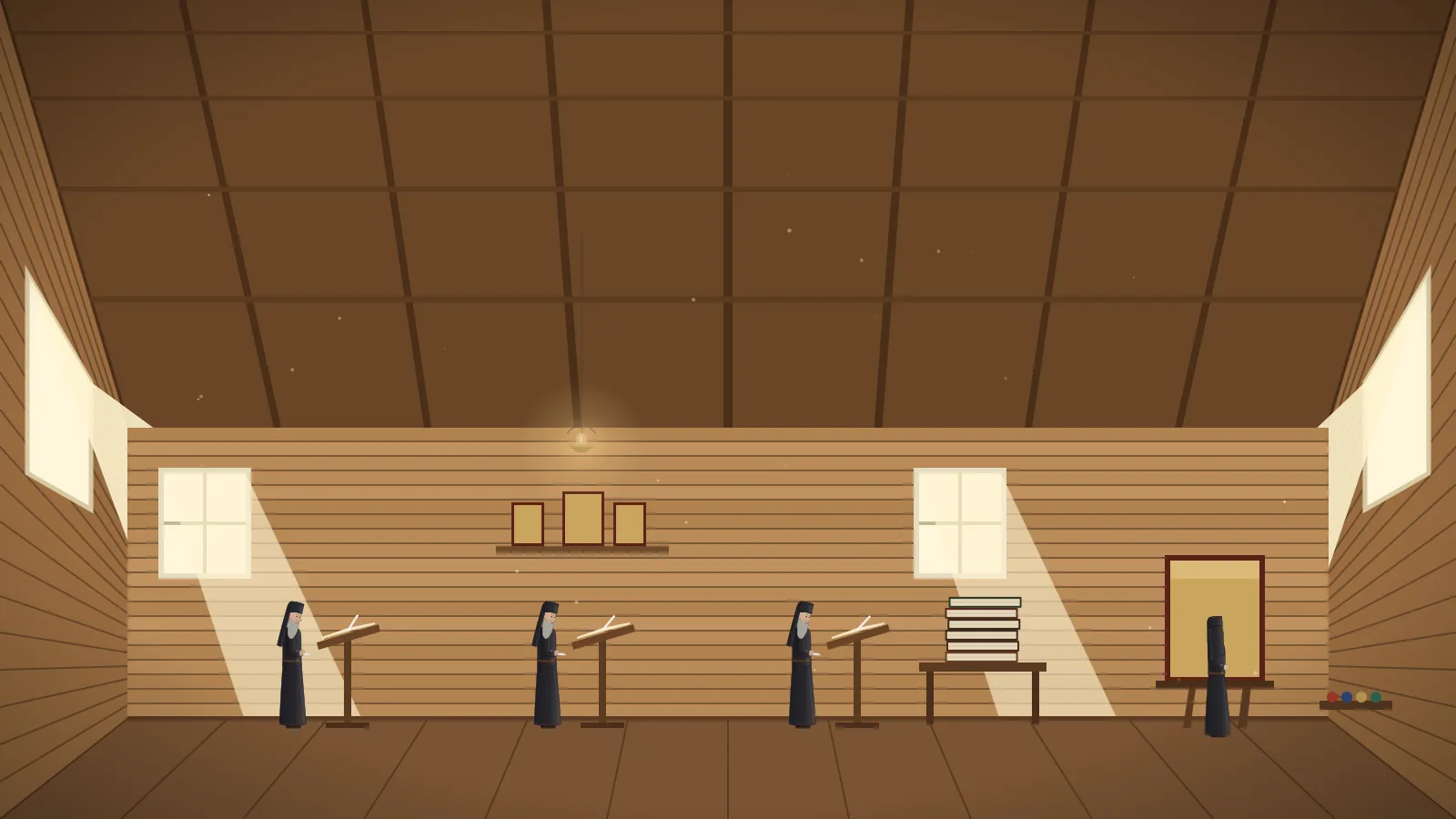
In 1694 priestless Old Believers founded the Vyg community in Karelia, among lakes and granite rocks. It became a centre of learning, where brothers and sisters copied books, painted icons and taught the chant.
That chant, the znamenny, is written not in notes but in small hook-shaped signs. It is sung in one voice, without harmony and without instruments.
Peter the Great let Old Believers register, but made them pay double taxes, and a special fee to keep their beards; copper beard tokens dated 1705 survive. For men of the old faith, the beard was part of the image of God.
The schism had left a hard question. If every bishop had accepted the reforms, where would new priests come from? The priestly Old Believers, the popovtsy, at first received priests who left the state church. The priestless, the bespopovtsy, concluded that the true priesthood had ended, and lay elders lead their prayers. Many smaller branches followed, among them the beguny, the runners, who refused all contact with the state.
In 1846 a former Greek metropolitan, Ambrose, joined the priestly Old Believers at Belaya Krinitsa, in Austrian Bukovina, and ordained bishops. Their church is centred today in Moscow, and for Romania in Brăila.
Chapter Vwatch from 6:43
To the Danube and Beyond
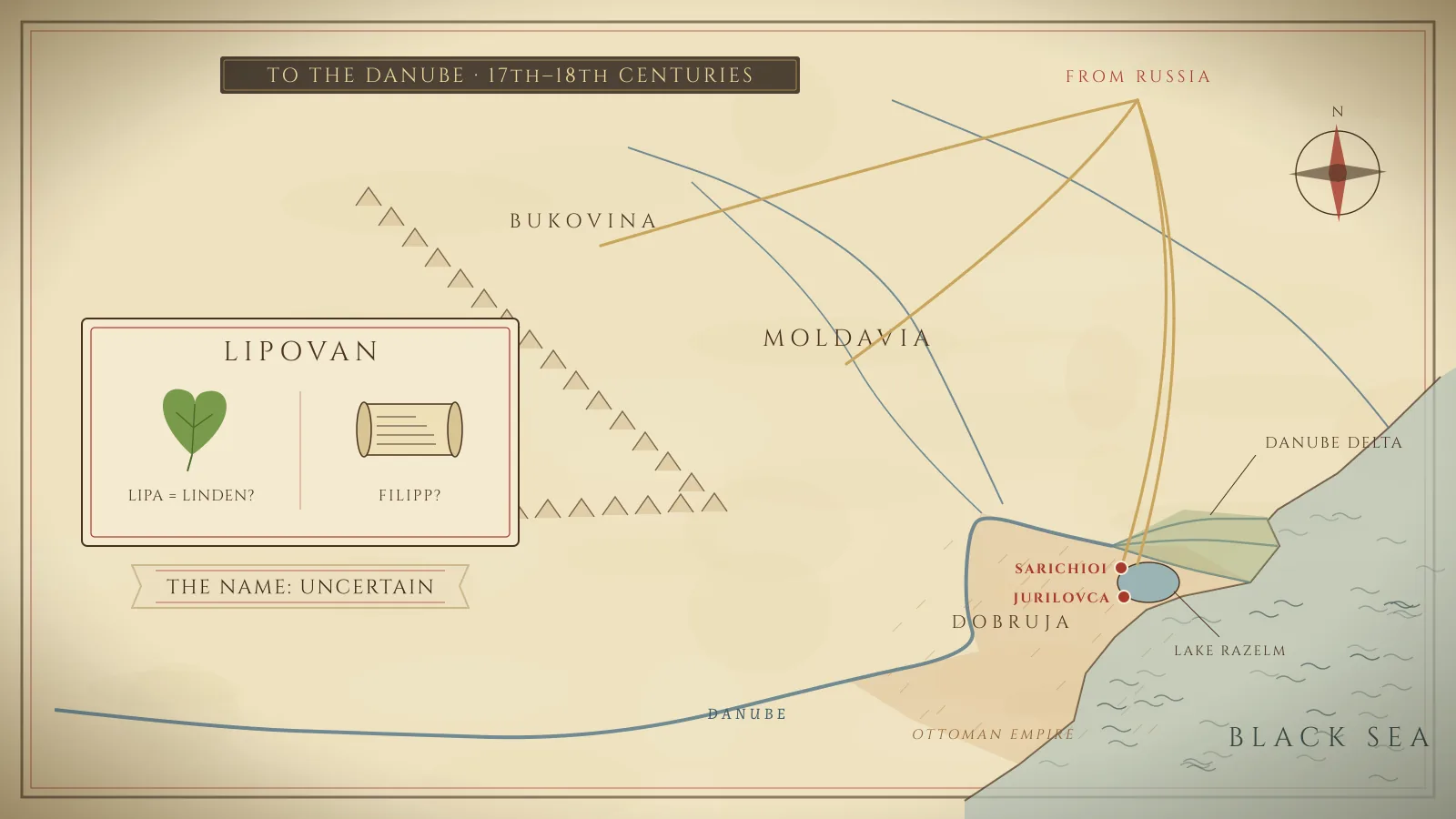
Others went south. From the late seventeenth century, and above all in the eighteenth, Old Believers settled in Moldavia, in Bukovina, and in the Danube Delta, then an Ottoman land. There they became the Lipovans. The name may come from lipa, the linden tree, or from an early leader named Filipp; nobody knows for certain.
In Russia, through two centuries of repression and grudging tolerance, Old Believers built strong merchant families, especially in Moscow.
On 17 April 1905, Tsar Nicholas II granted toleration. That Easter, the altars of Rogozhskoe in Moscow, sealed for half a century, were opened again, and hundreds of churches were built within a few years.
The freedom was short. After 1917, Soviet rule struck the Old Believers as hard as any other faith. Churches were closed, and priests and elders were arrested.
Many fled east, into Manchuria and China. When China too became Communist, these families moved on, in the 1950s and 1960s, to Brazil, Bolivia, Argentina and Uruguay. From there some came to Woodburn, Oregon, from 1964, and to Alaska’s Kenai Peninsula. A priestless community had already settled in Erie, Pennsylvania, before the First World War.
In Oregon and Alaska families farm and fish. To church the women still wear the long sarafan, and the men belted shirts.
Chapter VIwatch from 8:31
The Faith at Home
The lestovka counts the prayers. It is held low as the faithful bow to the ground, onto the podruchnik, a small cushion that keeps the hands clean for the sign of the cross.
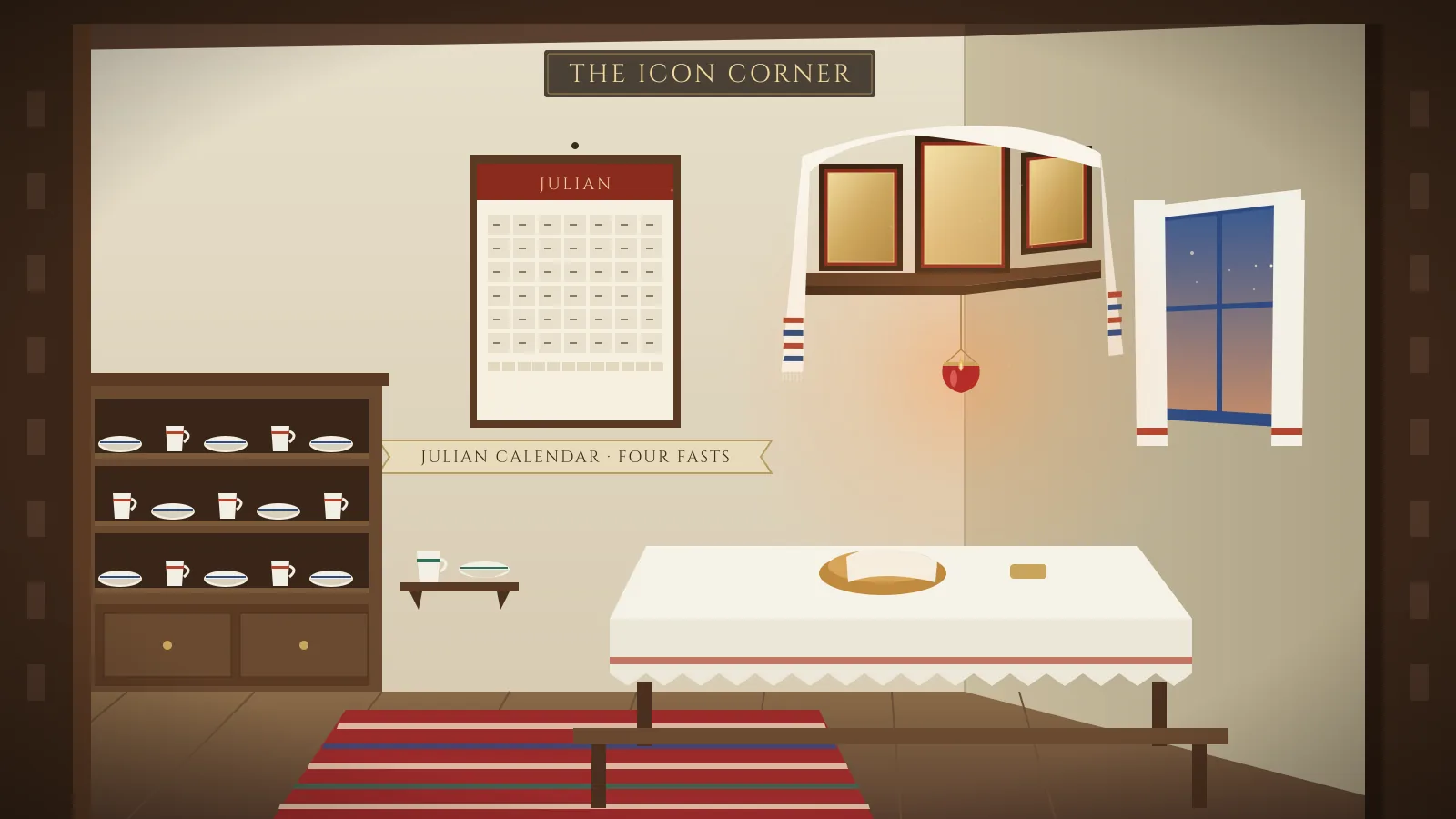
Homes have an icon corner, often with icons in the older style, and a lamp burning beneath them. Old Believers follow the Julian calendar, with four long fasts, and they fast on Wednesdays and Fridays. In stricter households each member has a cup and a bowl that outsiders do not share, a custom meant to keep the home pure.
Baptism is by full threefold immersion, and families expect children to marry within the faith. Members who marry out, or neglect the rites, may be barred from common prayer until they return.
To outsiders such rules can seem hard. Old Believers answer that this is how they have kept a small faith whole for three and a half centuries.
Chapter VIIwatch from 9:32
The Old Faith Today
In Romania the largest Lipovan community is in Tulcea County, in villages such as Jurilovca, Sarichioi and Mila 23, among channels of reeds and water lilies, where many are fishermen. The census of 2021 counted about 19,400 Lipovans in Romania. The canoeist Ivan Patzaichin, a Lipovan from Mila 23, won four Olympic golds for Romania. Other Lipovans live in Ukraine, Moldova and Bulgaria.
In 1912 the Russian census counted about 2.2 million Old Believers, surely too few. Today estimates run from one to several million worldwide.
In 1971 the Russian Orthodox Church lifted the old anathemas and recognised the old rites as equally valid. The Old Believer churches remain separate.
Chapter VIIIwatch from 10:25
What Historians Find
It is often said that the schism was only about fingers, that the old books were simply corrupt, and that the Old Believers were a movement of suicide, frozen in time.
Historians find a deeper quarrel, over authority and local faith; Russian forms older than the Greek; self-burnings real but brief, and opposed by many; and many branches, many of them living fully modern lives.
Easter morning comes to Jurilovca. Mist lies on the lake, and the bells ring in their tower. Families walk home along the shore with baskets of blessed bread. Out on the water the boats wait. And in the church, the old chant goes on, as it was sung in Moscow before 1652.