Codex of FaithsAn illustrated atlas of belief

Article of the day ·

Who was Saint Andrew? The first-called apostle and his X-shaped cross

Who Saint Andrew was in the Gospels, how he died at Patras, why his X-shaped cross flies on flags, and why Scotland, Greece, Romania, Russia and Ukraine all claim him.

In brief

  1. I.Andrew was a fisherman from Galilee and the brother of Simon Peter. In the Gospel of John he is one of the first two disciples to follow Jesus, and the only one of them named, so the Orthodox call him the Protokletos, the “First-Called”. His feast day is 30 November.
  2. II.An old tradition says he was crucified at Patras in Greece. The X-shaped cross, now called the saltire or Saint Andrew’s cross, is a later, medieval detail of the story.
  3. III.He is the patron saint of Scotland, whose flag is his white saltire on blue, and of Greece, Russia and Ukraine; the Romanian Orthodox Church proclaimed him protector of Romania in 1997.
  4. IV.Because Peter is linked with Rome and Andrew with Constantinople, the two brothers stand for the two great churches: each year Rome sends a delegation to the Ecumenical Patriarch on Andrew’s feast.

The story in a minute

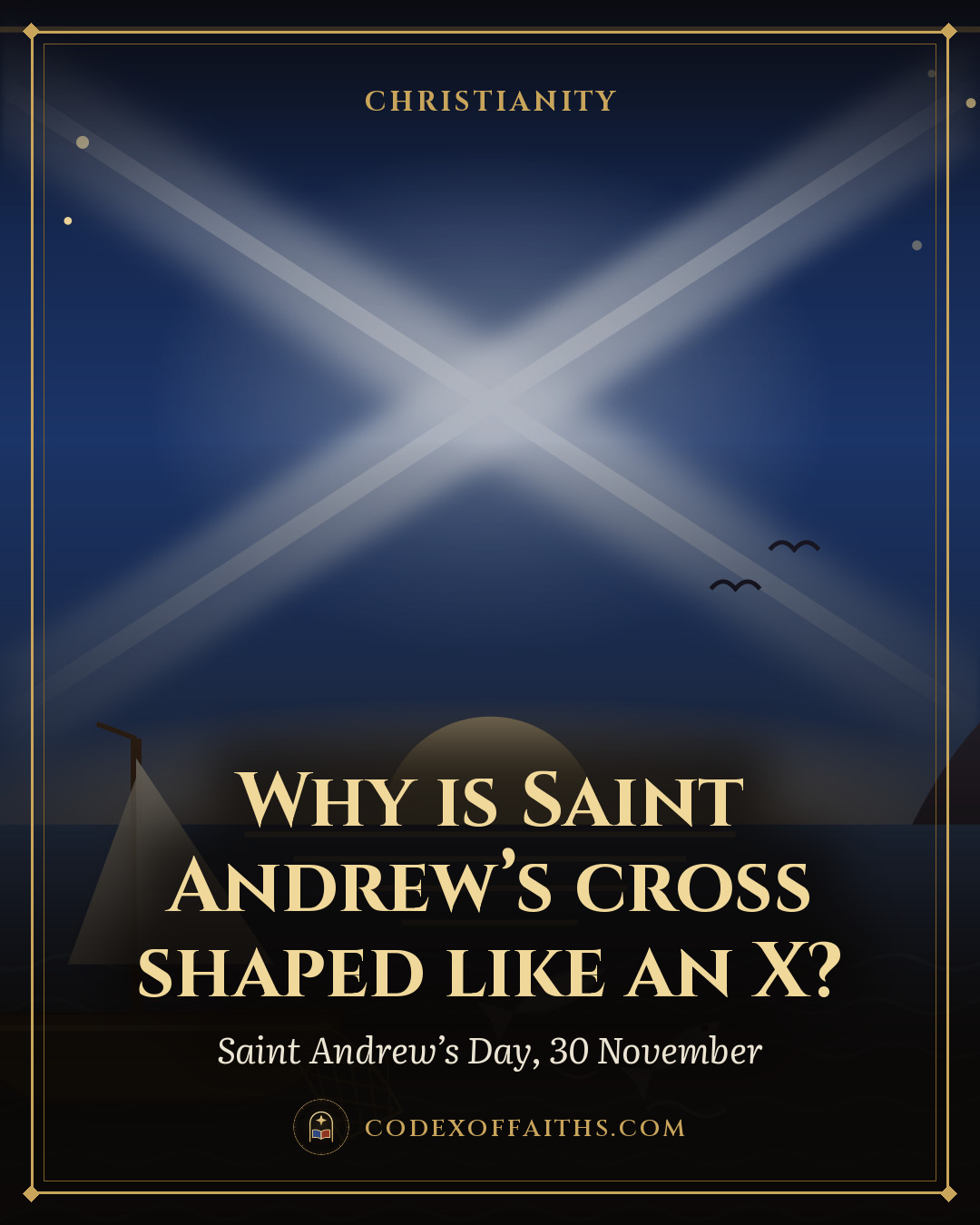
A small fishing boat with a net on a calm sea at dawn, two fish leaping beside it, and a white X-shaped cross of light across the blue sky above a rocky shore with a lone chapel; no figures shown.
Illustration: Codex of Faiths

On 30 November, Christians from Edinburgh to Athens, Bucharest and Kyiv keep the feast of the same man: Andrew, a fisherman from Galilee and the brother of Simon Peter. Very little is known about his life, yet several countries claim him as their patron, and his X-shaped cross flies on flags and naval ensigns. Who was he, and how did one fisherman come to belong to so many peoples?

Chapter I

The fisherman who brought his brother

The Gospels place Andrew among the first followers of Jesus. In Mark, Jesus sees two brothers, Simon and Andrew, casting a net into the Sea of Galilee and calls them to become “fishers of people”. The Gospel of John tells it differently: Andrew is first a disciple of John the Baptist, hears him point to Jesus, and follows Jesus home for the day. Then he finds his brother and tells him, “We have found the Messiah,” and brings him along. John names Bethsaida, by the lake, as the town of Andrew and Peter.

That small scene gave Andrew his title in the Eastern churches: the Protokletos, the “First-Called”. In John he appears twice more, always bringing someone: the boy with five barley loaves and two fish before the feeding of the five thousand, and a group of Greeks who want to see Jesus. His name is Greek too, Andreas, from a word meaning “man” or “manly”.

  • Fish
  • Cross
The fish, an early Christian sign, for the fisherman of Galilee.

Chapter II

Travels and a cross at Patras

After the Gospels, history fades into tradition. The church historian Eusebius, writing in the early fourth century and citing Origen, records the tradition that Andrew was allotted Scythia as his mission field, the lands north of the Black Sea. A second-century or third-century text, the Acts of Andrew, which the churches did not take into the Bible, tells of his journeys and of his death at Patras, in Achaea in Greece, where a Roman governor had him bound to a cross. Andrew, the story says, kept speaking to the crowd from the cross until he died.

None of the early accounts says the cross was X-shaped. That detail belongs to medieval tradition and art, with the later explanation that Andrew did not feel worthy to die on a cross like that of Jesus. The diagonal cross became his emblem, the saltire.

Chapter III

The brothers of Rome and Constantinople

In 357, the Roman emperor Constantius II had Andrew’s relics taken from Patras to Constantinople, the new capital of the empire. Rome had Peter; the new Rome now had Peter’s brother, and the Church of Constantinople came to honour Andrew as its founder and patron. That pairing still matters. Each year on 29 June, the feast of Peter and Paul, a delegation of the Ecumenical Patriarch goes to Rome, and on 30 November a delegation from the Pope goes to the Patriarch in Istanbul.

After the Fourth Crusade, in 1208, most of the relics were carried to Amalfi in southern Italy. Andrew’s head was taken to Rome in the fifteenth century, and in 1964 Pope Paul VI returned it to Patras, as a gesture towards the Orthodox Church.

  • Candle
  • Chi-Rho
Candles and the Chi-Rho, the first two Greek letters of “Christ”.

Chapter IV

Scotland and the saltire

A medieval legend says that a monk named Rule, or Regulus, brought some of Andrew’s bones from Greece to the coast of Fife, where the town of St Andrews grew up around them. Another, recorded centuries later, tells of a Pictish king, Angus mac Fergus, who before a battle at Athelstaneford around 832 saw a white saltire in the blue sky and vowed to make Andrew patron if he won.

What is certain is that by 1320 the Declaration of Arbroath called Andrew, “the Blessed Peter’s brother”, the patron of the Scots for ever. The white saltire on blue became the flag of Scotland and one of the crosses in the Union Flag. Since 2007 a law has made Saint Andrew’s Day a Scottish bank holiday, though employers are not obliged to give the day off.

Chapter V

Romania, Russia and Ukraine

In Romania, tradition holds that Andrew preached in Scythia Minor, the land between the lower Danube and the Black Sea now called Dobruja, where a cave near the village of Ion Corvin is shown as a place where he prayed. The Romanian Orthodox Church proclaimed him protector of Romania in 1997, and since 2012 his feast has been a public holiday. In folklore, the eve of his day is a night of wolves and of the restless dead, the strigoi, kept away with garlic rubbed on doors and windows.

The Primary Chronicle, written in Kyiv in the early twelfth century, tells that Andrew sailed up the Dnieper, blessed the hills where Kyiv would later stand, set up a cross and foretold a great city with many churches. St Andrew’s Church in Kyiv, built in the eighteenth century to a design by Bartolomeo Rastrelli, stands on the hill linked to the story. In the Russian Empire, the first and highest order of chivalry, founded by Peter the Great, was the Order of Saint Andrew the First-Called, and the navy flew his blue saltire on white. Churches that keep the Julian calendar, such as the Russian Orthodox Church, celebrate him on 13 December; the Orthodox Church of Ukraine and the Ukrainian Greek Catholic Church moved to 30 November in 2023.

Chapter VI

A feast at the edge of Advent

In the Western churches, Andrew’s feast also marks the turn of the year: the first Sunday of Advent is the Sunday nearest to 30 November, so the church year begins around his day. For the Orthodox, it falls in the Nativity Fast, and in Romania fish is allowed that day. A fisherman who was among the first to follow, and the first to bring others: that is the Andrew of the Gospels, and the reason so many peoples have wanted him as their own.

Questions people ask

When is Saint Andrew’s Day?

On 30 November, for Catholics, Anglicans and the Orthodox churches that use the revised calendar, such as the Greek and Romanian churches. Churches that keep the Julian calendar, such as the Russian, celebrate on 13 December. In the Western churches, the first Sunday of Advent is the Sunday nearest to 30 November.

Why is Saint Andrew’s cross shaped like an X?

The earliest accounts of his death say he was crucified at Patras but do not describe the cross. The X shape appears in medieval tradition and art, with the later explanation that Andrew felt unworthy to die on a cross like that of Jesus. The diagonal cross became his emblem and is known as the saltire.

Is Saint Andrew’s Day a public holiday?

In Romania it has been a public holiday since 2012. In Scotland the St Andrew’s Day Bank Holiday (Scotland) Act 2007 made it a bank holiday, though employers are not obliged to give the day off.

What is Saint Andrew’s Eve in Romania?

The night of 29 to 30 November. In Romanian folklore it was a night when strigoi, the restless dead, were thought to roam, and villagers rubbed garlic on doors and windows to keep them away. Andrew is also called the “apostle of the wolves”, who on that night were said to roam freely.

Sources and further reading

  1. Encyclopaedia Britannica, “St. Andrew”
  2. The Bible, John 1:35–44, 6:8–9 and 12:20–22; Mark 1:16–18 (New Revised Standard Version Updated Edition)
  3. Eusebius, The Church History, translated by Paul L. Maier (Kregel, 1999), book 3, chapter 1
  4. The Russian Primary Chronicle: Laurentian Text, translated by Samuel Hazzard Cross and Olgerd P. Sherbowitz-Wetzor (Cambridge, Mass.: Mediaeval Academy of America, 1953)
  5. St Andrew’s Day Bank Holiday (Scotland) Act 2007, legislation.gov.uk
  6. Agerpres, “Sărbători: Sfântul Apostol Andrei cel întâi chemat, Ocrotitorul României – Zi nelucrătoare (30 noiembrie)” (30 November 2025)