Codex of FaithsAn illustrated atlas of belief

Article of the day ·

What is the Presentation of Mary? The girl in the Temple, in Christianity and Islam

Why Christians keep a feast on 21 November for a three-year-old Mary taken to the Temple, where the story comes from, and how the Quran tells it of Maryam and Zechariah.

In brief

  1. I.On 21 November Catholics, Orthodox and other Christians remember how Mary, the mother of Jesus, was brought to the Temple in Jerusalem as a small child. The Orthodox call it the Entry of the Theotokos into the Temple and count it among their twelve great feasts.
  2. II.The story is not in the Bible. It comes from the Protoevangelium of James, a Greek text of the second century, which tells that Mary was taken to the Temple at three and lived there until she was twelve.
  3. III.The Quran tells a related story: Maryam’s mother dedicated her child to God, Zechariah became her guardian, and whenever he entered her mihrab he found food that God had given her.
  4. IV.Both tellings echo the Hebrew Bible’s story of Hannah, who brought her young son Samuel to the sanctuary at Shiloh to serve God for life.

The story in a minute

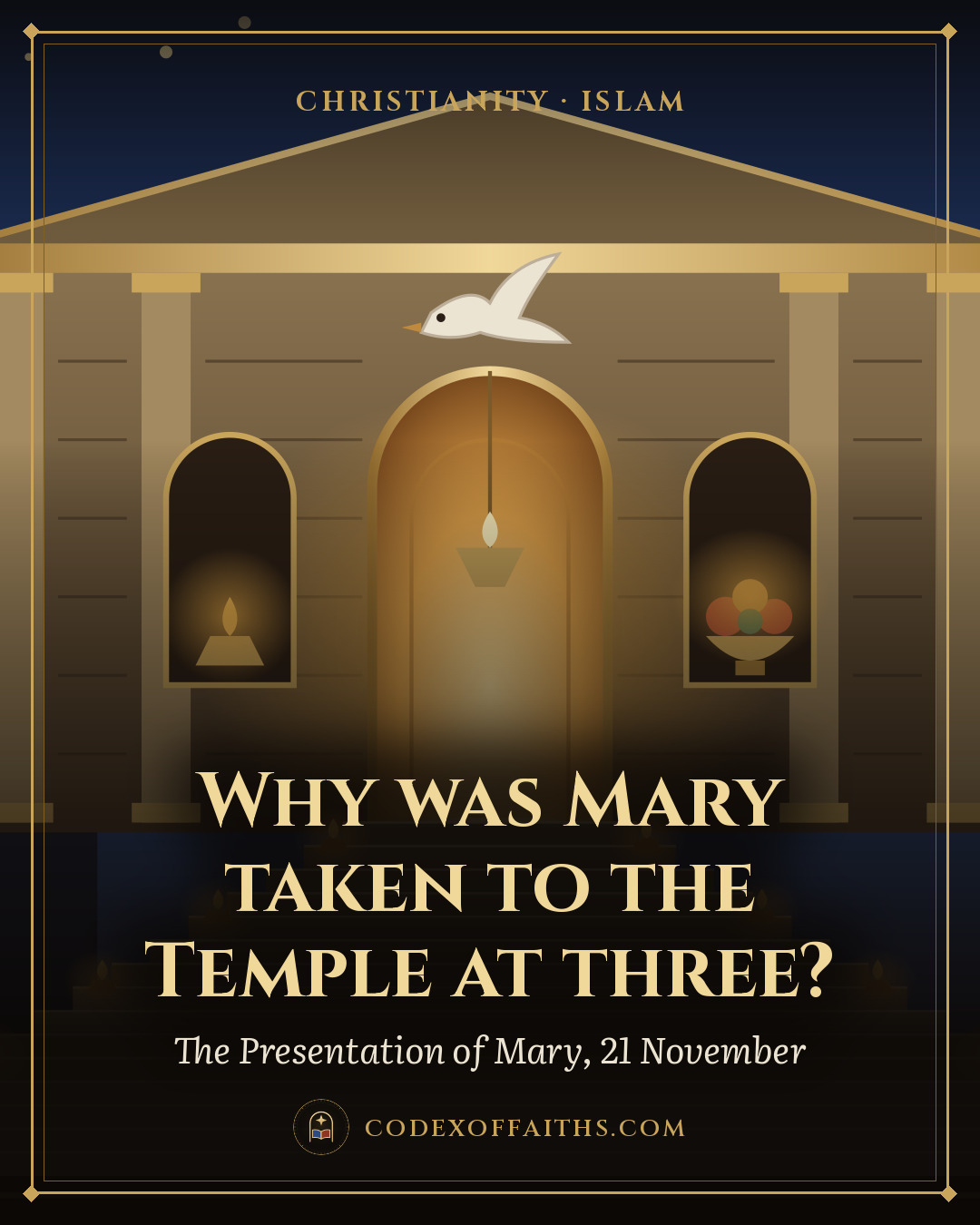
Fifteen stone steps rising to a lamplit temple doorway at night, small oil lamps burning along the steps, a dove above the door and a bowl of fruit in an arched niche beside it; no figures shown.
Illustration: Codex of Faiths

On 21 November, Catholic and Orthodox Christians keep a feast for a moment the Bible never mentions: the day a three-year-old Mary, the future mother of Jesus, was brought by her parents to the Temple in Jerusalem. The Orthodox count it among their twelve great feasts of the year; for Catholics it is a quieter memorial. A story of the same girl, dedicated to God before she was born, is also told in the Quran. Where does it come from, and why do two faiths remember it?

Chapter I

A story from the second century

The Gospels say almost nothing about Mary before the Annunciation. The gap was filled by a Greek text now called the Protoevangelium of James, the “first gospel” of James, written probably in the second century. It tells of a wealthy, childless couple, Joachim and Anna, who pray for a child and promise to give it to God. When their daughter Mary is three, they take her to the Temple, with girls carrying lamps before her so that she will not turn back. The priest kisses her, blesses her and sets her on the third step of the altar, and she dances there, and “all the house of Israel loved her.”

Mary stays in the Temple, the text says, “nurtured like a dove”, and receives her food from the hand of an angel. When she turns twelve, the priests decide she can no longer live in the sanctuary, and a husband is found for her: an elderly widower, Joseph, chosen when a dove flies out of his staff.

Historians see the story as a work of devotion, not a record. Nothing in Jewish sources of the time speaks of girls living in the Temple, and the author shows no detailed knowledge of how it worked. But the text was copied, translated and loved for centuries, and much of what Christians picture of Mary’s parents and childhood comes from it.

Chapter II

How it became a feast

The feast is traditionally linked to the dedication of a great church of Mary, the New Church or Nea, which the emperor Justinian built in Jerusalem and which was consecrated on 20 November 543. By the eighth century it was kept in Constantinople, where the patriarch Germanus preached on it. In the Eastern churches it became the Entry of the Most Holy Theotokos into the Temple, Theotokos meaning “God-bearer”, usually rendered “Mother of God”.

The West came to it late. In 1372 Pope Gregory XI celebrated it at Avignon, after a French knight, Philippe de Mézières, brought it from Cyprus. Pope Pius V removed it from the calendar in 1568, and Sixtus V restored it in 1585. Today it is the memorial of the Presentation of the Blessed Virgin Mary. In Venice the day has a second life: on 21 November the city crosses the Grand Canal on a bridge of boats to the church of Santa Maria della Salute, built after a vow during the plague of 1630–31.

  • Cross
  • Candle
The cross and the candle, carried in procession on the feast.

Chapter III

The feast in the Orthodox year

For the Orthodox the Entry is one of the twelve great feasts, with a day of preparation before it and four days after. It falls a week into the Nativity Fast, which begins on 15 November, and fish is usually allowed that day. At the service of the feast the church sings for the first time in the year the opening hymn of the Christmas canon, “Christ is born, glorify him!”: the girl entering the Temple is seen as the first step towards the birth to come.

In Romania the feast is Intrarea în Biserică a Maicii Domnului, known in the countryside as Vovidenia or Ovidenia, from the Slavonic name. Churches on the Julian calendar, such as the Russian and Serbian, keep the same feast on 4 December. The Coptic Church remembers Mary’s entry into the Temple on 3 Kiahk, around 12 December.

Chapter IV

Maryam in the Quran

The Quran tells a related story in its third chapter, Al Imran, “the family of Imran”. The wife of Imran, whom Muslim tradition calls Hanna, says while pregnant: “Lord, I have dedicated what is growing in my womb entirely to You.” When she gives birth to a girl, she names her Maryam and asks God to protect her and her children from Satan. God accepts the child and places her in the care of the prophet Zakariyya, Zechariah, the father of John the Baptist.

“Whenever Zachariah went in to see her in her sanctuary,” the Quran says, “he found her supplied with provisions.” When he asks where they come from, she answers that they are from God, who provides for whom he will without measure. Another verse says that men “cast their pens” to decide who would care for her; in the Christian story, staffs are used to choose her husband. The word for her room, mihrab The niche in a mosque wall that shows the direction of prayer. Glossary, later came to mean the niche in a mosque that shows the direction of prayer, and the verse about Zechariah has often been used in mihrab inscriptions. Maryam is the only woman named in the Quran, and its nineteenth chapter bears her name. Islam keeps no feast for her entry, but the story is recited and taught.

  • Crescent
  • Lamp
The crescent and the lamp: the Quran calls the room where Maryam prayed a *mihrab*.

Chapter V

Hannah and Samuel

Both tellings echo an older story in the Hebrew Bible. In the first book of Samuel, a childless woman named Hannah prays at the sanctuary of Shiloh and vows that if she has a son, she will give him to God. When the boy Samuel is weaned, she brings him to the priest Eli, and he grows up serving there; Hannah sings a song of thanks that Christians later heard again in Mary’s own song, the Magnificat. The names match too: Anna in Greek and Hanna in Arabic are forms of the Hebrew Hannah.

In Judaism the story of Hannah is read on Rosh Hashanah, and her silent, moving lips are taken as a model of heartfelt prayer. A child given to God, a mother’s vow, a holy place that becomes a home: a similar pattern runs through all three faiths, told each time in its own way.

  • Torah
  • Menorah
The Torah and the menorah of the sanctuary, where Hannah brought her son Samuel.

Questions people ask

When is the Presentation of Mary in 2026?

On Saturday 21 November 2026 for Catholics and for the Orthodox churches that use the revised calendar, such as the Greek and Romanian churches. Churches that keep the Julian calendar, such as the Russian and Serbian, celebrate on 4 December. The Coptic Church remembers Mary’s entry into the Temple on 3 Kiahk, around 12 December.

Is the story in the Bible?

No. The Gospels say nothing of Mary’s childhood. The story comes from the Protoevangelium of James, written in Greek probably in the second century, which the churches did not take into the Bible but which shaped Christian art, hymns and feasts. Historians see it as a pious story rather than a record: Jewish sources of the time know of no girls living in the Temple.

Does Islam celebrate it?

No. There is no Muslim feast for it, but the story of Maryam’s dedication is told in the Quran, in the third chapter, Al Imran, and the nineteenth chapter of the Quran is named after her. She is the only woman named in the Quran.

What do the Orthodox do on the feast?

They keep it as one of the twelve great feasts, with a day before and four days after. It falls during the Nativity Fast, and fish is usually allowed that day. At the service of the feast the first hymn of Christmas, “Christ is born, glorify him”, is sung for the first time in the year.

Sources and further reading

  1. Bart D. Ehrman and Zlatko Pleše, The Apocryphal Gospels: Texts and Translations (Oxford University Press, 2011), the Proto-Gospel of James
  2. The Qur’an, translated by M. A. S. Abdel Haleem (Oxford University Press, 2004), 3:35–37, 3:42–44 and sura 19
  3. Catholic Encyclopedia (1911), “Feast of the Presentation of the Blessed Virgin Mary”, New Advent
  4. Stephen J. Shoemaker, Mary in Early Christian Faith and Devotion (Yale University Press, 2016)
  5. Encyclopaedia Britannica, “Mary”
  6. The Bible, 1 Samuel 1–2 (New Revised Standard Version)