
The story of the film
Padua, Venice, Florence, Rome and Arcetri · 1609–1642, and 1992
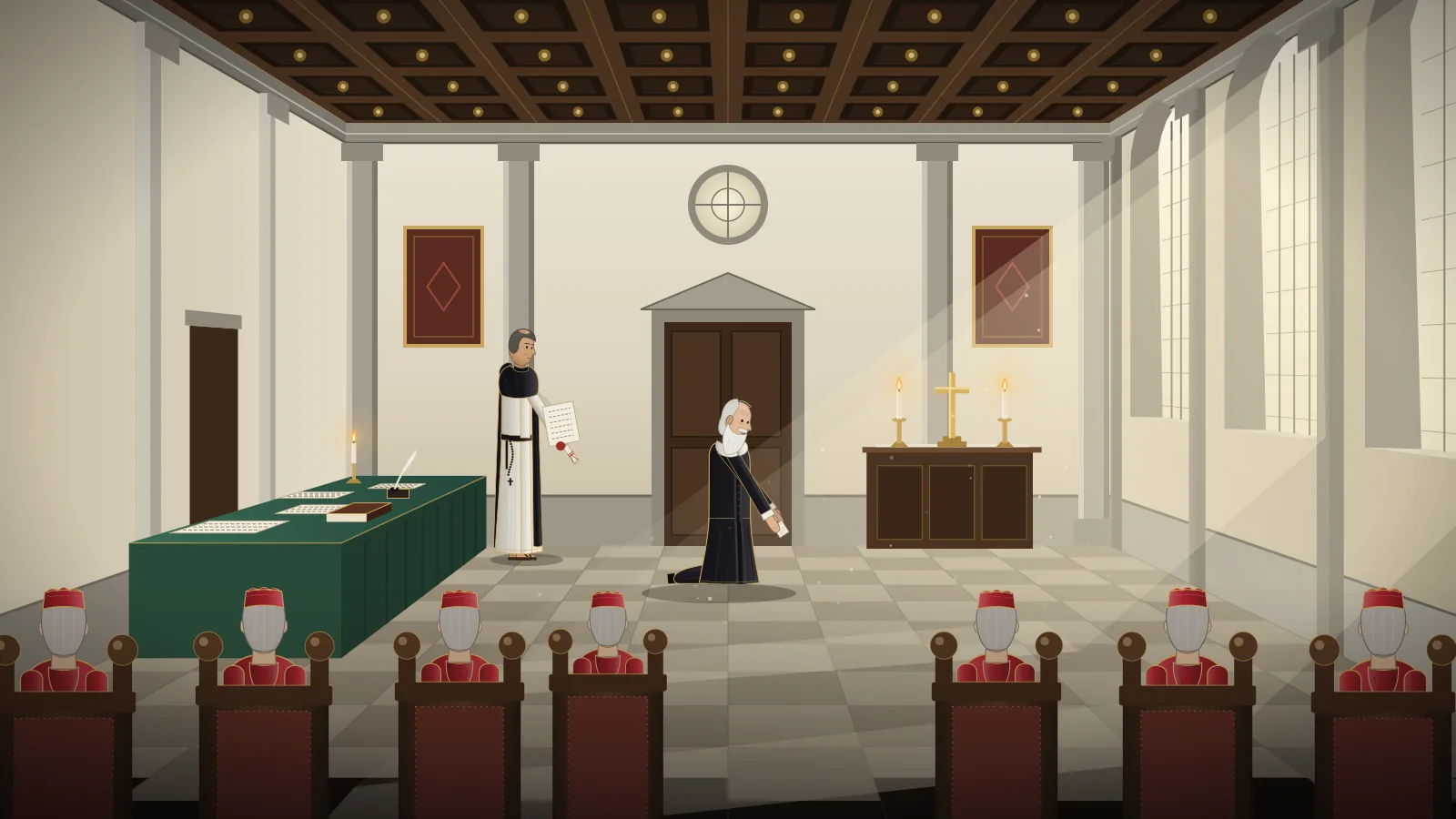
On 22 June 1633, in a hall of the Dominican convent of Santa Maria sopra Minerva in Rome, an old man knelt before his judges. He was 69, ill, and famous across Europe. Before the cardinals of the Holy Office, he read aloud that he abjured, cursed and detested the errors named in his sentence.
His name was Galileo Galilei. His troubles had begun 24 years earlier, with a tube of wood and glass, pointed at the night sky.
Chapter Iwatch from 0:41
The Starry Messenger
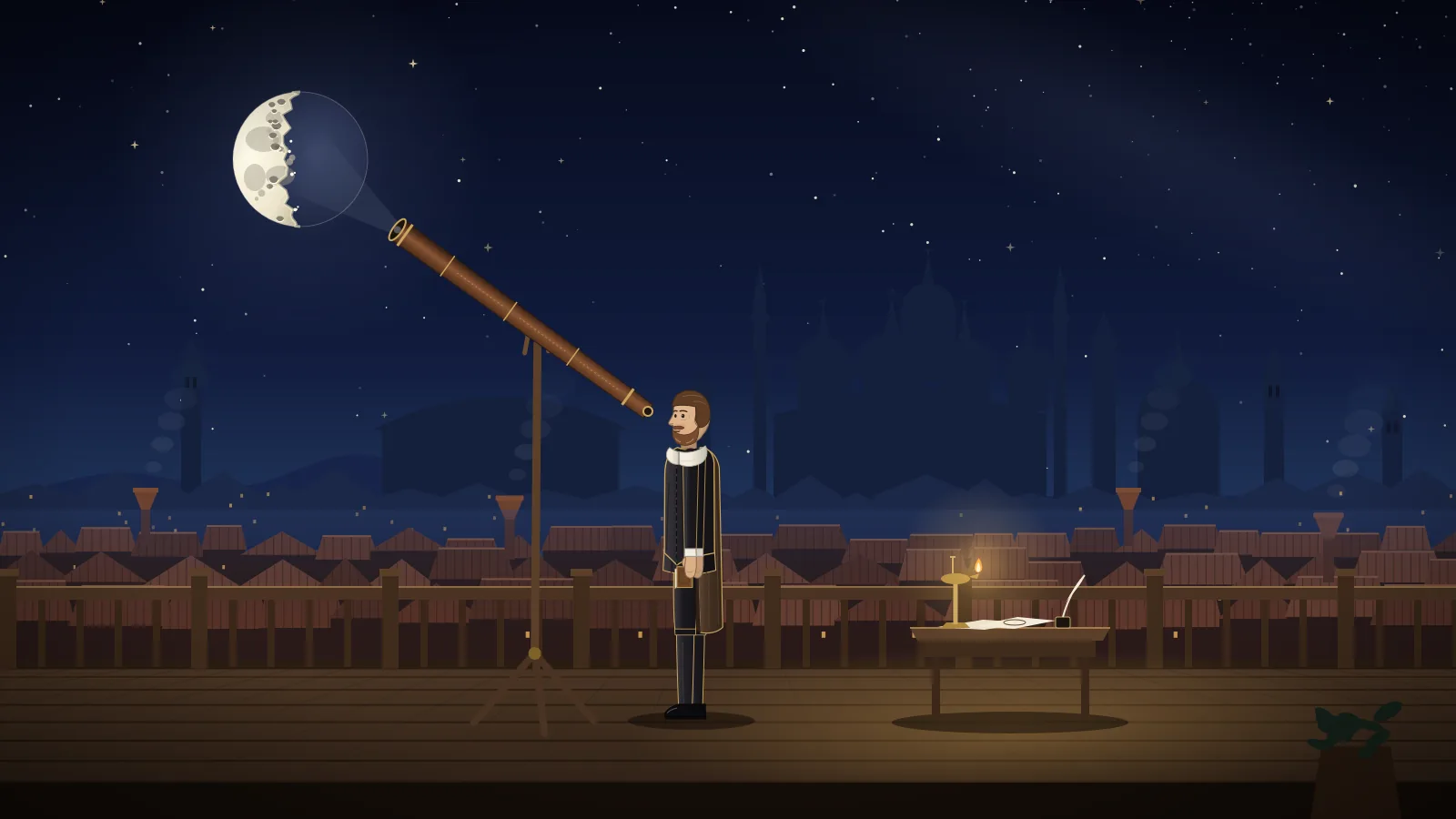
In 1609 Galileo was 45, a professor of mathematics at Padua, in the Republic of Venice. That summer he heard of a spyglass made in the Netherlands, and he built a better one. From a bell tower in Venice he showed it to the city’s leading men, and by his own account it showed ships at sea 2 hours before they could be seen without it.
Then he turned it upward. The Moon, which ancient philosophers had called a perfect sphere, turned out to have mountains and valleys, with shadows that moved as the sunlight crept across them.
In January 1610 he saw three small stars in a line beside Jupiter. The next night they had moved. Within a week he had found a fourth. Night after night he drew their places, until the answer was plain. They were not stars at all. They were moons, circling Jupiter, as our Moon circles the Earth.
They were not stars at all.
In March a short book appeared in Venice: Sidereus Nuncius, the Starry Messenger. It was printed in 550 copies, and they spread across Europe. Galileo named the moons the Medicean Stars, after the Medici, the ruling family of Tuscany, and that autumn he became mathematician and philosopher to the Grand Duke, at his court in Florence.
By the end of the year he had seen that Venus, like the Moon, had phases: full, half, crescent. That was hard to explain if Venus circled the Earth. In 1611 he visited Rome in triumph. The Jesuit astronomers of the Roman College checked his discoveries for themselves, and honoured him.
Chapter IIwatch from 2:22
Two Systems and a Sermon
The new sky fitted the system of Nicolaus Copernicus, who in 1543 had argued that the Earth spins, and travels around the Sun. But it also fitted the system of Tycho Brahe, in which the planets circle the Sun while the Sun circles a motionless Earth.
And a moving Earth raised hard questions. Why did nobody feel it? Why did the stars never seem to shift as the Earth swung round the Sun through the year? The evidence of the day could not yet settle it.
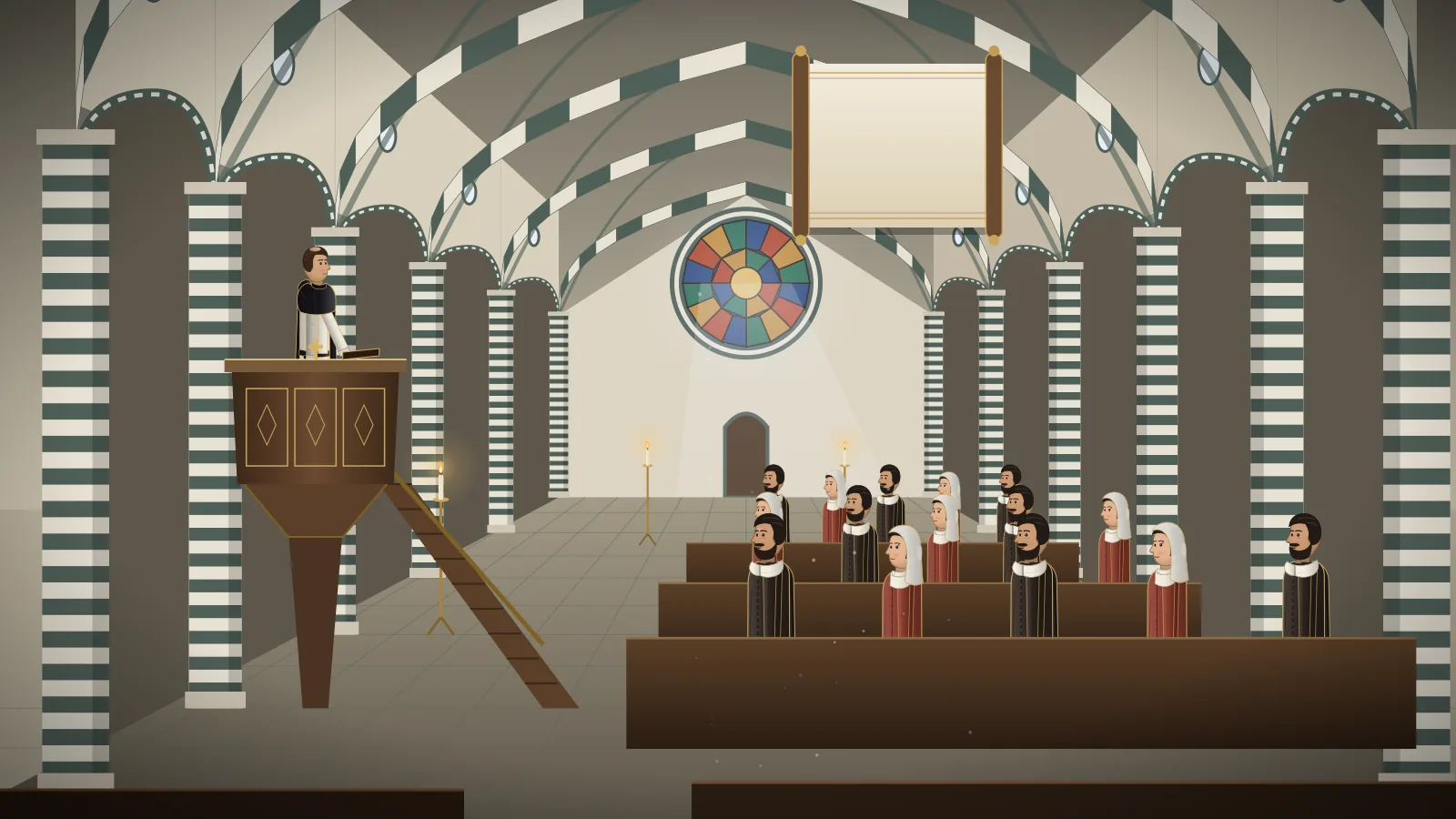
There was also the Bible. In the Book of Joshua, the Sun stands still. A psalm says that the world is firmly established, and cannot be moved. In December 1614 a Dominican friar, Tommaso Caccini, preached in a church in Florence against Galileo’s followers. According to the standard accounts, he took his text from the Book of Acts: “Ye men of Galilee, why stand ye gazing up into heaven?”
Galileo replied in letters. Scripture cannot err, he argued, but its interpreters can. The Bible, in a phrase he borrowed from a cardinal, teaches how to go to heaven, not how the heavens go.
Scripture cannot err, he argued, but its interpreters can.
Chapter IIIwatch from 3:36
The Decree of 1616
In Rome, the Jesuit Cardinal Robert Bellarmine was careful. If a true proof were ever found, he wrote in 1615, the passages of Scripture would have to be read again. But he did not believe that such a proof existed.
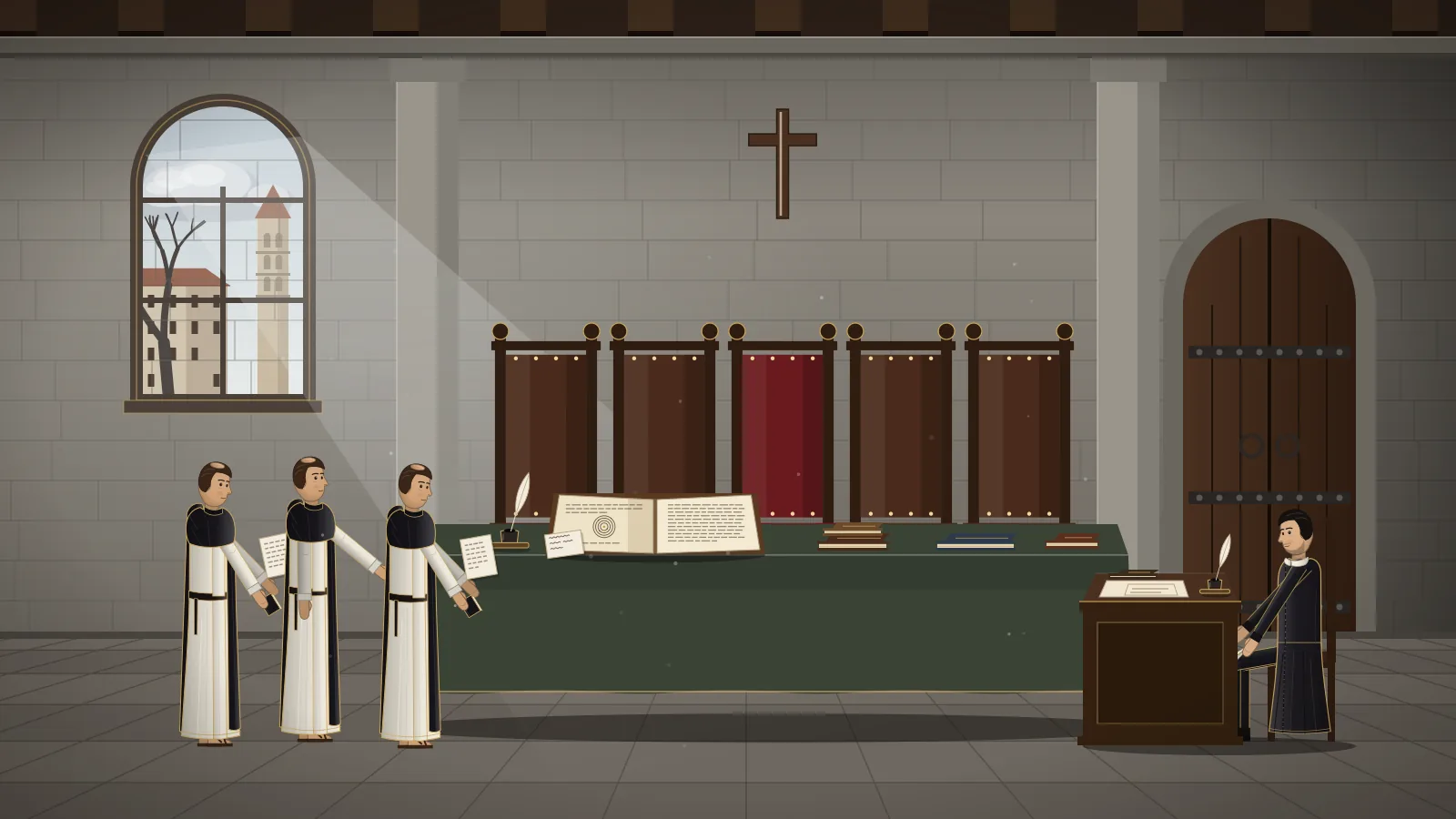
In February 1616 the theologians of the Holy Office gave their opinion. The idea that the Sun stood still at the centre of the world was, they declared, “foolish and absurd in philosophy, and formally heretical”. On 26 February Bellarmine told Galileo to abandon the opinion. In March, Copernicus’s book was suspended until corrected.
A note in the file records a stricter order: never to hold, teach or defend the idea in any way, by word or in writing. The note is unsigned. It may record a real second order, or an irregular or exaggerated one, and some older writers even thought it a later fabrication. Historians still argue about that note.
Historians still argue about that note.
Galileo himself was not condemned. Bellarmine even gave him a signed certificate saying so. Galileo went home to Florence with the paper, and kept it.
Chapter IVwatch from 4:28
The Dialogue
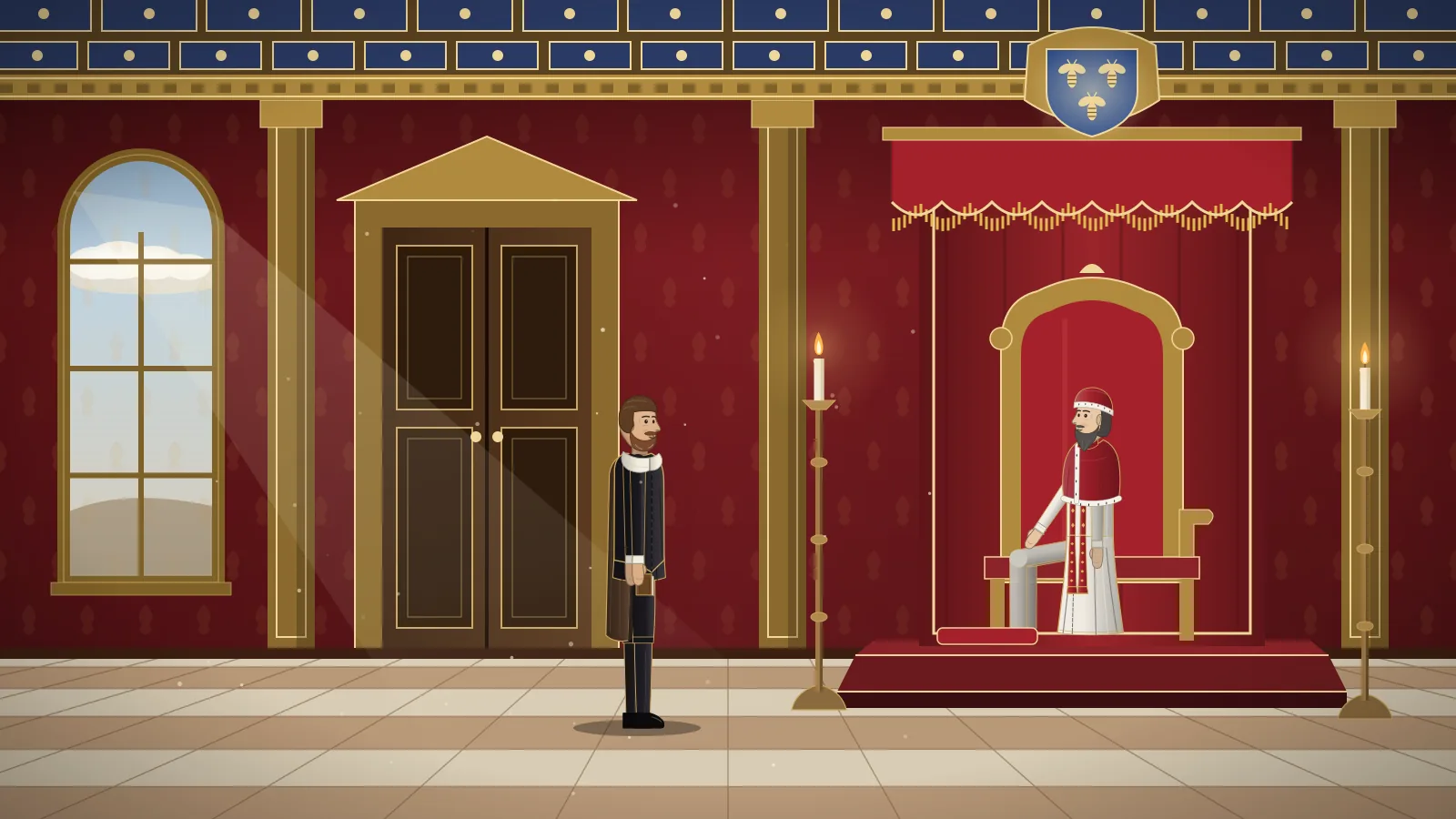
In 1623 a Florentine cardinal, Maffeo Barberini, who had once praised Galileo in a poem, was elected pope, as Urban VIII. Received six times in 1624, Galileo came away believing he could write about Copernicus, as long as he treated it as a hypothesis.
He wrote his new book in Italian, not Latin, so that any educated reader could follow it. Three friends debate for four days in a palace in Venice. One, Salviati, defends Copernicus. Sagredo is the open-minded host. The third, the defender of the old system, is named Simplicio, and loses nearly every argument.
The Dialogue passed the censors and appeared in Florence in February 1632. Its main proof, Galileo believed, came from the tides of the sea. There, he was wrong.
At the very end of the book, Simplicio voices an argument the pope himself liked to make. Urban, many historians think, felt mocked, and deceived. The times made things worse. Europe was at war, and in March 1632 Spain accused the pope of failing the Catholic cause. He could not look weak.
Urban, many historians think, felt mocked, and deceived.
That summer the sale of the book was stopped. A search of the files turned up the note of 1616, and Galileo was summoned to Rome.
Chapter Vwatch from 5:51
Before the Holy Office
Three doctors wrote that he was too sick to travel. He was told to come anyway, and in January 1633 he set out in winter, carried in a litter. In February he reached Rome. He stayed not in a prison, but at the Villa Medici, the home of the Tuscan ambassador, Francesco Niccolini.
In April the questioning began. Galileo said he did not remember any order forbidding him to teach the idea in any way, and he showed Bellarmine’s certificate. He insisted that his book did not defend Copernicus, then admitted he had argued its case too strongly. The experts who had read it said it plainly did.
On 21 June he was questioned once more, and threatened with torture. He answered that he was there to obey. Most historians think the threat went no further.
The next day came the sentence. He was found “vehemently suspected of heresy”, a lesser verdict than heresy itself, which could have meant death. The Dialogue was banned. He was sentenced to prison, and to recite the seven penitential psalms every week for 3 years. Of his 10 judges, 7 signed.
Kneeling, he read his abjuration.
Kneeling, he read his abjuration. Then he signed it, in his own hand.
Chapter VIwatch from 7:21
The Villa at Arcetri
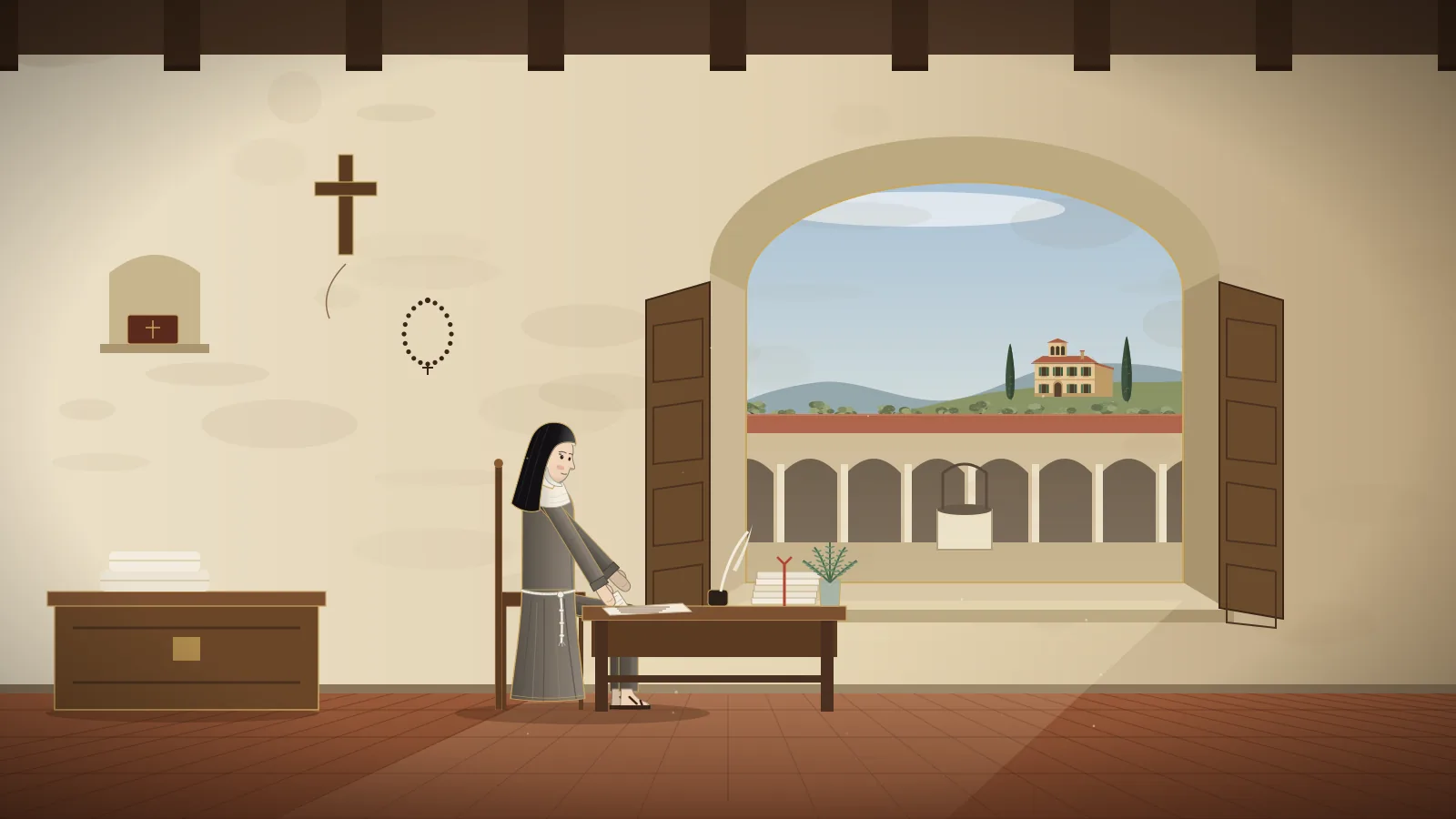
The prison was soon changed to confinement, first at the embassy, then in Siena, where the archbishop, Ascanio Piccolomini, welcomed him as a guest. In December he was allowed home, to his small villa at Arcetri, in the hills above Florence. He could not travel freely, or publish anything new.
Close by, in the convent of San Matteo, lived his eldest daughter, the Poor Clare nun Maria Celeste. More than 100 of her letters to him survive, though his replies are lost. She took on his weekly psalms herself. In April 1634 she fell ill and died, aged 33. Galileo called her a woman of exquisite mind and singular goodness.
Galileo called her a woman of exquisite mind and singular goodness.
He kept working, on motion and on the strength of materials. The manuscript was carried abroad and printed in Leiden, in 1638, as Two New Sciences. By then, he was blind.
Galileo died at Arcetri on 8 January 1642. He was buried quietly, in a small side room at the church of Santa Croce in Florence. His grand tomb came only in 1737.
Chapter VIIwatch from 8:29
And Yet It Moves
Legend says that as he rose from his knees in 1633, he muttered “Eppur si muove”: and yet it moves. No witness records it. The words first appear in print in 1757, more than a century after his death.
Nor was he burned, like Giordano Bruno in 1600. Many churchmen admired him, and some of his fiercest critics were fellow scholars. It was never simply science against faith.
It was never simply science against faith.
Direct evidence of the Earth’s motion came only in 1728, from the aberration of starlight. The stars’ yearly shift, the one his critics had looked for in vain, followed in 1838.
In 1835 the Dialogue left the Index of Prohibited Books. In 1979 Pope John Paul II asked for a new study of the case. On 31 October 1992 he said that the theologians had wrongly made a scientific question a matter of faith, and he called the affair a “tragic mutual incomprehension”. It was not a formal reversal of the sentence. But after 359 years, it admitted that Galileo’s judges had erred.
In 1989 a spacecraft named Galileo set off for Jupiter. For nearly 8 years it circled the planet, studying the four moons he had found.
In Rome, an old man had once knelt and given up the moving Earth. But on any clear night, a small telescope still shows Jupiter, and beside it, four tiny points of light, moving.




























































