
The story of the film
Flanders, Glastonbury, Germany, England, Genoa and Valencia · c. 1180 to the present
Late one evening, in a castle beside a river, a young knight sat at supper with a wounded lord who could not stand. Then a strange procession passed through the hall. First came a youth with a white lance, a drop of blood running from its tip. Then came two youths with golden candlesticks. Then came a maiden, holding a vessel of gold and precious stones. Such a light shone from it that the candles dimmed, like stars when the sun rises.
The young knight longed to ask what it meant. But he had been taught not to talk too much. So he said nothing.
Chapter Iwatch from 0:48
The Question Nobody Asked
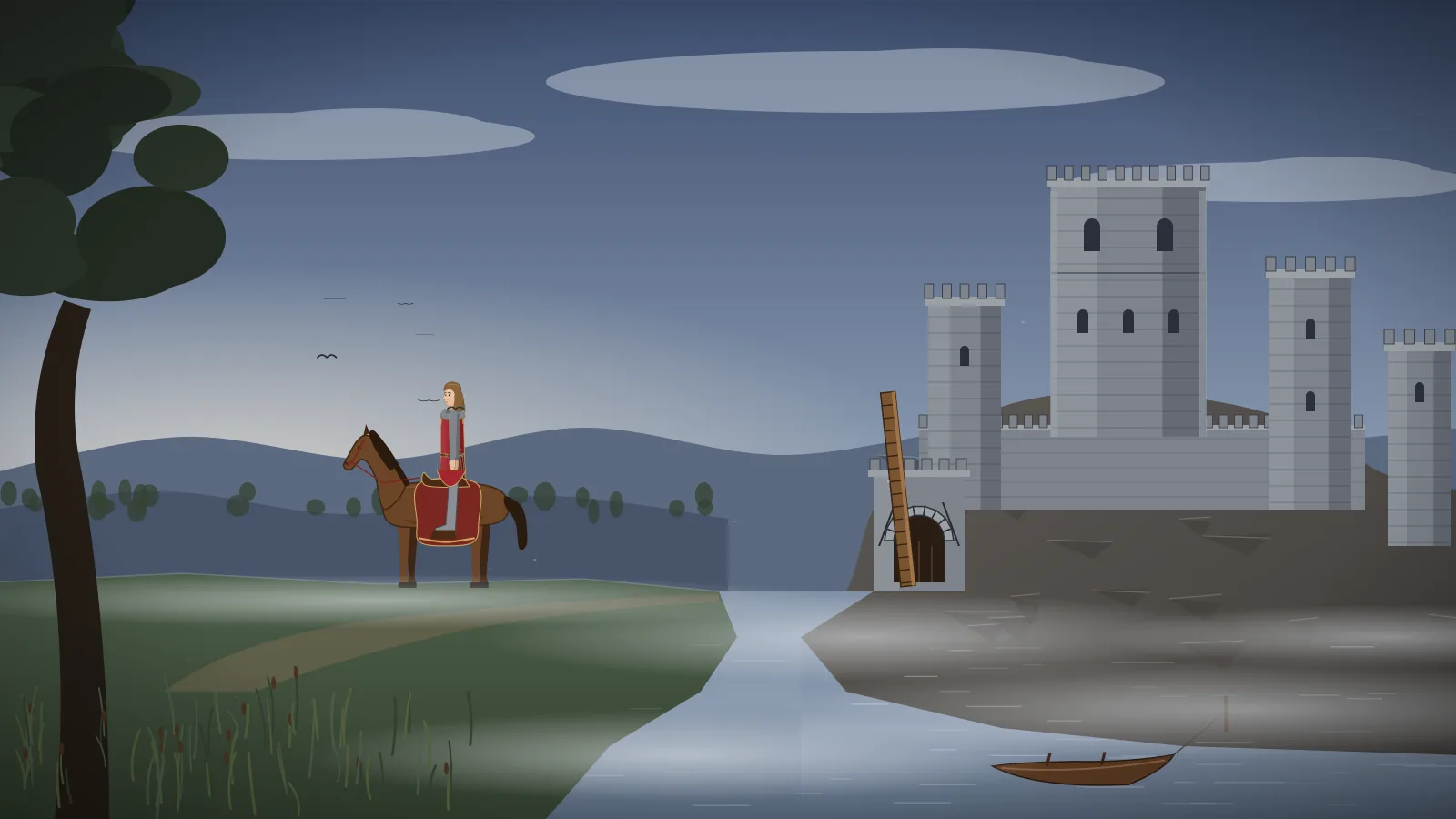
Next morning the castle was empty. The halls that had glowed with candlelight the night before stood silent, and no servant came. The young knight saddled his horse alone. As he rode out, the drawbridge rose behind him, and no one answered his call.
Later, he learned what his silence had cost. Had he asked whom the grail served, the wounded king would have been healed. He had held his tongue out of good manners, remembering the advice of the man who had made him a knight, and that small act of politeness had become a failure he would carry for the rest of the story.
Had he asked whom the grail served, the wounded king would have been healed.
That scene was written in the 1180s, in French verse, by a poet named Chrétien de Troyes. He was already famous for his tales of King Arthur’s knights. His new hero was the young knight Perceval. And in his poem, for the first time, there was a grail. No earlier text that survives mentions one.
Chrétien wrote the poem for Philip, Count of Flanders. Philip, Chrétien says, gave him a book with the story. No such book has ever been found.
In Old French, a graal was simply a wide, deep serving dish, the kind that carried fine food to a lord’s table. Later in the poem, a hermit explains what the grail held. It was no pike or salmon, but a single Mass wafer, which kept the wounded king’s father alive. But who the maiden was, where the grail came from, and why it shone, Chrétien never said.
He never finished. After some 9,000 lines, the poem breaks off in the middle of a sentence. Many scholars think death stopped Chrétien’s pen. His patron, Count Philip, died in 1191, far away, at the siege of Acre. The story stopped. But readers wanted an ending, and others would give them one.
Chapter IIwatch from 2:34
The Coffin at Glastonbury
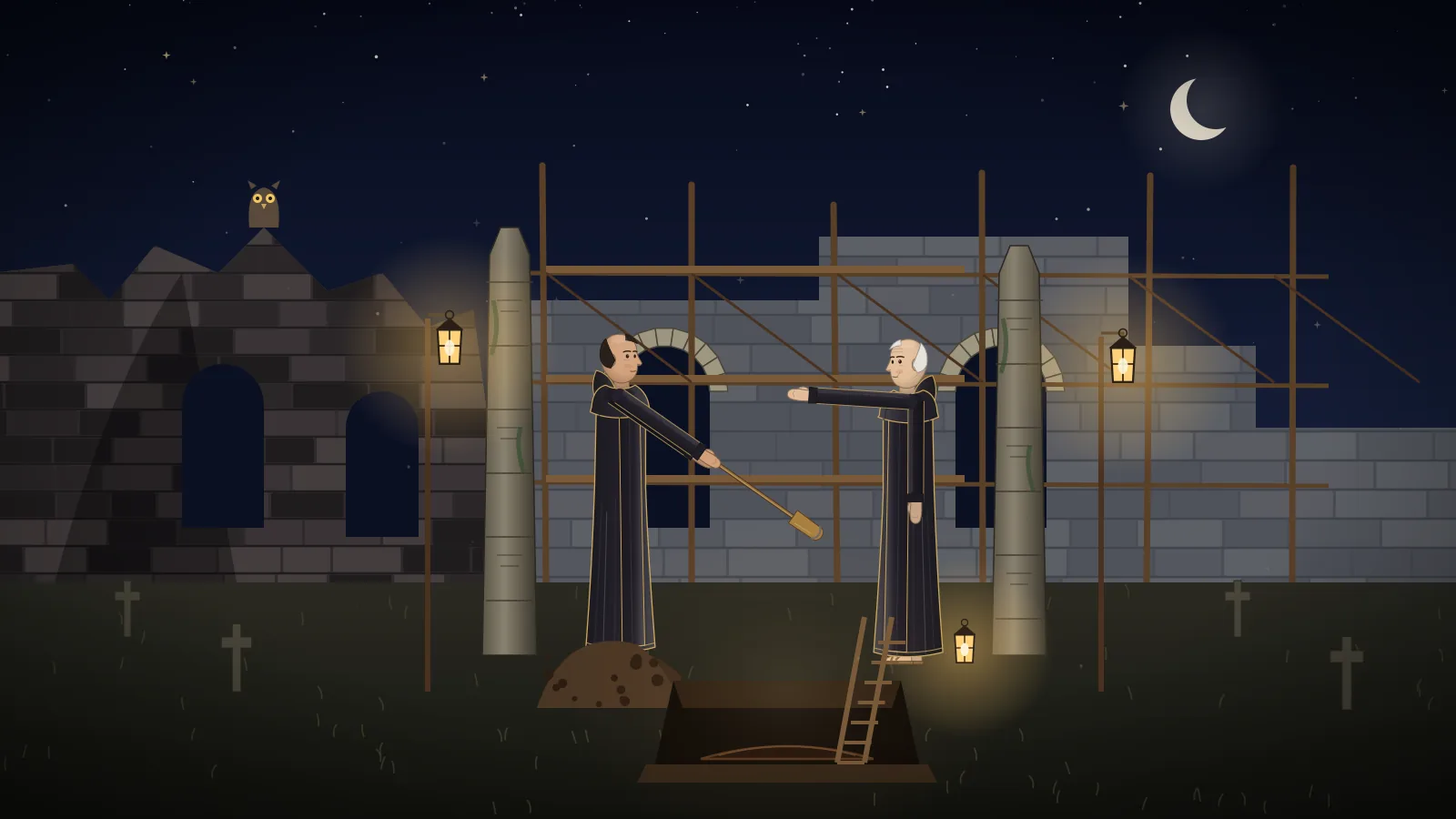
That same year, the monks of Glastonbury Abbey, in the west of England, announced an astonishing find. Their abbey had burned 7 years before, in 1184, and they were rebuilding. Now, digging in their cemetery, they said they had found an oak coffin, deep in the ground, at least 16 feet down by one account.
With it was a lead cross. According to Gerald of Wales, who wrote about the find and said he had seen the cross, it read: here lies buried the famous King Arthur, in the Isle of Avalon.
Many historians think the monks staged it, to draw pilgrims.
Many historians think the monks staged it, to draw pilgrims and the money they would bring. The cross itself later disappeared. But from then on, Glastonbury could claim to be Avalon, the mysterious island where Arthur was carried after his last battle. The abbey had joined the story of Arthur, and before long it would join the story of the grail as well.
Chapter IIIwatch from 3:21
The Cup of the Last Supper
Around 1200, a poet named Robert de Boron took the grail in a new direction. Chrétien’s shining dish had come from nowhere. Robert gave it a past.
In his poem, the grail became the vessel of the Last Supper, the cup Jesus shared with his disciples on the night before he died. The Gospels say that Joseph of Arimathea buried Jesus. In Robert’s poem, Joseph also caught drops of Christ’s blood in that same vessel.
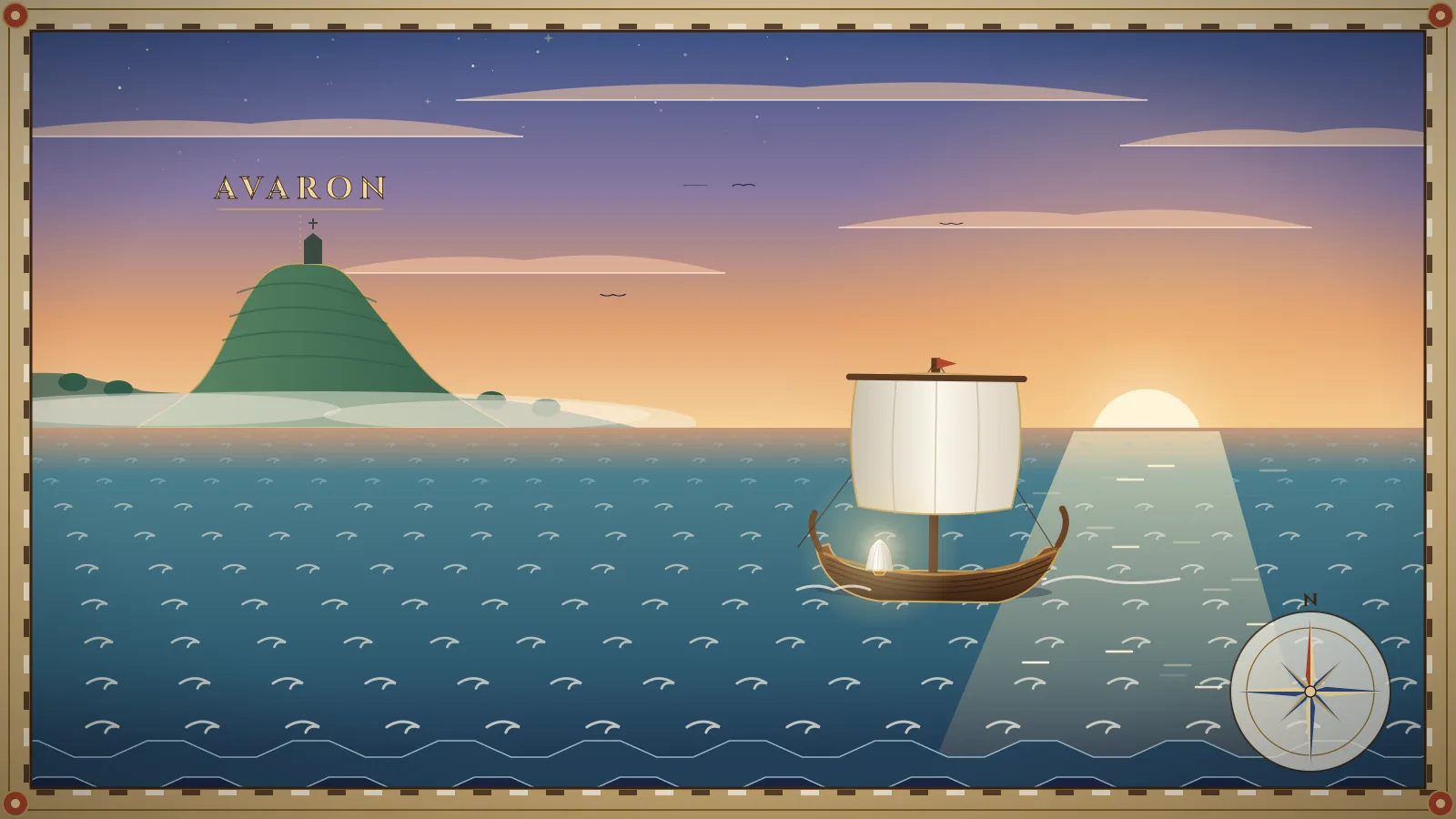
Thrown into prison, the poem says, Joseph was kept alive by the grail for years. Later his followers met at a table recalling the Last Supper, with one seat left empty. Then the grail’s keepers set out westward, toward what Robert called the vales of Avaron. Many scholars think he meant Avalon, and Glastonbury.
None of this is in the Bible.
None of this is in the Bible. Robert drew on older legends, and filled the gap Chrétien had left. The plain serving dish of the 1180s had become a cup, and the cup had become the most sacred vessel a medieval Christian could imagine.
Chapter IVwatch from 4:22
The Stone and the Dove
In Germany, a knight and poet named Wolfram von Eschenbach retold the story, early in the 1200s, as Parzival. Wolfram claimed, perhaps as a joke, that he could not read. His real source, he said, was a master named Kyot. Most scholars think Kyot was invented.
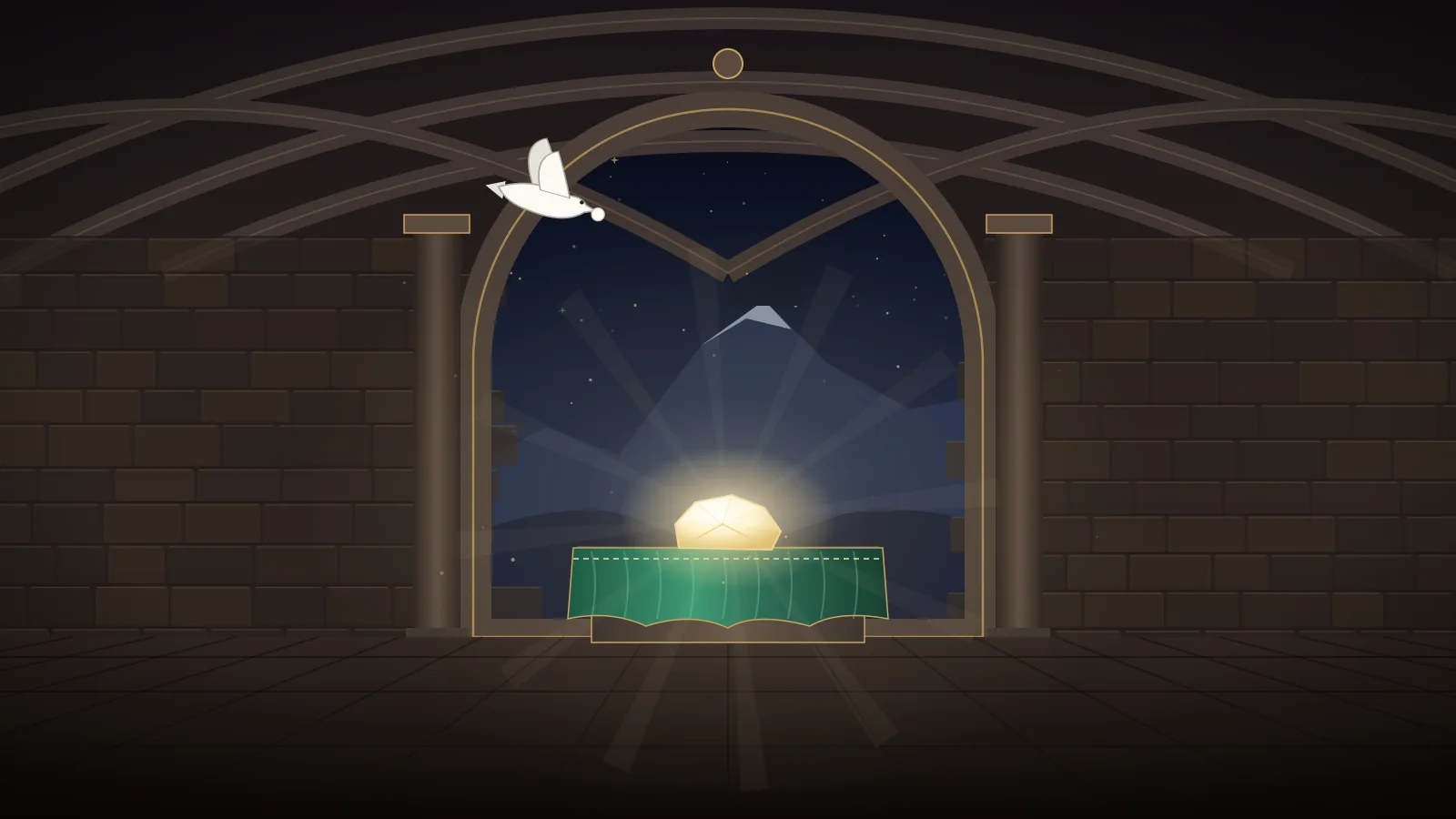
Wolfram’s grail was not a dish or a cup at all. It was a stone. Every Good Friday, he wrote, a dove flew down from heaven and laid a small white wafer upon it.
Wolfram’s grail was not a dish or a cup at all. It was a stone.
The stone gave its keepers whatever food and drink they wished. And those keepers were a brotherhood of knights, guarding it in a hidden castle, far from the roads of ordinary men.
Chapter Vwatch from 5:07
The Quest
Soon after, French writers composed a vast prose cycle of Arthurian tales, now called the Vulgate. In its Quest of the Holy Grail, written around 1225, a new hero arrived.
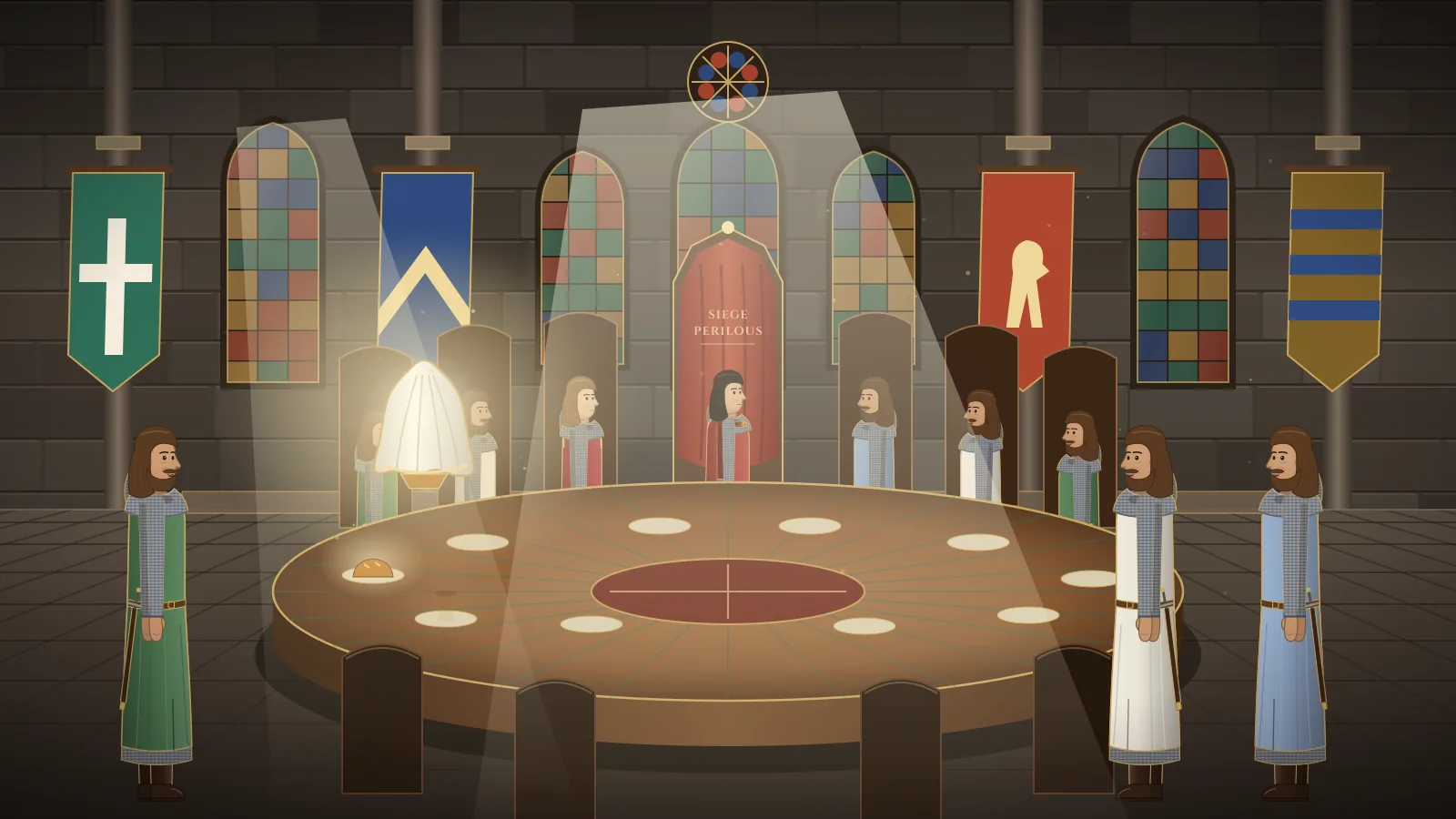
He was Galahad, the son of Lancelot. At Pentecost he sat in the one seat at the Round Table that brought disaster on the unworthy: the Siege Perilous. Then thunder sounded, and a sunbeam filled the hall. The grail passed through, covered in white silk, carried by no one they could see, and every knight was fed with the food he loved best.
Then the knights vowed to seek it. They rode out into the forest, each by his own road, and most of them failed. Courage was not enough. Only a pure heart could reach the grail. Even Lancelot, the greatest knight of the court, came near it, and fell senseless for days.
Courage was not enough. Only a pure heart could reach the grail.
Galahad, with Perceval and Bors, followed it by ship to a city called Sarras. There, the romance says, Galahad looked into the vessel and died in peace, and the grail was taken up to heaven. The quest that Chrétien had begun with a silence ended in light.
Almost 2 and a half centuries later, an imprisoned English knight gathered these French tales into one great book. Sir Thomas Malory finished it around 1470, asking his readers to pray that he might be set free. William Caxton printed it at Westminster in 1485, as Le Morte d’Arthur. For English readers, it became the classic quest of the grail.
Chapter VIwatch from 6:44
Thorn, Emerald and Agate
Glastonbury, meanwhile, grew a legend of its own. By the 1200s, its monks said that Joseph of Arimathea himself had founded their church. Later came a thorn tree said to have grown from Joseph’s staff. In 1539 the abbey was closed, and its great church fell into ruin.
Real vessels were claimed too. In 1101, crusaders from Genoa brought home a green, six-sided dish, believed to be carved from a single emerald. By the 1290s it was called the grail. Napoleon took it to Paris, where it proved to be glass. It came home broken, in 1816.
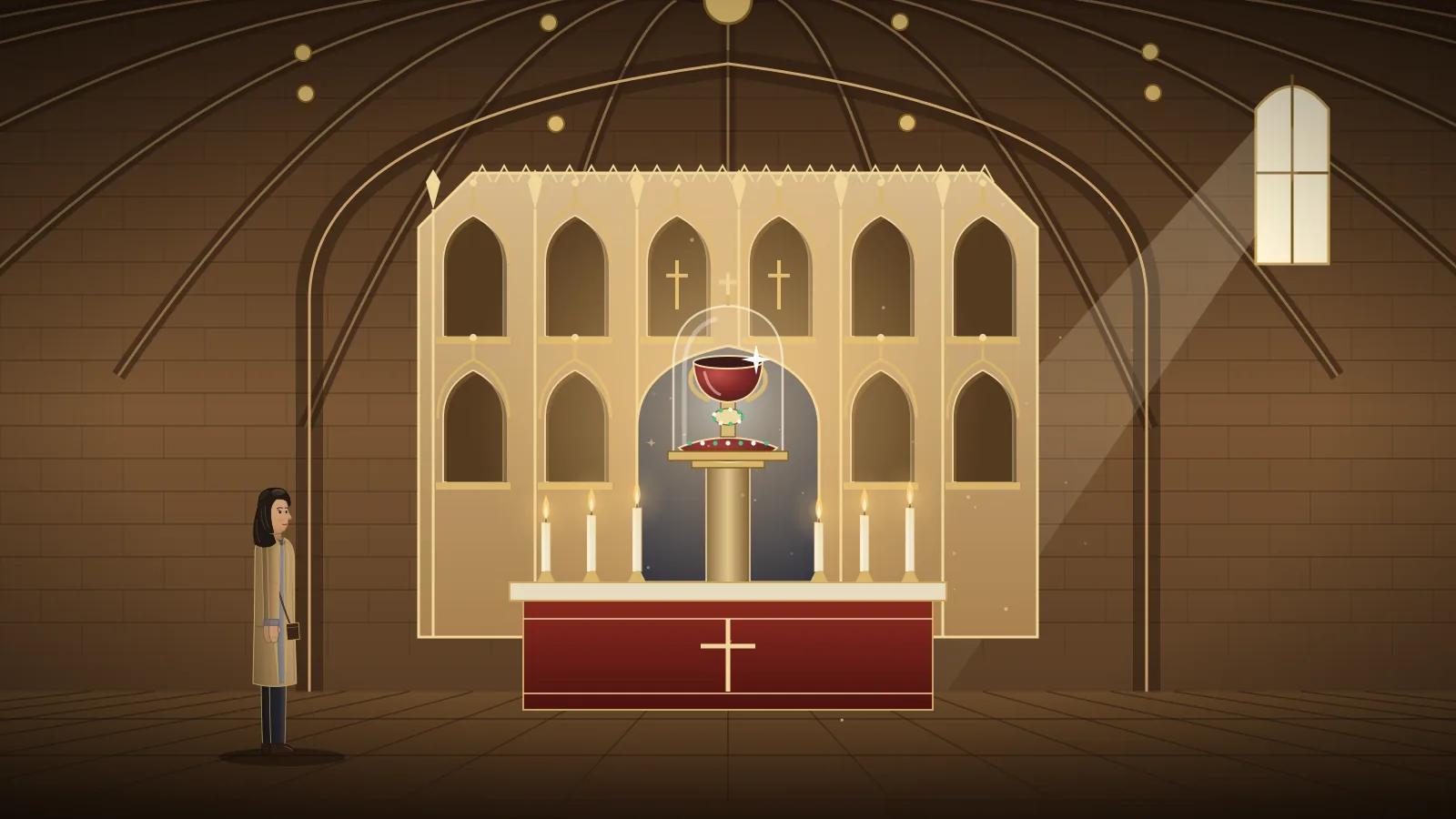
In Valencia Cathedral, in Spain, a small cup of dark red agate is venerated as the Holy Chalice. The stone cup itself may be 2,000 years old. But its first certain record dates from 1399. Two popes have celebrated Mass with it: John Paul II in 1982 and Benedict XVI in 2006.
A silver cup shown as the grail at the Chicago World’s Fair of 1933 is now thought, by the Metropolitan Museum of Art in New York, to be a 6th-century lamp.
No claimed grail can be traced back to Jerusalem.
No claimed grail can be traced back to Jerusalem, and the Catholic Church has never declared any of them the cup of the Last Supper.
Chapter VIIwatch from 8:06
The Grail That Grew
In the 1800s the grail returned in poetry and paint. In 1869, Alfred Tennyson retold Galahad’s quest for Victorian readers. In 1882, at Bayreuth, Richard Wagner staged his last opera, Parsifal. Drawn from Wolfram’s poem, it was a meditation on compassion and healing.
Then the quest reached the cinema. Monty Python laughed at it in 1975. Indiana Jones raced to find it in 1989.
In 1982, a bestseller claimed that san graal, holy grail, hid sang real, royal blood: a secret line descended from Jesus. Historians reject the idea, but a famous novel later spread it worldwide.
A dish became a cup, then a stone, then a cup again.
What the records show is a story that grew. A dish became a cup, then a stone, then a cup again, as each writer answered questions Chrétien had left open. What legend says is that the grail is still out there somewhere, waiting to be found. For many Christians, the grail remains an image of the Eucharist, the bread and wine of the Mass. And in everyday English, a holy grail is anything longed for, and hard to reach.
It all began with a young knight at supper, watching a light go by, and saying nothing. Chrétien never wrote the answer. Perhaps that is why, more than 800 years later, we are still asking his question: whom does the grail serve?




























































