Codex of FaithsAn illustrated atlas of belief

Article of the day ·

Diwali in four faiths: Hindu, Jain, Sikh and Buddhist

Why Hindus, Jains, Sikhs and Newar Buddhists all light lamps on the same autumn night: Rama’s return and Lakshmi, Mahavira’s liberation, Guru Hargobind’s release, and Nepal’s Tihar, with a day for crows and dogs.

In brief

  1. I.Diwali, from Sanskrit dipavali, “row of lamps”, falls on the new-moon night of Kartika (Ashvin in southern and western calendars), in October or November; in 2026 on 8 November.
  2. II.Hindus recall Rama’s return to Ayodhya and worship Lakshmi, goddess of fortune; in the south it is often kept a day earlier, recalling Krishna’s victory over Narakasura.
  3. III.Jains mark the night Mahavira reached final liberation; Sikhs celebrate Bandi Chhor Divas, the release of Guru Hargobind from Gwalior fort.
  4. IV.In Nepal the festival is Tihar, with days for crows, dogs and cows; Newar Buddhists and Hindus keep Mha Puja, a worship of one’s own body, and the Nepal Sambat new year.

The story in a minute

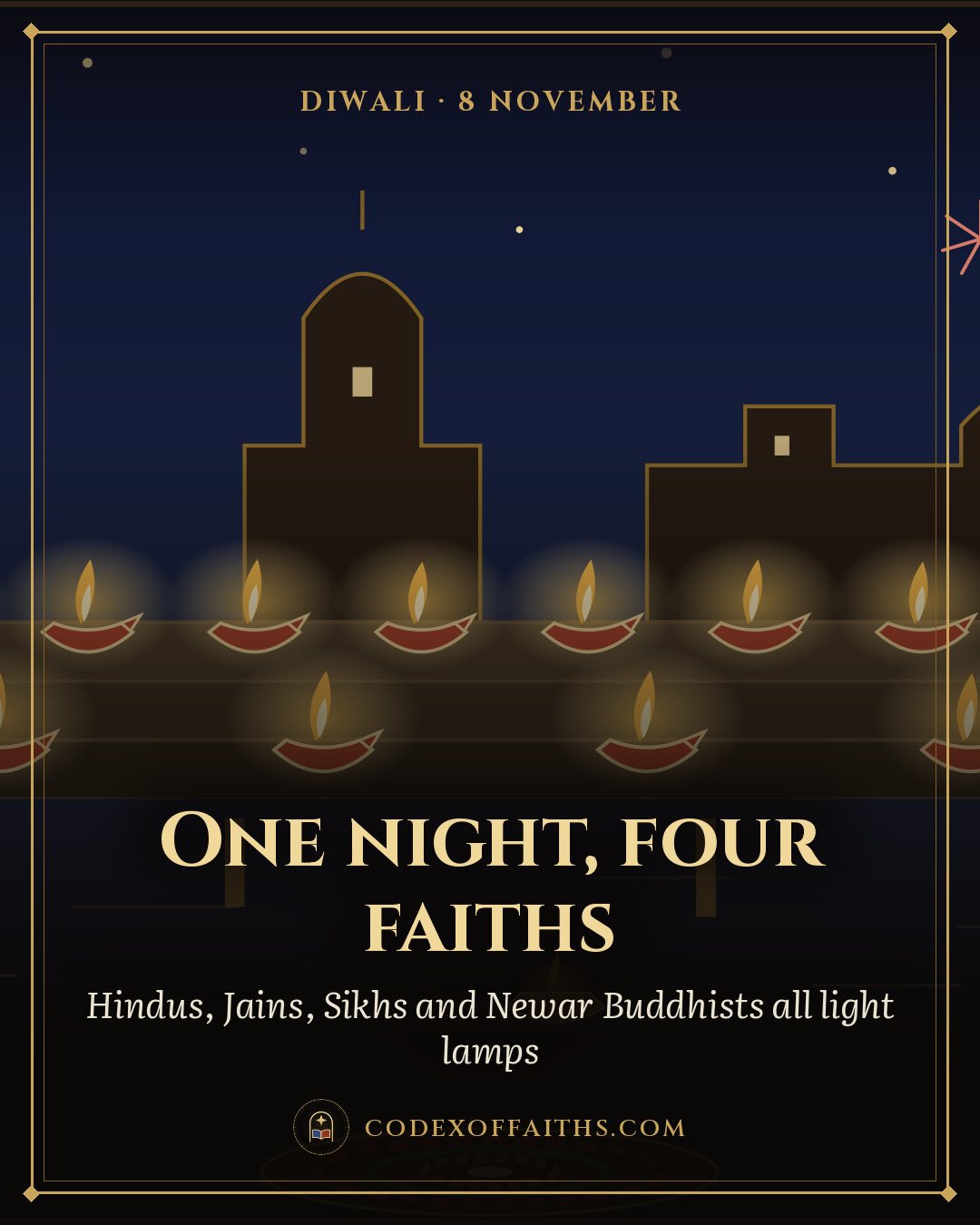
Clay oil lamps burning in a row at dusk, with a pattern of coloured powder on the ground.
Illustration: Codex of Faiths

On one autumn night, small clay lamps burn along windows, roofs and riverbanks across South Asia and wherever its people have settled. Most of the people lighting them are Hindus, but not all. Jains, Sikhs and many Buddhists in Nepal keep the same night, and each tradition tells its own story of why it is a night for light.

Chapter I

One night, many lamps

Diwali takes its name from the Sanskrit dipavali, a “row of lamps”. It falls on the night of the new moon, the darkest night of the lunar month of Kartika in the northern reckoning (Ashvin in the calendars of the south and west), which comes in October or November; in 2026 the main night is 8 November. Because it follows the moon, its date moves each year in the Western calendar.

The shared picture is simple: light pushed back against the dark. What the light stands for differs from one faith to the next: a king coming home, a goddess of fortune, a teacher’s liberation, a guru’s release.

  • The diya
The diya, a small clay oil lamp, is lit in all four traditions.

Chapter II

Hindu: the return of Rama and the night of Lakshmi

In the north of India, Diwali celebrates the return of Rama, with Sita and his brother Lakshmana, to his city of Ayodhya after fourteen years of exile and the defeat of the demon king Ravana; the people lit rows of lamps to welcome him. In the south the festival is often kept a day earlier, on Naraka Chaturdashi, recalling Krishna’s victory over the demon Narakasura. In Bengal the same night belongs to the goddess Kali.

Everywhere it is the night of Lakshmi, goddess of wealth and good fortune. Houses are cleaned, patterns of coloured powder, rangoli, are drawn at the door to welcome her, and families perform Lakshmi puja Worship: offerings of flowers, food, light and incense to a deity, at home or in a temple. Glossary. In much of India Diwali is a five-day festival, from Dhanteras, a day for buying metal and new utensils, to Bhai Dooj, when sisters pray for their brothers. In Gujarat and among many traders, new account books are blessed on Diwali evening, and the new business year, Bestu Varas, begins the next day.

  • ॐ Hindu
  • Lakshmi’s lotus

Chapter III

Jain: the liberation of Mahavira

For Jains, Diwali is the night on which Mahavira, the twenty-fourth Tirthankara A “ford-maker”: one of twenty-four liberated teachers who show the way across the river of rebirth. Mahavira was the last. Glossary, reached moksha Liberation from the cycle of rebirth, the highest goal of life in Hinduism and Jainism. Glossary, final liberation, at Pavapuri in what is now Bihar. Jain tradition dates it to 527 BCE. The Kalpa Sutra says that on that new-moon night the eighteen confederate kings of Kashi and Kosala, who were keeping a fast, lit lamps, saying: “Since the light of intelligence is gone, let us make an illumination of material matter.”

Jains often keep the night with fasting, prayer and the reading of scripture rather than feasting, and many avoid fireworks because of the harm they do to small living beings. The same night, the Kalpa Sutra says, Mahavira’s chief disciple, Gautama Indrabhuti, reached perfect knowledge, kevala jnana Perfect, all-knowing knowledge, attained by a soul freed from karma. Glossary; popular tradition places it at dawn. For many Jains the new year of the Vira Nirvana era begins the next day.

  • Jain
  • Right knowledge

Chapter IV

Sikh: Bandi Chhor Divas, the day of release

Sikhs celebrate the same night as Bandi Chhor Divas, the “day of release of the prisoners”. Tradition tells that the sixth Guru, Hargobind, was held in Gwalior fort by the Mughal emperor Jahangir. When he was freed, he refused to leave unless 52 imprisoned rajas, hill kings, were released with him; told that only those who could hold on to his clothes might go, he wore a cloak with 52 tassels and led them all out.

His return to Amritsar was greeted with lamps, and the Golden Temple, the Harmandir Sahib, is still illuminated on this night, often with fireworks over its pool. The Sikh name stresses freedom and justice rather than fortune.

  • Sikh
  • ੴ One God

Chapter V

Buddhist: Tihar and Mha Puja in Nepal

Most Buddhists in the world do not keep Diwali, but in Nepal, where the festival is called Tihar, many Buddhists, especially Newars, take part. Its five days honour animals and people in turn: the crow, messenger of death, on the first day; the dog on the second, when dogs are garlanded and given food; the cow and the goddess Lakshmi on the third.

On the fourth day, when many Hindus worship oxen (Govardhan Puja), the Newars of the Kathmandu Valley, both Buddhists and Hindus, keep Mha Puja, “worship of the body”. Each member of the family sits behind a mandala of rice and colours and is honoured, so that body and mind are strengthened for the year ahead. The same day begins the year of Nepal Sambat, the Newar era counted from 879 CE. On the last day sisters mark their brothers’ foreheads with a tika of seven colours.

  • Buddhist
  • Mha Puja

Chapter VI

What they share

The four traditions disagree about God, the self and liberation, yet they meet on this night around the same small flame. For Hindus it welcomes fortune and a returning king; for Jains it stands in for a teacher’s lost light; for Sikhs it celebrates a release; for Newars it opens a new year with honour for the living. A diya, a clay saucer with a cotton wick in oil, costs almost nothing, and may be the most widely shared religious object in South Asia.

Questions people ask

Is Diwali only a Hindu festival?

No. It is above all a Hindu festival, but Jains, Sikhs and many Newar Buddhists in Nepal also keep the same night, each with its own reason for lighting lamps.

Why do some Jains not set off fireworks at Diwali?

Many Jains keep the night with fasting, prayer and reading, and avoid fireworks because of the harm they do to insects and other small living beings, in keeping with ahimsa, non-violence.

What does Bandi Chhor mean?

“Release of the prisoners”. Sikh tradition says Guru Hargobind refused to leave Gwalior fort unless 52 imprisoned rajas were freed with him, and led them out holding the tassels of his cloak.

Why is there a day for dogs in Nepal?

On Kukur Tihar, the second day of Tihar, dogs are garlanded, marked with a red tika and given food, in honour of their loyalty and of the dogs linked to Yama, the lord of death.

Sources and further reading

  1. Encyclopaedia Britannica, “Diwali”
  2. Encyclopaedia Britannica, “How Is Diwali Celebrated? Festival of Lights and Beyond”
  3. Paul Dundas, The Jains (2nd ed., Routledge, 2002)
  4. Eleanor Nesbitt, Sikhism: A Very Short Introduction (2nd ed., Oxford University Press, 2016)
  5. David N. Gellner, Monk, Householder, and Tantric Priest: Newar Buddhism and its Hierarchy of Ritual (Cambridge University Press, 1992)
  6. Gavin Flood, An Introduction to Hinduism (Cambridge University Press, 1996)