Codex of FaithsAn illustrated atlas of belief

Article of the day ·

What are the Twin Holy Birthdays? The Bahá’í festival of two founders

Why Bahá’ís celebrate the Báb and Bahá’u’lláh on two days in a row: two men born two years apart who never met, a lunar date in a solar calendar, and how the festival is kept, this year on 10 and 11 November.

In brief

  1. I.The Twin Holy Birthdays are two Bahá’í holy days in a row: the birth of the Báb in Shiraz in 1819 and the birth of Bahá’u’lláh in Tehran in 1817.
  2. II.Bahá’í sources say the two men never met; they were born almost two years apart, but in the Islamic lunar calendar their birthdays fall on consecutive days, the first and second of Muharram.
  3. III.Since 2015 Bahá’ís everywhere keep them on the first and second days after the eighth new moon following Naw-Rúz, so the dates move between mid-October and mid-November; in 2026 they are 10 and 11 November.
  4. IV.Work is suspended on both days. There is no set ritual and no clergy: communities gather for prayers, readings, music and food, usually with friends of other faiths invited.

The story in a minute

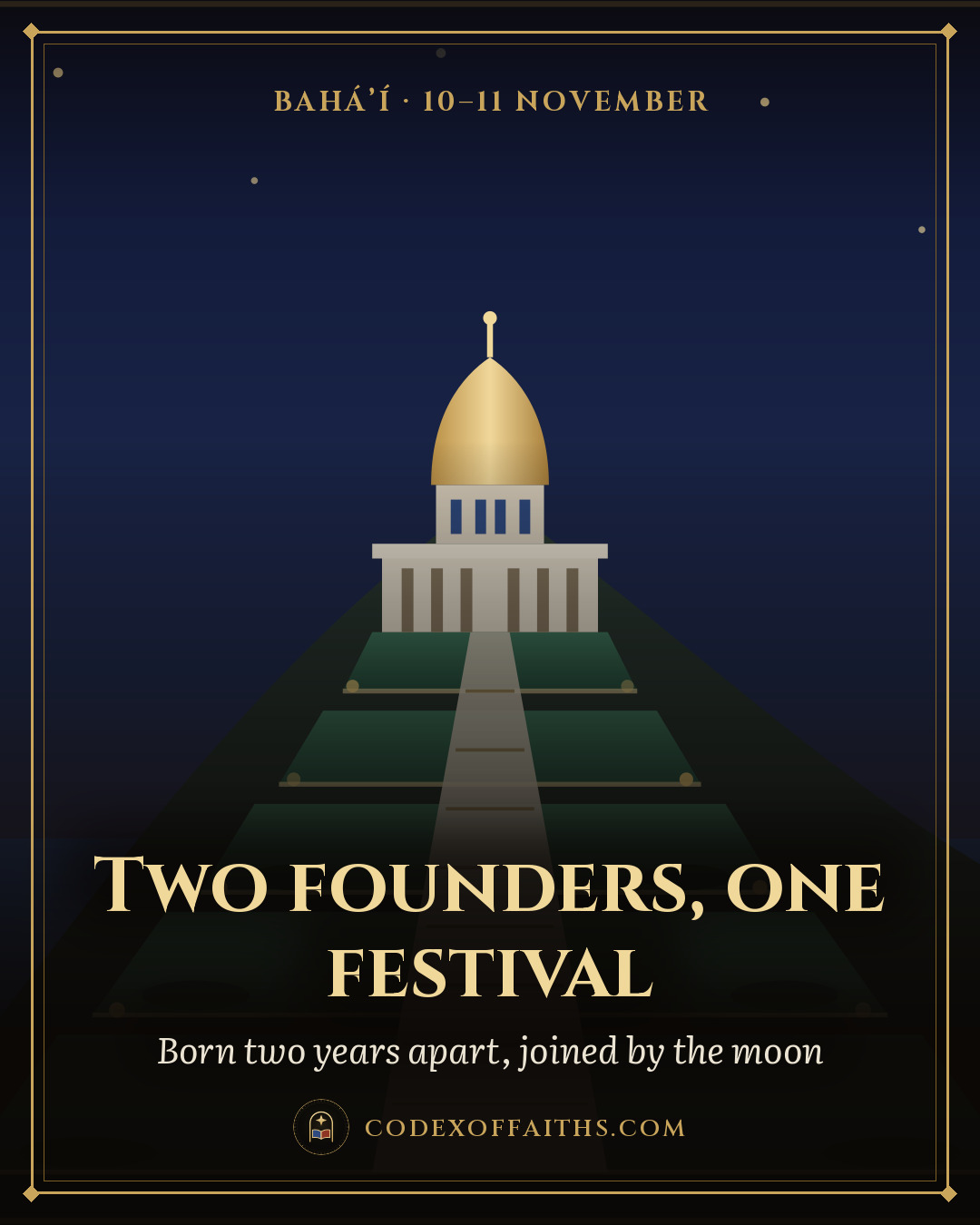
Illuminated garden terraces climbing a mountainside at dusk, with two lamps shining under a thin new moon.
Illustration: Codex of Faiths

Many religions with a founder mark that founder’s birth once a year. Bahá’ís mark two, one straight after the other, and treat them as a single festival. The two men were born in different cities, almost two years apart, and never met. What joins their birthdays is a quirk of the moon, and it gives one of the world’s newest religions one of its most unusual dates.

Chapter I

Two births, two years apart

The Báb, whose given name was Sayyid ‘Alí-Muhammad, was born in Shiraz, in southern Iran, on 20 October 1819. His father, a merchant, died when he was a child, and an uncle raised him and took him into the family trade. In 1844, at the age of twenty-four, he declared that he was the Báb, “the Gate”. His claims grew over the next few years into that of a new revelation, and he foretold one greater still to come. He was executed in Tabriz in 1850, when he was thirty.

Bahá’u’lláh, born Mírzá Husayn-‘Alí, came into the world in Tehran on 12 November 1817. His family were nobles from Núr, in the north of Iran, and his father served the Persian court. He declined a career at court, became known for his care of the poor, and joined the Báb’s movement in 1844. In 1863, in exile in Baghdad, he declared that he was the one the Báb had foretold. Bahá’ís regard both men as messengers of God, and Bahá’u’lláh as the founder of their faith.

According to Bahá’í sources, the two exchanged letters through messengers but never met in person.

  • Bahá’í
The nine-pointed star, a common Bahá’í emblem.

Chapter II

The first and second of Muharram

In the Western calendar the birthdays are about three weeks short of two years apart. In the Islamic lunar calendar, in use in Iran when they were born, they are next-door neighbours. The Báb was born on the first day of Muharram, the first month of the year, and Bahá’u’lláh on the second.

For Bahá’ís this is more than a coincidence. Bahá’u’lláh’s book of laws, the Kitáb-i-Aqdas, speaks of festivals that fall on “the twin days”, and in an answer to a question about them, published with the book, he wrote that “these two days are accounted as one in the sight of God”. Both are among the nine holy days of the Bahá’í year on which work is suspended.

Chapter III

A lunar date in a solar calendar

The Bahá’í calendar, the Badí‘ calendar, is solar. It has nineteen months of nineteen days, with a few extra days added to complete the year, and it begins at Naw-Rúz, the northern spring equinox. Seven of the nine holy days keep almost the same place in the Western calendar every year.

The Twin Holy Birthdays are the exception, because they keep the memory of a lunar date. For a long time Bahá’ís in the East kept them by the moon, on the first and second of Muharram, while those in the West kept them on the Western dates, 20 October and 12 November. In 2014 the Universal House of Justice, the faith’s elected governing body, set one rule for everyone, in force from Naw-Rúz 2015: the two days are the first and second after the eighth new moon following Naw-Rúz, worked out in advance from astronomical tables, with Tehran as the point of reference.

The result moves through the northern autumn. In 2026 the festival falls on 10 and 11 November, and in 2027 on 30 and 31 October. It always stays between mid-October and mid-November, so it never drifts round the year as Islamic festivals do.

  • Naw-Rúz
  • The new moon

Chapter IV

How the days are kept

There is no fixed ritual. The Bahá’í Faith has no clergy, so a gathering is arranged by the local community or simply by a family. Most include prayers and readings from the sacred writings, often stories of the two lives, followed by music, food and conversation. Friends and neighbours of other faiths are usually welcome, and children often take part with songs, drawings or readings.

A Bahá’í day begins at sunset, so each holy day opens on the evening before. Bahá’ís are asked to stop work on both days, and to keep children out of school where they can. Beyond that, the character of the day is left to local custom, and it varies a great deal from place to place. The two birthdays are celebrated as joyful days, unlike the solemn holy days that remember the deaths of the Báb and of Bahá’u’lláh.

  • Lamps and prayers
  • A House of Worship

Chapter V

Two shrines on one coast

The two men lie less than twenty kilometres apart near the coast of northern Israel, around the bay of Haifa and Akka. Bahá’u’lláh was exiled to Akka in 1868 as a prisoner of the Ottoman Empire. The Shrine of the Báb stands on Mount Carmel in Haifa, at the centre of a long stair of garden terraces. The Shrine of Bahá’u’lláh is at Bahjí, near Akka. They are the two holiest places in the Bahá’í world, and in 2008 UNESCO added them to the World Heritage List.

In 2017 and 2019, the two hundredth anniversaries of the births, Bahá’í communities around the world held large celebrations. In an ordinary year, it remains what it has long been: two evenings each year when a small and scattered community gathers to remember two lives, joined by the moon.

Questions people ask

When are the Twin Holy Birthdays in 2026?

The birth of the Báb on 10 November and the birth of Bahá’u’lláh on 11 November. A Bahá’í day begins at sunset, so each holy day starts on the evening before. In 2027 they fall on 30 and 31 October.

Why do the dates change every year?

Almost all of the Bahá’í calendar is solar, but these two days are set by the moon: they follow the eighth new moon after Naw-Rúz, calculated in advance with Tehran as the point of reference.

Did the Báb and Bahá’u’lláh ever meet?

According to Bahá’í sources, no. Bahá’u’lláh became a follower of the Báb’s movement in 1844 and they exchanged letters, but they never met in person.

Can people who are not Bahá’ís attend?

Generally yes. Bahá’í gatherings for holy days are often open to neighbours and friends, and they have no fixed liturgy that a guest would need to know.