Codex of FaithsAn illustrated atlas of belief

Article of the day ·

What is Tulsi Vivah? The Hindu wedding of the sacred basil plant

Why Hindu families dress a basil plant as a bride at the end of the monsoon months: the god who wakes, the story of Vrinda, the shaligram stone, and sacred plants in other faiths.

In brief

  1. I.Tulsi is holy basil (Ocimum tenuiflorum), the most widely kept sacred plant in Hindu homes, grown in a raised planter in the courtyard and honoured daily with water and a lamp.
  2. II.Tulsi Vivah, “the wedding of Tulsi”, marries the plant to Vishnu, usually in the form of a shaligram stone or as Krishna. It is held around Prabodhini Ekadashi, the day Vishnu is said to wake from a four-month sleep; in India in 2026 that day falls on 20 November.
  3. III.The rite follows a real Hindu wedding: the plant is dressed as a bride, a canopy of sugarcane is built, vows are recited and the two are led around each other. Many families then treat the season of weddings as open.
  4. IV.The story behind it is of Vrinda, a faithful wife whose devotion made her husband invincible; popular tradition says Vishnu promised she would be worshipped as the tulsi plant and wed to him every year.

The story in a minute

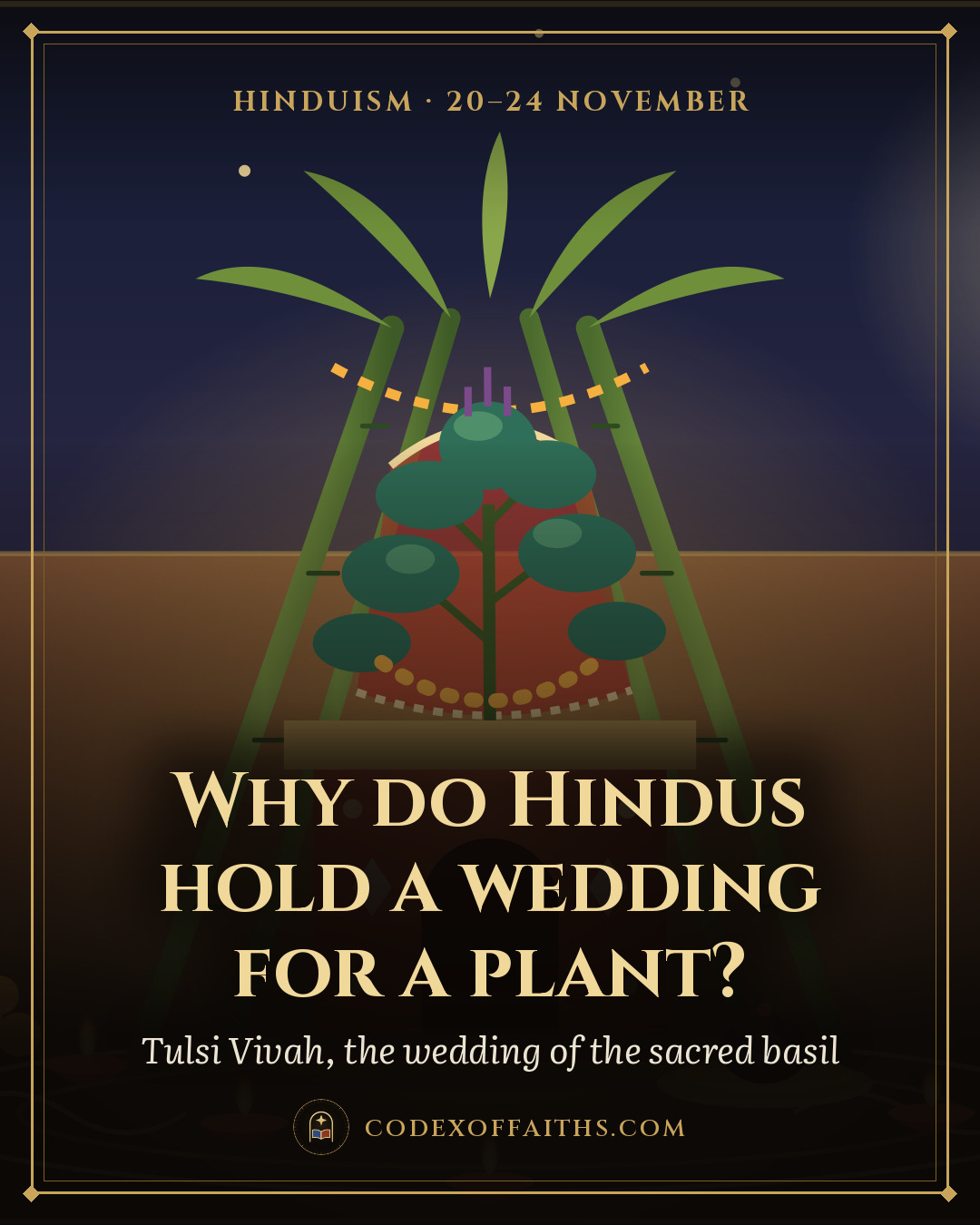
A tulsi basil plant in a raised square clay planter, draped with a red veil and garlands, stands under a small canopy of sugarcane stalks in a courtyard at dusk, with clay lamps, a dark round stone on a brass plate and a nearly full moon rising.
Illustration: Codex of Faiths

In the courtyards of many Hindu homes stands a small raised planter of clay or brick, often painted and decorated, with a bushy green plant in it. Every day someone pours water at its roots and lights a lamp before it. Once a year, in the lunar month of Kartika, the plant becomes a bride. The family dresses it in a red veil and bangles, builds a canopy of sugarcane over it, and marries it to Vishnu, with songs, sweets and a wedding feast. This is Tulsi Vivah, the wedding of the holy basil.

Chapter I

The sacred basil

Tulsi Holy basil, a plant revered by Hindus as sacred to Vishnu and kept and worshipped in many homes. Glossary, or tulasi, is holy basil, Ocimum tenuiflorum, a fragrant relative of the kitchen herb. In Hindu belief it is more than a plant: it is honoured as a goddess, often called Vrinda, and is especially dear to Vishnu and to Krishna, one of his forms. The planter it grows in, the tulsi vrindavan or tulsi chaura, often stands at the centre of the courtyard or by the door.

Tulsi runs through daily devotion. Its leaves are added to food offered to Vishnu before it is shared as prasad Food or other offerings presented to a deity and returned to worshippers as a blessing to be shared. Glossary, devotees walk around the plant while praying, and Vaishnavas wear necklaces and rosaries of tulsi wood. It is also an old remedy in Indian medicine, and many families make tea from its leaves.

  • Diya
  • Lotus
Lamps and the lotus: Tulsi Vivah is a lamp-lit wedding for Vishnu, whose emblem is the lotus.

Chapter II

The god who wakes

The wedding is tied to the calendar of Vishnu. According to the tradition, he falls asleep on the cosmic ocean on Devshayani Ekadashi, in the month of Ashadha (June or July), and sleeps for four months, the period called Chaturmas The four months of the monsoon season, kept by many Hindus and Jains as a time of devotion, fasting and staying in one place. Glossary, when many Hindus avoid holding weddings. He wakes on Prabodhini Ekadashi, also called Devutthana or Dev Uthani Ekadashi, the eleventh day of the bright half of Kartika, eleven lunar days after the new moon of Diwali (in 2026, twelve days later).

In India in 2026 Prabodhini Ekadashi falls on 20 November. Many calendars set the wedding of Tulsi on the next day, Dvadashi (21 November); some families hold it on the Ekadashi evening, and others choose any day up to the full moon of Kartika, Kartik Purnima, which falls on 24 November. With the god awake and married, the season of human weddings is considered open.

Chapter III

Vrinda’s story

The best-known story behind the rite is told in several versions, in the Shiva, Padma and Skanda Puranas and in popular retellings. Vrinda was the wife of Jalandhara, a powerful demon king. Her faithfulness to him was so complete that it made him invincible, and even the gods could not defeat him. To break that protection, Vishnu took Jalandhara’s form and came to Vrinda, and Jalandhara fell in battle against Shiva.

When Vrinda learned what had happened, she cursed Vishnu and gave up her life. In the Puranic accounts the curse is that he too would be parted from his wife; in the popular telling recited at Tulsi Vivah, and in a related Puranic story of Tulasi and the demon Shankhachuda, she curses him to become a stone, the shaligram. Vishnu promised that she would be worshipped as the tulsi plant and that no offering to him would be complete without her leaves, and popular tradition adds that he would marry her every year. Some tellings stress Vrinda’s virtue, others Vishnu’s remorse; the festival’s historical origins are not recorded.

Chapter IV

A wedding in the courtyard

The rite follows the shape of a Hindu wedding. The planter is cleaned and painted, and the plant is dressed as a bride with a red or yellow cloth, bangles, a necklace and the red powder of a married woman. The bridegroom is Vishnu, usually as a shaligram, a black stone often containing an ammonite fossil from the Kali Gandaki river in Nepal, or as a small image of Krishna.

In many homes sugarcane stalks are tied together to make the wedding canopy, the mandap. A cotton thread may be wound around the pair to join them, vows are recited, sometimes by a priest and often by the family, and the groom is carried around the bride as a couple walks around the sacred fire. Women sing wedding songs, lamps are lit, and seasonal offerings such as sugarcane, Indian gooseberries (amla), tamarind and puffed rice are shared. In some places a family without a daughter performs the giving away of the bride, kanyadan, as if for its own child.

In Maharashtra and Gujarat the festival is kept with particular care, and in some temples it becomes a public celebration with processions. In other homes it is a quiet evening around the plant.

Chapter V

Sacred plants in other faiths

Many traditions hold particular plants holy. Buddhists honour the bodhi tree, a fig like the one under which the Buddha attained awakening, and the Sri Maha Bodhi at Anuradhapura in Sri Lanka is said to have grown from a cutting of the original tree, brought in the 3rd century BCE. In Shinto, branches of the evergreen sakaki An evergreen tree sacred in Shinto, whose branches are offered at shrines and used in rites. Glossary are offered at shrines and used in rites. At Sukkot Jews take four species, a palm branch, myrtle, willow and a citron, and wave them together. In Zoroastrian worship the haoma plant was pressed in the oldest rites, and priests still pound its twigs in a mortar during the Yasna ceremony today.

What Tulsi Vivah adds is the wedding: a plant at the centre of the house, treated for one evening as a daughter, and a god invited back into the life of the family.

  • Buddhism
  • Shinto
  • Judaism
  • Zoroastrianism

Questions people ask

When is Tulsi Vivah in 2026?

Calendars differ. In India Prabodhini Ekadashi falls on 20 November 2026, and many calendars set Tulsi Vivah on the next day, Dvadashi (21 November); some families hold it on the Ekadashi evening, others on any day up to the full moon of Kartika, on 24 November. Outside India the dates can shift by a day.

What is a shaligram?

A shaligram is a black stone, usually an ammonite fossil, found in the Kali Gandaki river in Nepal. Vaishnava Hindus worship it as a natural form of Vishnu that needs no consecration, and it often stands in for him as the bridegroom of Tulsi.

Why do Hindus keep tulsi at home?

Tulsi is thought of as a goddess and as dear to Vishnu and Krishna. Many households water it and light a lamp before it each morning or evening, its leaves are placed in food offered to Vishnu, and Vaishnavas wear beads of tulsi wood.

Is Tulsi Vivah kept everywhere in India?

It is widely kept, above all in western and northern India (Maharashtra, Gujarat, Rajasthan, Uttar Pradesh) and among Vaishnava families; in parts of the south it is kept on Ksheerabdi Dvadashi. Customs, dates and the length of the celebration vary from region to region.

Sources and further reading

  1. Encyclopaedia Britannica, “Holy basil”
  2. Encyclopaedia Britannica, “Tulsi Vivah”
  3. Encyclopaedia Britannica, “Vishnu”
  4. Drik Panchang, “Tulasi Vivah 2026”
  5. Gavin Flood, An Introduction to Hinduism (Cambridge University Press, 1996)
  6. Constance A. Jones and James D. Ryan, Encyclopedia of Hinduism (Facts On File, 2007)