Codex of FaithsAn illustrated atlas of belief

Article of the day ·

What is Chhath Puja? The Hindu festival of offerings to the setting and rising sun

Why millions of Hindus stand in rivers at sunset and dawn a week after Diwali: the four days of Chhath, the fast without water, the baskets of thekua, and the sun in other faiths.

In brief

  1. I.Chhath comes from the word for “sixth”: the festival falls on the sixth day of the bright half of the month of Kartika, about a week after Diwali. In 2026 it runs from 13 to 16 November.
  2. II.It is kept above all in Bihar, Jharkhand and eastern Uttar Pradesh in India and in the Madhesh plains of Nepal, and by families from those regions across India and abroad.
  3. III.Over four days the devotees, most of them women, bathe, eat one pure meal, then fast for about 36 hours without food or water before offering to the setting sun and, next morning, to the rising sun.
  4. IV.Standing in a river or pond, they raise bamboo baskets of fruit, sugarcane and thekua, a sweet of wheat, jaggery and ghee. Devotees stress that no priest is needed: each makes the offering directly.

The story in a minute

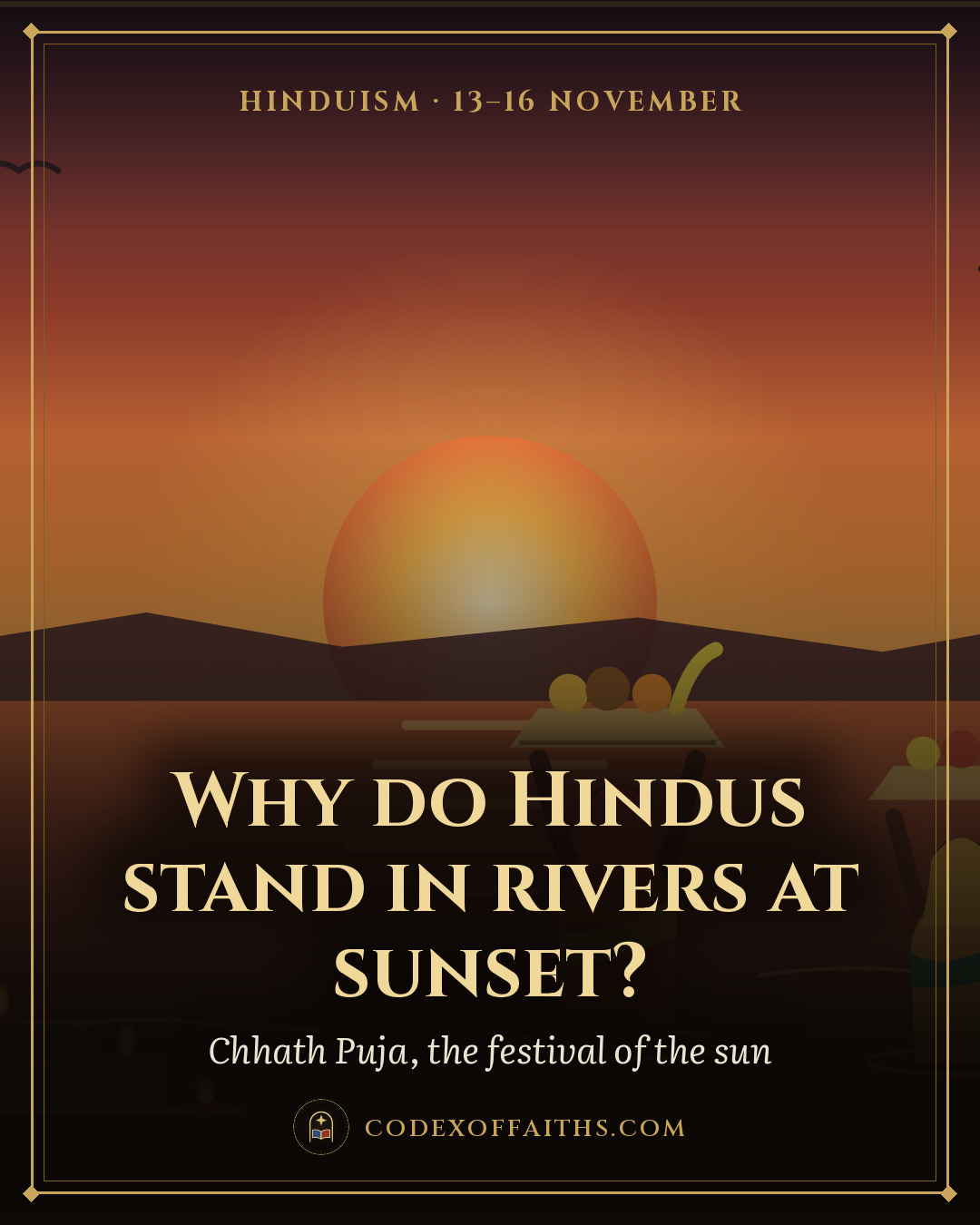
Women seen from behind stand waist-deep in a river at sunset, raising woven bamboo baskets of fruit and sugarcane towards a large orange sun, with clay lamps burning on the steps of the bank.
Illustration: Codex of Faiths

At sunset on the third day of Chhath, the banks of the Ganges at Patna, and of rivers, ponds and village tanks across eastern India and southern Nepal, fill with families. Women in new saris step into the water up to the waist, raise woven baskets heaped with fruit and sweets towards the low red sun, and wait. Around them, relatives sing, lamps burn on the steps and the sugarcane stalks stand in bundles. Next morning, before dawn, they are back in the water to greet the sun as it rises. This is Chhath Puja, one of the most demanding festivals in the Hindu year.

Chapter I

The sixth day

The name comes from chhath, “sixth”, the local form of the Sanskrit shashthi. The main offering falls on the sixth day of the bright, waxing half of the lunar month of Kartika, about a week after Diwali, in October or November. In 2026 it runs from 13 to 16 November, with the evening offering on 15 November and the dawn offering on 16 November.

Chhath belongs above all to the people of Bihar, Jharkhand and eastern Uttar Pradesh, speakers of Bhojpuri, Maithili and Magahi, and to the Madhesh plains of Nepal. As families from these regions moved for work, they took it with them: today it is kept on the banks of the Yamuna in Delhi, on Mumbai’s beaches and by communities abroad, in Mauritius among other places. A smaller Chaiti Chhath is kept in spring.

Chapter II

Sun and mother

Chhath is offered to Surya, the sun, and to Chhathi Maiya, a mother goddess of the sixth day who is asked to protect children. Many identify her with Shashthi Devi, a goddess worshipped in parts of India on the sixth day after a child’s birth.

The sun has been sacred in India since the oldest hymns. The Gayatri mantra A verse of the Rigveda addressed to the sun god Savitr, recited daily at dawn and dusk by many Hindus. Glossary of the Rigveda, still recited daily by many Hindus, is addressed to Savitr, the sun as the power that stirs life; great temples were later built to Surya, from Martand in Kashmir to Modhera in Gujarat and Konark in Odisha, carved as the sun’s chariot. Tradition links Chhath to the epics: it is said that Sita kept it after returning to Ayodhya with Rama, and that Karna, son of the sun god in the Mahabharata, stood in the water each day to pray to his father. These are stories told about the festival; its exact origins are not recorded.

Chapter III

Four days

The festival is a sequence of purifications that builds to the two offerings.

On the first day, Nahay Khay, “bathe and eat”, the devotee bathes in a river or pond and eats one pure vegetarian meal, often rice with bottle gourd and lentils, cooked without onion or garlic. The house is cleaned.

On the second, Kharna, the devotee fasts all day and in the evening eats a sweet rice pudding made with jaggery, with flatbread, after an offering. Then the great fast begins: about 36 hours without food or water.

On the third evening, Sandhya Arghya, the family goes down to the water. The devotee stands in it and offers arghya, water or milk poured towards the setting sun, and raises the baskets.

On the fourth morning, Usha Arghya, the offering is made to the rising sun. Only then is the fast broken, usually with a little of the blessed food, the prasad Food or other offerings presented to a deity and returned to worshippers as a blessing to be shared. Glossary, shared with everyone who came.

Chapter IV

Baskets, thekua and songs

The offerings are carried in flat winnowing baskets and deep round baskets of split bamboo. They hold seasonal fruit such as bananas, coconuts and citrus, radishes and ginger plants, rice, lamps and thekua, a crisp sweet of wheat flour, jaggery and ghee shaped in a wooden mould and fried. Whole stalks of sugarcane are often set up as a canopy over the lamps at home or by the water.

Devotees say that what makes Chhath distinct is its simplicity. There is no image of a god at the riverbank and no priest is needed: each devotee faces the sun and makes the offering directly. Purity rules are strict, and families clean and decorate the banks themselves. Through the days women sing Chhath songs in Bhojpuri and Maithili, passed down in families and now also widely recorded.

Chapter V

The sun in other faiths

Many traditions turn to the sun, though in different ways. In Zoroastrianism the Khorshed Niyayesh, a litany to the sun, is recited during the hours of daylight, and prayer is made facing a source of light. In Shinto the sun is the kami The gods or sacred powers of Shinto, present in nature, ancestors and great people. Glossary Amaterasu, whose main shrine is at Ise. In ancient Egypt the sun god Ra crossed the sky by day in his boat and passed through the underworld by night. In Judaism, once every 28 years, a blessing called Birkat Hachamah thanks the Creator for the sun; it was last said in 2009. Many Christians hold Easter services at sunrise.

What Chhath adds is the water and the waiting: a crowd standing in a river, fasting, watching the light go and come back.

  • Zoroastrianism
  • Shinto
  • Judaism
  • Ancient Egypt

Questions people ask

Who is worshipped at Chhath?

Surya, the sun, and Chhathi Maiya, a mother goddess linked with the sixth day and the protection of children, often identified with Shashthi Devi. Devotees thank them for life and health and ask for the well-being of their families.

Is Chhath only for women?

No. Most of those who keep the full fast are women, but men also keep it, and the whole family helps: carrying the baskets to the water, cleaning the banks, singing and cooking.

Why the setting sun as well as the rising sun?

Most Hindu sun worship greets the sun in the morning. Chhath is unusual in honouring the setting sun first, on the third evening, and the rising sun the next dawn, which many devotees explain as thanks for the whole of the sun’s course.

Is there a second Chhath in the year?

Yes. A smaller Chaiti Chhath is kept in spring, in the month of Chaitra (March–April), with the same rites. The autumn festival in Kartika is far the bigger one.

Sources and further reading

  1. Encyclopaedia Britannica, “Chhath Puja”
  2. Encyclopaedia Britannica, “Surya”
  3. Drik Panchang, “Chhath Puja 2026”
  4. Gavin Flood, An Introduction to Hinduism (Cambridge University Press, 1996)
  5. Constance A. Jones and James D. Ryan, Encyclopedia of Hinduism (Facts On File, 2007)