Codex of FaithsAn illustrated atlas of belief

Article of the day ·

What is Kartik Purnima? One full moon, four festivals of light

Why one November full moon brings lamps to the ghats of Varanasi, Guru Nanak’s birthday, the Jain pilgrims’ climb at Palitana and floating lights in Thailand and Myanmar.

In brief

  1. I.Kartik Purnima is the full moon that ends Kartik, a lunar month many Hindus count as the holiest of the year; in 2026 it falls on 24 November.
  2. II.In Varanasi it is Dev Deepawali, “the Diwali of the gods”, when the river steps are lined with lamps; across India people bathe in sacred rivers and lakes.
  3. III.Sikhs celebrate the birth of Guru Nanak, the first Guru, on this full moon, and Jains mark the end of the rainy-season retreat, when the holy hill of Shatrunjaya opens again to pilgrims.
  4. IV.In Thailand and Myanmar, Buddhists keep the full moon of the same season with floating lights and lamps: Loy Krathong and Tazaungdaing.

The story in a minute

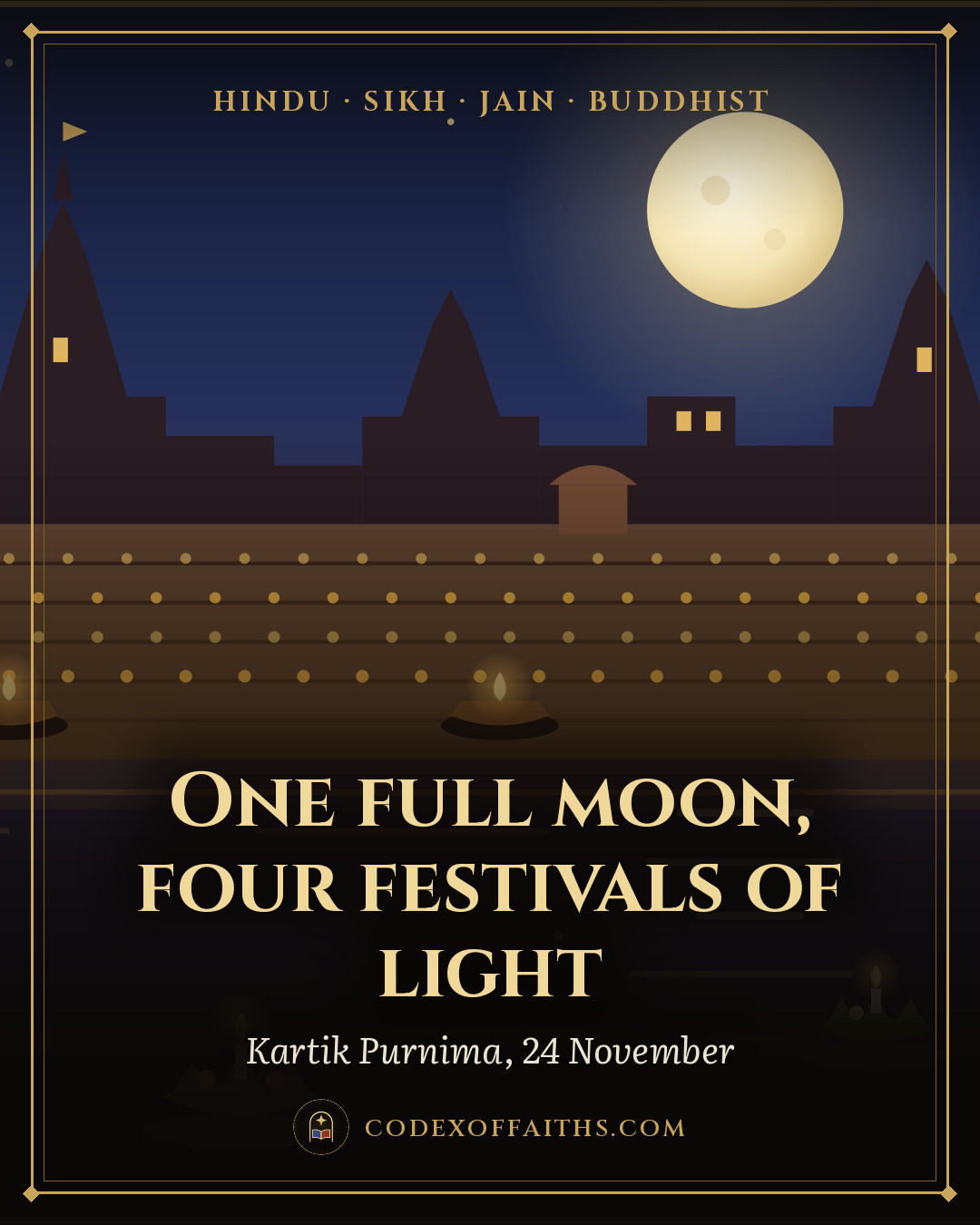
Stone steps of a riverside city at dusk lined with thousands of small oil lamps under a full moon, temple spires above, with little leaf boats carrying candles drifting on the dark water.
Illustration: Codex of Faiths

On one night in late autumn, a single full moon rises over very different celebrations. On the river steps of Varanasi, more than a million clay lamps are lit for the gods. In gurdwaras across the world, Sikhs celebrate the birth of Guru Nanak. At Palitana in Gujarat, Jain pilgrims climb a holy hill that has been closed for the rainy season. And in Thailand and Myanmar, small boats of leaves carrying candles drift out onto rivers and lakes. In India this full moon is called Kartik Purnima; in 2026 it falls on 24 November.

Chapter I

The month of lamps

Hindu calendars follow the moon, and purnima is the full-moon day. Kartik, which falls in October and November, is for many Hindus, and above all for devotees of Vishnu, the holiest month of the year. Through the month people rise before dawn to bathe, keep vows and offer small lamps, diya A small clay oil lamp with a cotton wick, lit in great numbers at Diwali. Glossary, to the gods, and hang lamps on tall poles so that their light reaches the sky. In the northern reckoning, Diwali falls in the middle of the month, on the new moon; the wedding of the sacred basil plant, Tulsi Vivah, comes in the bright fortnight that follows. Kartik Purnima closes the month.

  • Diya
  • ॐ Om
The clay lamp and the sacred syllable Om: Kartik is the month of lamps.

Chapter II

The Diwali of the gods

In Varanasi the full moon of Kartik is Dev Deepawali, “the Diwali of the gods”. A popular story tells that on this day the god Shiva destroyed Tripurasura, the demon of three flying cities, which is why the day is also called Tripurari Purnima or Tripuri Purnima. The gods, it is said, came down to the Ganges to celebrate, and the city lights lamps to welcome them. At dusk the long flights of stone steps, the ghats, are covered with lamps from one end of the city to the other, and boats crowd the river to watch the evening worship of the Ganges, the arati A rite in which a lamp is waved before an image of a god, then offered to the worshippers. Glossary.

Elsewhere the full moon is a day for bathing in sacred waters. At Pushkar in Rajasthan pilgrims bathe in the holy lake during the great fair held there in Kartik, and in Odisha people float little boats with lamps, remembering the sailors who once traded across the sea to Southeast Asia.

Chapter III

Guru Nanak’s birthday

For Sikhs the same full moon is Guru Nanak Gurpurab, also called Prakash Purab, the birthday of Guru Nanak, the first of the ten Gurus. Sikh tradition places his birth in 1469 at Talwandi, now Nankana Sahib in Pakistan, on the full moon of Kartik. Some historians, reading the earliest accounts of his life, argue for a date in April instead; most Sikhs celebrate in November.

The festival begins two days before with an Akhand Path A continuous reading of the whole Guru Granth Sahib by relays of readers, lasting about 48 hours. Glossary, an unbroken reading of the whole Guru Granth Sahib, the Sikh scripture, which takes about forty-eight hours. On the eve, processions called nagar kirtan A Sikh procession through the streets, singing hymns and carrying the Guru Granth Sahib, held at major festivals. Glossary carry the scripture through the streets with hymns. On the day itself gurdwaras are lit with lamps and candles, hymns are sung through the night, and the free community kitchen, the langar The free communal kitchen of every gurdwara, where all eat together as equals. Glossary, serves anyone who comes, as Guru Nanak taught.

  • ੴ Ik Onkar
  • Khanda
Ik Onkar, “One Creator”, the opening words of the Sikh scripture, and the Khanda.

Chapter IV

The Jain pilgrims’ climb

For Jains, Kartik Purnima marks the end of Chaturmas The four months of the monsoon season, kept by many Hindus and Jains as a time of devotion, fasting and staying in one place. Glossary, the four months of the rainy season during which monks and nuns stay in one place instead of walking from town to town, so as not to harm the many small creatures that the rains bring out. When the season ends, they set out again.

At Palitana in Gujarat, the sacred hill of Shatrunjaya, crowned by hundreds of temples, is closed to pilgrims during the rains. It opens again at Kartik Purnima, and thousands of Jains climb its thousands of steps that day. Many also remember the hill’s link with the first Tirthankara A “ford-maker”: one of twenty-four liberated teachers who show the way across the river of rebirth. Mahavira was the last. Glossary, Rishabhanatha, who is said to have taught there.

  • Ahimsa
  • Three jewels
The raised hand of non-violence and the three jewels of Jain teaching.

Chapter V

Lights on the water

Further east, Buddhists keep the full moon of the same season with festivals of their own. In Thailand, Loy Krathong falls on the full moon of the twelfth Thai lunar month, which in 2026 is the same night. People float a krathong, a little raft of banana leaves and flowers with a candle and incense, on rivers, canals and ponds. Many say it gives thanks to the water and lets misfortune float away; others link it with honouring the Buddha.

In Myanmar the full moon of the month of Tazaungmon brings Tazaungdaing, the festival of lights. Pagodas and homes are lit with lamps and lanterns, and at some pagodas weavers compete through the night to finish new robes before dawn, offered to Buddha images and monks, as the season of offering robes to the monasteries comes to an end.

  • Lotus
  • Dharma wheel
The lotus and the wheel of the teaching, symbols of the Buddhist full-moon days.

Chapter VI

Why the full moon?

These festivals are not one festival, and their meanings differ: a victory of Shiva, the birth of a Guru, the end of a season of staying put, thanks to the waters. What they share is the calendar. Each tradition counts its months by the moon, and the full moon at the end of the rainy season, when the nights grow long and the harvest is in, has long been a time for lamps. That is why one night can bring light to the Ganges, a gurdwara, a Jain hill and a Thai canal at once.

Questions people ask

When is Kartik Purnima in 2026?

On 24 November 2026. Its date moves each year because it follows the moon: it falls on the full moon of the month of Kartik, in October or November. In 2027 it falls in mid-November.

Is Dev Deepawali the same as Diwali?

No. Diwali falls on the new moon at the start of Kartik’s bright half; Dev Deepawali, “the Diwali of the gods”, falls fifteen days later on the full moon, and is kept above all in Varanasi.

Why do Sikhs celebrate Guru Nanak’s birthday on a full moon?

Sikh tradition places his birth in 1469 on the full moon of Kartik, and the festival follows the lunar calendar. Some historians argue from early accounts that he was born in April, but most Sikhs keep the November date.

Is Loy Krathong the same festival?

No. It belongs to Thai tradition and its own lunar calendar, on the full moon of the twelfth Thai month. That full moon usually coincides with Kartik Purnima, as it does in 2026.

Sources and further reading

  1. Encyclopaedia Britannica, “Diwali”
  2. Encyclopaedia Britannica, “Nanak”
  3. Encyclopaedia Britannica, “Thailand Celebrates Loy Krathong, the Traditional Festival of Lights” (video)
  4. Diana L. Eck, Banaras: City of Light (Alfred A. Knopf, 1982)
  5. W. H. McLeod, Guru Nanak and the Sikh Religion (Clarendon Press, Oxford, 1968)
  6. John E. Cort, Jains in the World: Religious Values and Ideology in India (Oxford University Press, 2001)