Codex of FaithsAn illustrated atlas of belief

Article of the day ·

What is Niinamesai? Japan’s harvest festival of the first rice

Why Japan gives thanks for the new rice every 23 November: the night rite of Niinamesai at the imperial palace and the shrines, its ancient myths, and harvest thanksgivings in other faiths.

In brief

  1. I.Niinamesai, “the festival of tasting the new”, is the Shinto rite of thanks for the rice harvest, held every year on 23 November at the imperial palace and at shrines across Japan.
  2. II.At the palace the emperor offers the year’s new rice, millet and sake to the kami through the night, in two sessions, and then tastes them himself.
  3. III.Since 1948 the day has been a public holiday under a new name, Kinrō Kansha no Hi, Labour Thanksgiving Day.
  4. IV.The first Niinamesai of a new reign is held on a far grander scale, as the Daijōsai, the great food-offering rite.

The story in a minute

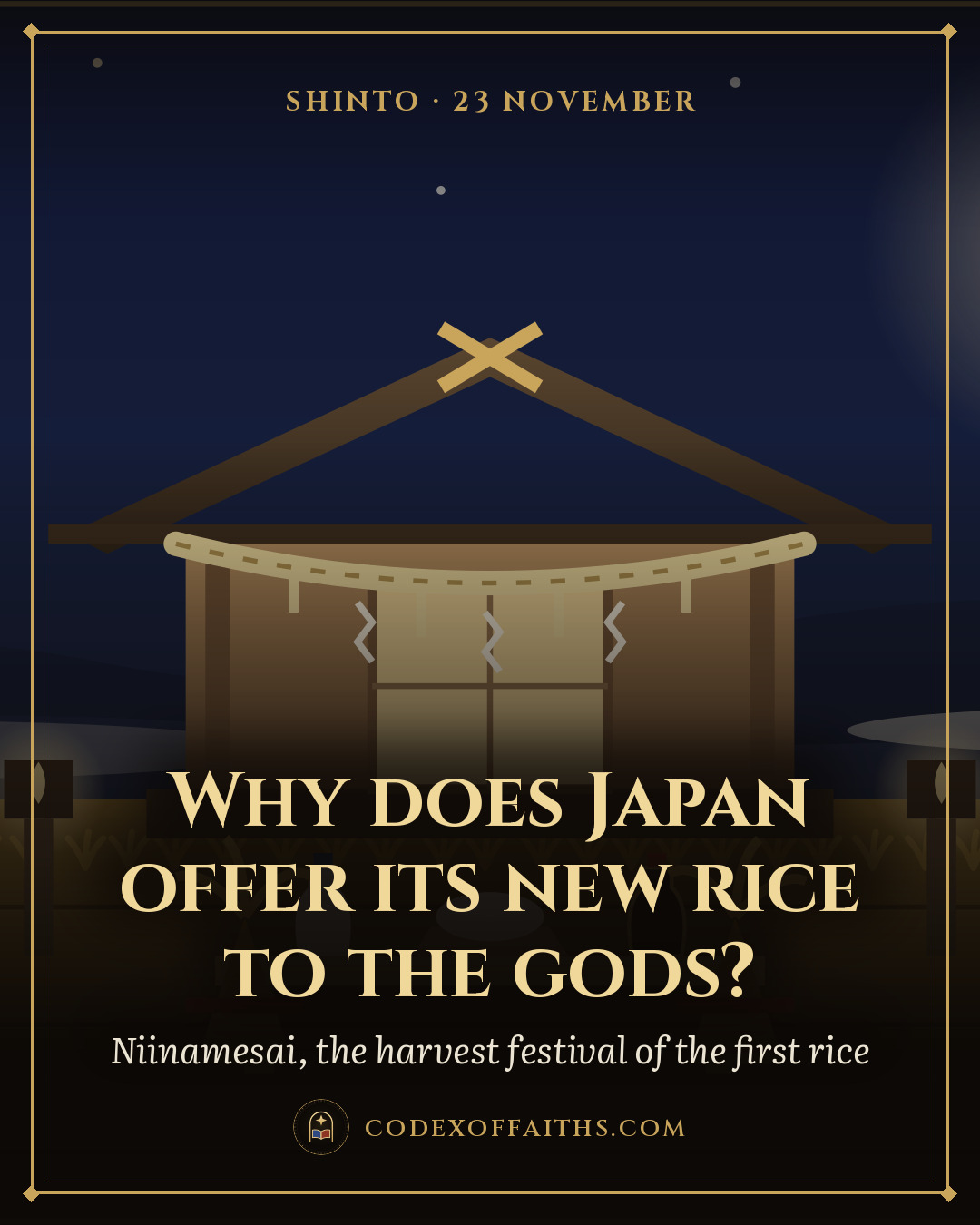
A shrine hall at night under a full moon, its doorway hung with a thick rope of rice straw, with sheaves of ripe rice, white sake jars and a tray of new rice laid on an offering table before it, between golden rice fields.
Illustration: Codex of Faiths

On the night of 23 November, while most of Japan enjoys a day off, a small wooden hall in the grounds of the imperial palace in Tokyo is lit by lamps. Inside, the emperor lays out bowls of newly harvested rice and millet, cups of white and black sake and other gifts of land and sea, offers them to the kami, and then eats from them himself. This is Niinamesai, “the festival of tasting the new”, one of the oldest and most important harvest rites of Shinto.

Chapter I

The festival of the new rice

The name joins nii, “new”, name, “tasting”, and sai, “festival”. Rice has been at the heart of Japanese life for more than two thousand years: it was food, wealth and tax, and its fields shaped the year. The rope of rice straw, the shimenawa A rope of twisted rice straw, often hung with paper streamers, that marks a sacred place or object in Shinto. Glossary, still marks sacred places at every shrine. Spring rites pray for a good crop; Niinamesai closes the cycle by giving thanks for the one that has been brought in.

The same instinct runs through the rite at the palace: the first of the harvest belongs to the kami The gods or sacred powers of Shinto, present in nature, ancestors and great people. Glossary, and people eat of it only after it has been offered.

Chapter II

A rite through the night

The palace rite takes place in the Shinkaden, a hall beside the palace sanctuaries. It is held in two sessions: the first in the evening and the second late at night, from about eleven until one in the morning. Dressed in pure white, the emperor offers the new rice and millet, white and black sake brewed from the new rice, and other foods to the sun goddess Amaterasu and to the gods of heaven and earth, and then eats and drinks of the offerings. The meal shared with the kami is the heart of the rite.

Part of the rice comes from a small paddy inside the palace grounds, where the emperor plants seedlings in spring and cuts the ripe rice in autumn, a custom begun by Emperor Shōwa in the twentieth century. Rice and millet are also sent by chosen farmers from every prefecture of Japan, a custom dating from 1892. At the same time, shrines across the country hold their own Niinamesai: priests purify the offerings, read a norito Prayers addressed to the kami by Shinto priests. Glossary of thanks and present the new crop to the shrine’s kami.

Chapter III

A rite as old as the myths

The rite is already ancient in Japan’s first chronicles, the Kojiki Japan’s oldest chronicle, “Record of Ancient Matters”, presented in 712, gathering myths of the kami and early history. Glossary (712) and the Nihon Shoki (720). In their stories Amaterasu herself holds the feast of the first fruits, and her unruly brother Susanoo disgraces it by defiling the hall where she tastes the new rice. Soon after, the sun goddess hides in a cave and the world goes dark, until the other gods coax her out.

In the old court calendar the rite fell on the second day of the hare in the eleventh lunar month. After Japan adopted the Western calendar in 1873, the rite was held that year on the second day of the hare of the new November, which was the 23rd, and the date was then fixed on 23 November. A related rite, Kannamesai, held at the Grand Shrine of Ise in mid-October, offers the year’s first rice to Amaterasu and the other kami of Ise.

Chapter IV

The great rite of a new reign

Once in each reign the rite is held on a scale like no other. The first Niinamesai after an emperor takes the throne is called the Daijōsai, “the great food-offering festival”. Rice is grown for it in two fields, one in the east of Japan and one in the west, chosen by an old method of divination. A complex of halls, the Daijōkyū, is built of unpainted wood for that one night and taken down afterwards. The most recent was held in November 2019.

The Daijōsai has long been debated. It costs a great deal, and in post-war Japan, where state and religion are kept apart, some ask whether public money should pay for a Shinto rite. In 2019 the government paid for it from the Imperial Court budget, which is public money, at a cost of more than 2.7 billion yen; a senior member of the imperial family argued that the household’s private funds should be used instead.

Chapter V

From Niinamesai to Labour Thanksgiving

From 1873 to 1947 the day was a national holiday called Niinamesai. In 1948, under the post-war constitution, it became Kinrō Kansha no Hi, “the day of thanks for labour”, a day to honour work and production and for people to thank one another. Many Japanese now know it only by that name. Children often make thank-you cards for police officers, firefighters and others who work for the community, while the old rite goes on, quietly, in the palace and the shrines.

Chapter VI

Harvest thanks in other faiths

Japan is far from alone in giving the first of the harvest back. In Judaism Sukkot, the Feast of Booths, brings in the autumn harvest with a week of meals in a leafy shelter, the sukkah The temporary leafy shelter in which Jews eat, and some sleep, during the festival of Sukkot. Glossary. Many churches in Britain and elsewhere hold a Harvest Festival each autumn, decorating the altar with sheaves and fruit that are later given away. Among Tamils in South India and around the world, Pongal in mid-January is named after the dish of new rice boiled in milk until it bubbles over, a sign of plenty. In China and Korea the full moon of the eighth month brings families together for the Mid-Autumn Festival and Chuseok; in Korea, Chuseok also brings offerings to the ancestors from the new crop.

The details differ, but the gesture is the same across these traditions: before the new food is enjoyed, thanks are given for it.

  • Sukkah
  • Moon cake
Harvest thanks in other traditions: the booth of Sukkot and the moon cake of the Mid-Autumn Festival.

Questions people ask

Is Niinamesai a public holiday?

Yes, under another name. From 1873 the day was a holiday called Niinamesai; since 1948 it has been Labour Thanksgiving Day, a day to honour work and give thanks to one another. The rite itself still takes place at the palace and in shrines.

Why 23 November?

The rite used to fall on the second day of the hare in the eleventh month of the old lunar calendar. After Japan adopted the Western calendar in 1873, the rite was held that year on the second day of the hare of the new November, the 23rd, and the date was then fixed there.

Can visitors see it?

The palace rite is private. Many shrines hold their own Niinamesai on the same day, and worshippers can attend; some shrines also bring out the year’s new rice and sake.

Is it the same as American Thanksgiving?

No. Thanksgiving in the United States grew from harvest feasts in New England and falls on the fourth Thursday of November; Niinamesai is far older and Shinto. They simply fall close together.

Sources and further reading

  1. Encyclopaedia Britannica, “Shintō”
  2. Kokugakuin University, Encyclopedia of Shinto, “Niiname sai”
  3. Helen Hardacre, Shinto: A History (Oxford University Press, 2017)
  4. John Breen and Mark Teeuwen, A New History of Shinto (Wiley-Blackwell, 2010)
  5. Emiko Ohnuki-Tierney, Rice as Self: Japanese Identities through Time (Princeton University Press, 1993)