Codex of FaithsAn illustrated atlas of belief

Article of the day ·

What is Christ the King Sunday? How the church year ends

Why many churches end their year with a feast of Christ the King, why German Lutherans remember the dead that Sunday, and how other faiths speak of God as king.

In brief

  1. I.Christ the King is the last Sunday of the church year in the Roman Rite of the Catholic Church; the next Sunday is the first of Advent, when the new year begins. In 2026 it falls on 22 November.
  2. II.Pope Pius XI created the feast in 1925, in the encyclical Quas primas, and set it in October; the calendar reform of 1969 moved it to the end of the year and named it “Our Lord Jesus Christ, King of the Universe”.
  3. III.Many Anglican, Lutheran, Methodist and other Protestant churches keep the same Sunday as Christ the King or the Reign of Christ, and in Germany Protestants remember their dead on it, the Totensonntag.
  4. IV.The Orthodox churches have no such feast: their church year begins on 1 September. Jews proclaim God as king at the New Year, and in Islam al-Malik, “the King”, is one of the names of God.

The story in a minute

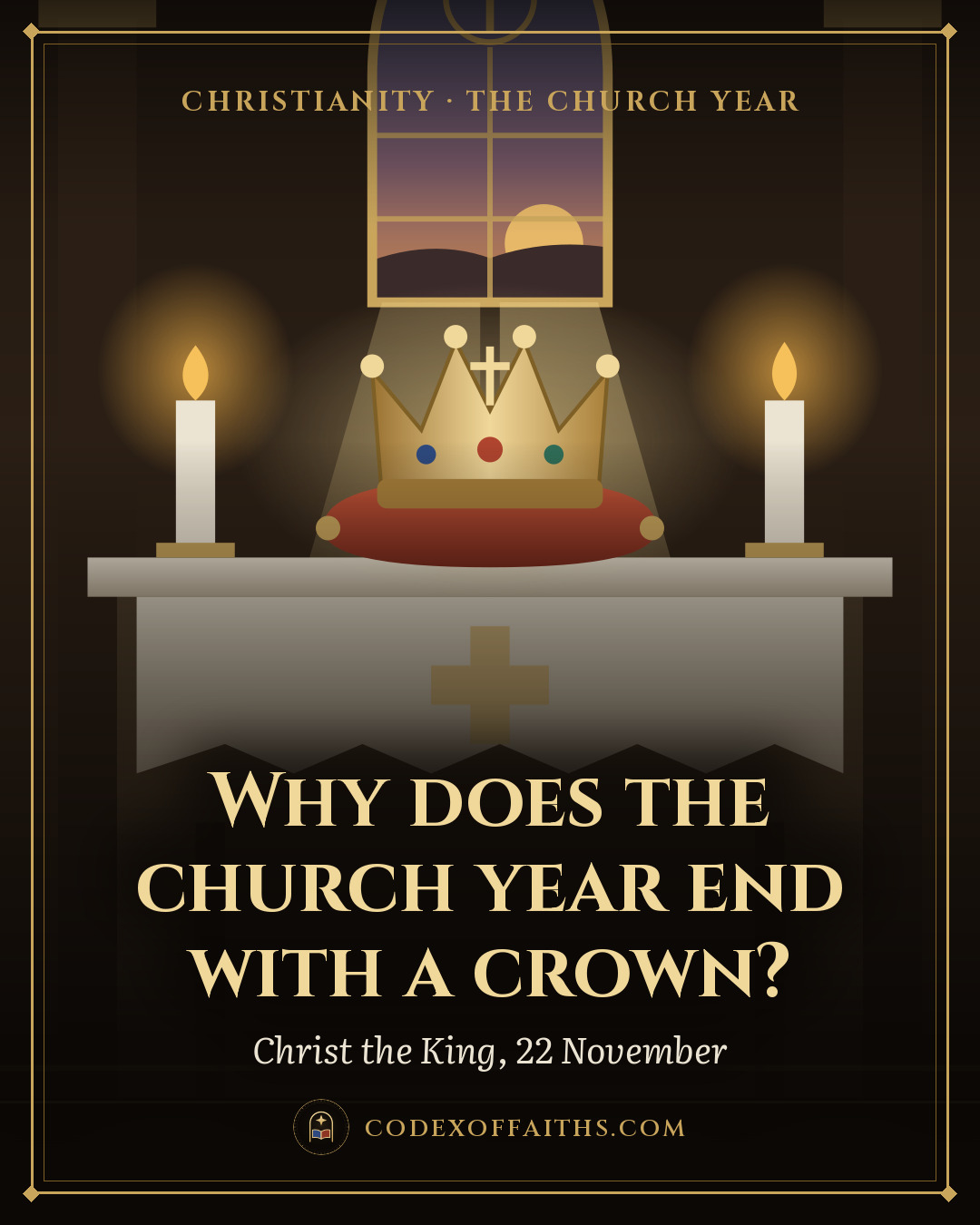
A golden crown resting on a red cushion before a stone altar with a cross, tall candles burning on either side, and autumn leaves drifting past a high church window; no figures shown.
Illustration: Codex of Faiths

The civil year ends on 31 December, but the year of many churches ends a month earlier. On the last Sunday before Advent, Catholics and many Protestants keep a feast of Christ the King, and the following Sunday a new church year begins. In 2026 that last Sunday falls on 22 November. The feast is young, just over a hundred years old, and it was born of a particular moment in history.

Chapter I

A feast from 1925

On 11 December 1925 Pope Pius XI published the encyclical Quas primas, “In the first”, and with it a new feast of Christ the King. The year was the 1,600th anniversary of the Council of Nicaea, which had declared Christ “of one being with the Father”. The world, the pope wrote, had thrust Christ and his law out of private and public life, and this was why lasting peace among nations had not come. He was writing seven years after the end of the First World War. A yearly feast would remind Catholics that Christ’s rule reaches into every part of life, private and public.

The idea of Christ as king is far older than the feast. The New Testament calls him “King of kings and Lord of lords”, and the Gospels tell of the sign nailed above the cross, “The King of the Jews”. What was new in 1925 was a day set aside for that title alone. Pius XI placed it on the last Sunday of October, just before All Saints.

  • Cross
  • Chi-Rho
The cross and the Chi-Rho, the first two Greek letters of “Christ”.

Chapter II

Why it moved to the end of the year

In 1969, after the Second Vatican Council, the Catholic calendar was reformed, and the feast moved to the last Sunday of the church year, the Sunday before Advent. Its full name became “Our Lord Jesus Christ, King of the Universe”, and it was raised to a solemnity, the highest rank of feast. Its meaning shifted with its date: the end of the year looks to the end of time, when, in Christian belief, Christ will return.

The readings follow a three-year cycle. In 2026 the Gospel is the parable of the sheep and the goats in Matthew, where the king tells those who fed the hungry, welcomed the stranger and visited the sick and the prisoner, “as you did it to one of the least of these my brothers, you did it to me.” The vestments are white or gold. Catholics who keep the older Latin Mass of 1962 still celebrate the feast in October.

Chapter III

Beyond Rome

The feast began as a Catholic one, but since the 1970s many Protestant churches have shared common tables of Sunday readings with Catholics, and the last Sunday came with them. Anglicans, Lutherans, Methodists, Presbyterians and others now keep it as Christ the King or as the Reign of Christ, a name some prefer to the word “king”.

In the Church of England the day had an older nickname. The prayer set for the Sunday before Advent in the Book of Common Prayer begins “Stir up, we beseech thee, O Lord, the wills of thy faithful people”, so it was called Stir-up Sunday, and families took it as the day to stir the Christmas pudding, so that it would be ready in time.

Chapter IV

The Sunday of the Dead

In Germany the Protestant churches mark the same Sunday differently. It is the Totensonntag, the Sunday of the Dead, or Ewigkeitssonntag, the Sunday of Eternity. King Frederick William III of Prussia made it a general day of remembrance of the dead in 1816, soon after the Napoleonic wars; the name and the custom of remembering the dead at the end of the church year go back to Protestant church orders of the sixteenth century. In many churches the names of those who died during the past year are read out and a candle is lit for each, and families visit graves. Catholics in Germany remember their dead on All Souls’ Day, 2 November.

  • Candle
  • Grave lights
Candles and grave lights for the Sunday of the Dead.

Chapter V

The Orthodox year

The Orthodox churches have no feast of Christ the King. Their church year follows another rhythm: it begins on 1 September, a date that goes back to the tax year of the Byzantine Empire. The idea of Christ as ruler is everywhere in their churches, though, in the great image of Christ Pantokrator, “ruler of all”, that looks down from many domes. Their season before Christmas is the Nativity Fast, which began on 15 November in the churches that follow the revised calendar; churches that keep the Julian calendar begin it on 28 November.

Chapter VI

God as king in other faiths

Speaking of God as king is older than Christianity. At Rosh Hashanah, the Jewish New Year, the prayers proclaim God as king of the world: one section of the service, the Malkhuyot, gathers verses on his kingship, and the shofar A ram’s horn sounded in the synagogue at Rosh Hashanah and at the close of Yom Kippur. Glossary, the ram’s horn, is sounded; an old explanation, going back to Saadia Gaon, compares it to the trumpet blast at a king’s coronation. The prayer Avinu Malkeinu, “Our Father, our King”, is said from Rosh Hashanah through Yom Kippur, the Days of Awe. A few weeks later, at Simchat Torah, Jews finish the yearly reading of the Torah and begin it again at once, another way of closing one year and opening the next.

In Islam, al-Malik, “the King”, is one of the names of God in the Quran, and the opening chapter recited in every prayer calls God “Master of the Day of Judgement” (in some readings, “King of the Day of Judgement”). The images differ, and so do the beliefs about who reigns and how, but the old language of crowns and thrones is shared, and each tradition, in its own way, returns to it.

  • Shofar
  • Torah
The shofar of the Jewish New Year and the open Torah, read through to the end each year.

Questions people ask

When is Christ the King Sunday in 2026?

On 22 November 2026. It is always the Sunday before the first Sunday of Advent, so it falls between 20 and 26 November. In 2027 it falls on 21 November.

Why was the feast created?

Pius XI wrote that many people and states had pushed God and Christ out of public life, and that this lay behind the strife and lack of peace among nations in the years after the First World War. A yearly feast, he hoped, would remind Catholics that Christ’s rule reaches every part of life. He issued it in 1925, the 1,600th anniversary of the Council of Nicaea.

Is Christ the King a Protestant feast too?

It began as a Catholic feast, but since the 1970s and 1980s many Protestant churches have adopted it through shared lectionaries, the tables of Bible readings for each Sunday. Some call it the Reign of Christ, to avoid the word “king”.

What is Stir-up Sunday?

In the Church of England, the Sunday before Advent was long known by the first words of its prayer in the Book of Common Prayer, “Stir up, we beseech thee, O Lord, the wills of thy faithful people”. In England it became the day for stirring the Christmas pudding.